12 Things to Do in Argentina, in Travel Order (2026)
Twelve things to do in Argentina in the order a trip runs, from Buenos Aires and Iguazu to Jujuy, the glaciers and Valdés, with the 2026 park fees.

The things to do in Argentina are spread over a country 3,700 km long, so the order you do them in matters more than the list itself. Almost every trip starts in Buenos Aires. From there the flights go north-east to Iguazu, north-west to Salta and Jujuy, west to Mendoza, and south to the lakes, the glaciers and the end of the road at Ushuaia. If you are still choosing the regions, our guide to the best places to visit in Argentina compares them by nights and season.
We list twelve experiences in that order, region by region. The park fees are the official 2026 ones in Argentine pesos, and the altitudes come from the national tourism portal. One correction before you plan: the walkway to the Devil’s Throat at Iguazu was closed from August 2026, so check it before you build a day around it.
The twelve at a glance
| # | Experience | Region | When | Foreign fee |
|---|---|---|---|---|
| 1 | San Telmo, tango and the Colón | Buenos Aires | Spring and autumn | None |
| 2 | A day at an estancia | The pampa | All year | None |
| 3 | The Iguazu circuits | North-east | Any month | ARS 60,000 |
| 4 | The Quebrada de Humahuaca | Northwest | April to June | None |
| 5 | Salinas Grandes | Northwest | April to June | None |
| 6 | Torrontés in Cafayate | Northwest | April to June | None |
| 7 | The Uco Valley wineries | Mendoza | All year | None |
| 8 | The lakes around Bariloche | Lake District | All year | ARS 35,000 |
| 9 | The Perito Moreno glacier | El Calafate | All year | ARS 50,000 |
| 10 | The lakes below Fitz Roy | El Chaltén | November to March | ARS 50,000 |
| 11 | The Beagle Channel and the park | Ushuaia | All year | ARS 40,000 |
| 12 | Whales and penguins | Atlantic coast | June to December | ARS 50,000 |
The foreign fee column gives the general adult fare for the protected area, which is what a visitor from abroad pays. Where it says None, the place itself has no entry fee; wineries, shows and boats charge their own prices.
How the park fees work in 2026
Argentina’s national parks service raised its fares on 1 June 2026. Its tariff page gives the general fare at Iguazu as ARS 60,000, at Los Glaciares as ARS 50,000, at Tierra del Fuego as ARS 40,000 and at Nahuel Huapi, around Bariloche, as ARS 35,000. If you go back to the same park within 72 hours, the second day is half price. Two details catch people out. At Tierra del Fuego the second-day discount only applies to tickets bought online. And at the El Chaltén trailheads, the northern sector of Los Glaciares, tickets are sold online only and paid by card, with no cash.
Península Valdés is a provincial reserve with its own fare, covered in the last section.
Buenos Aires, where the trip starts
1. See the city on a Sunday: San Telmo, a milonga and the Colón
Give Buenos Aires at least two full days, and make one of them a Sunday. That is the day of the antiques and crafts fair in San Telmo, around Plaza Dorrego and along Calle Defensa. In the evening, go to a milonga, the social dance where people from the city still go to dance tango, and not only a dinner show; many of them start with a class for beginners. And see the Teatro Colón, the opera house, from the inside.
The food is half of the reason to stay. Dinner starts late, at a parrilla, the grill house, with empanadas first, then the beef and a Malbec from Mendoza. Our guide to the things to do in Buenos Aires has 21 more ideas by neighbourhood, with opening hours.
The pampa, a day out of the city
2. Spend a day or a night at an estancia
The flat grassland around Buenos Aires is cattle country, and the working ranches there, the estancias, open their gates to visitors. A day out usually means a long asado lunch, a display of horsemanship by the gauchos, and time to ride or take a carriage across the fields. Some take guests for the night as well.
It is the day most itineraries leave empty, and it explains the city better than another museum: the beef, the leather and the folklore you saw in Buenos Aires all come from out here. On our Argentina tours, the estancia day comes straight after the city. Our guide to the Argentina countryside covers the estancias further out and the gaucho town of San Antonio de Areco.
Iguazu, in the subtropical north-east
3. Walk the two open circuits at Iguazu Falls
Iguazu is the reason to fly north. Along almost 3 km, the Iguazú river drops about 80 m, according to the Argentine World Heritage committee’s fact sheet, and the park has been a UNESCO site since 1984. On the Argentine side you walk two circuits: the Upper Circuit along the top of the falls, and the Lower Circuit, 1,750 m with stairs, close enough to feel the spray.
The third circuit, the walkway over the river to the Devil’s Throat, the biggest drop, was closed when we last checked, in October 2026. The concession that runs the visitor area shut it on 3 August 2026 ahead of forecast high water, and its news page had announced no reopening by mid-October. On 15 October it wrote of the park’s “recent reopening” after a spell of high water, with the Upper and Lower circuits and the train running, and on 29 October it still listed the Devil’s Throat circuit as closed. Check that page before you go.
The Brazilian side has a walkway that ends in front of the same drop, but its concession closed it on 13 October 2026 as the river rose and had not reopened it by 29 October; the main Brazilian trail and its viewpoints stayed open. Our guide to the Iguazu Falls Brazil side explains the crossing and the tickets, and the one on planning an Iguazu Falls vacation sets out how many nights to give the falls.
The park opens every day from 08:00 to 18:00, rain or holiday, and the concession’s hours page puts the last entry at 16:00 and the last entry to the circuits at 15:45. The general fare is ARS 60,000 for a day. A Flexipass covers three days for ARS 120,000 or seven for ARS 210,000.
The northwest: Jujuy and Salta
The northwest is the Argentina that most first trips leave out, and it is high. Plan the season around the rain: our best time to visit Argentina guide puts the best months at April to June, when the summer rains have stopped and the roads are dry.
4. Drive the Quebrada de Humahuaca
The Quebrada is a valley about 155 km long that follows the Río Grande north from San Salvador de Jujuy. People have lived along it for 10,000 years, and UNESCO listed it in 2003. Route 9 runs the length of it, climbing from 1,600 m to 4,500 m, according to Argentina’s national tourism portal.
Three villages give the drive its stops. Purmamarca, 65 km from San Salvador de Jujuy, sits at 2,324 m under the Hill of Seven Colours. Tilcara comes next, halfway up the valley. Humahuaca, 126 km from Jujuy, is at 3,012 m, and the portal recommends two to four days there. It is also the starting point for the Serranía de Hornocal, the range of striped peaks in the photograph at the top of this page.
5. Climb over the Cuesta de Lipán to the salt flats
From Purmamarca, Route 52 climbs the Cuesta de Lipán, a pass at 4,170 m, and drops onto the Salinas Grandes, 66 km from the village. The salt flat sits at about 3,400 m (the national portal gives two averages for it on two pages, 3,350 m and 3,450 m). The white crust is cut with channels of turquoise brine, like the one below.
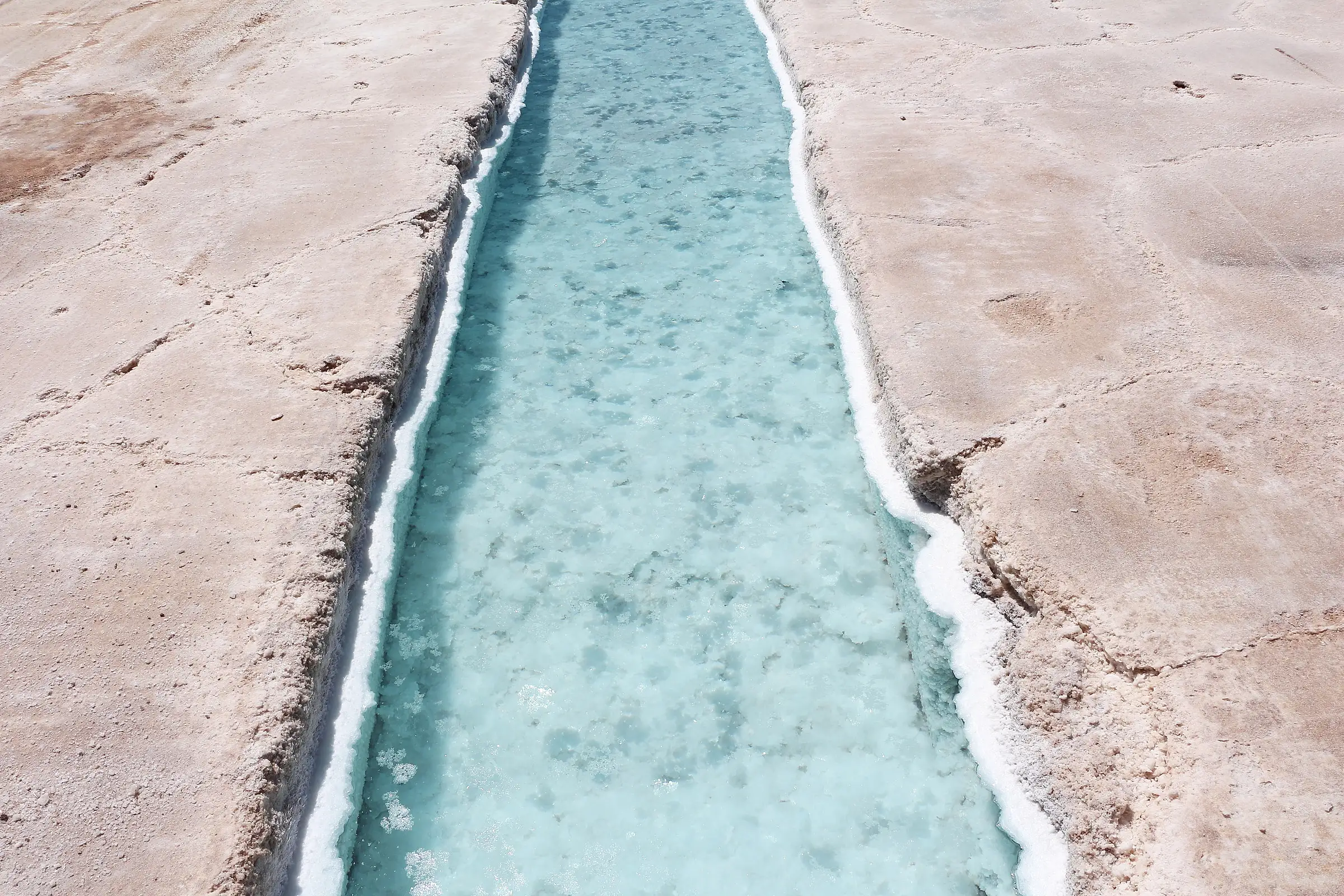
A brine channel in the Salinas Grandes, Jujuy, November 2018. Photo by Bernard Gagnon, CC BY-SA 4.0, via Wikimedia Commons.

This is the highest point of a normal Argentina trip, so take it slowly. Sleep your first night in Purmamarca or lower, and read our guide to South America altitude before you go up.
6. Taste torrontés in Cafayate
South of Salta, Route 68 runs 183 km to Cafayate, at 1,683 m, through the red rock of the Quebrada de las Conchas. Cafayate is the home of torrontés, the white wine of the high valleys. The portal’s Cafayate page gives the distance and the altitude. Two nights give you time for a few wineries and for the drive through the gorge in the afternoon light.
Mendoza, under the Andes
7. Spend two nights in the Uco Valley
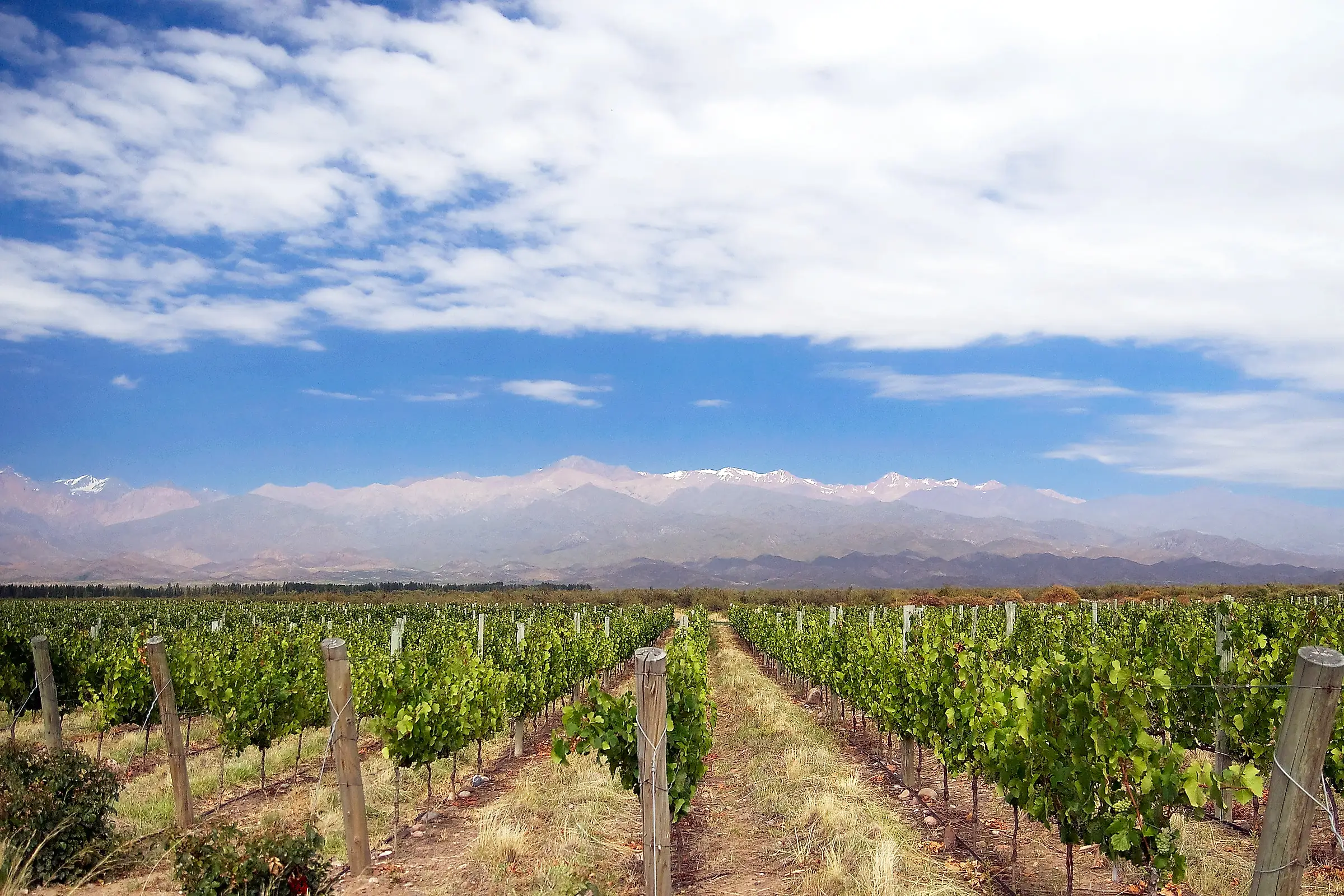
Vineyards near Los Árboles in the Uco Valley, Mendoza, 2008. Photo by David, CC BY 2.0, via Wikimedia Commons.

Mendoza is where the Malbec comes from, and the Uco Valley is the part of the province to stay in. It covers the departments of Tupungato, Tunuyán and San Carlos, south of Mendoza city on Route 40, with vineyards between 900 m and 1,700 m, according to the portal’s Uco Valley page. Stay at a winery, out of the city: you wake up in the vines, and the tastings are a walk away instead of a drive.
The harvest festival, the Vendimia, closes the summer. Its 2025 edition ran from 26 February to 9 March. To the west, the Aconcagua, at 6,962 m the highest mountain in the Americas, can be seen from the Horcones entrance of its provincial park, at 2,800 m. Climbing it is an expedition of its own, run by our sister site Andes Trekking, not part of a wine trip.
The Lake District, around Bariloche
8. Cross the lakes around Bariloche
Bariloche, at 893 m, sits on the shore of Lake Nahuel Huapi, inside the national park of the same name, where the general fare is ARS 35,000. The lakes are the reason to come: boats leave for the islands and forests of the lake, the road around the Llao Llao peninsula runs between two lakes, and the Cruce Andino carries on across the Andes to Chile by water. Our things to do in Patagonia guide has the boat routes and the crossing, with their sources.
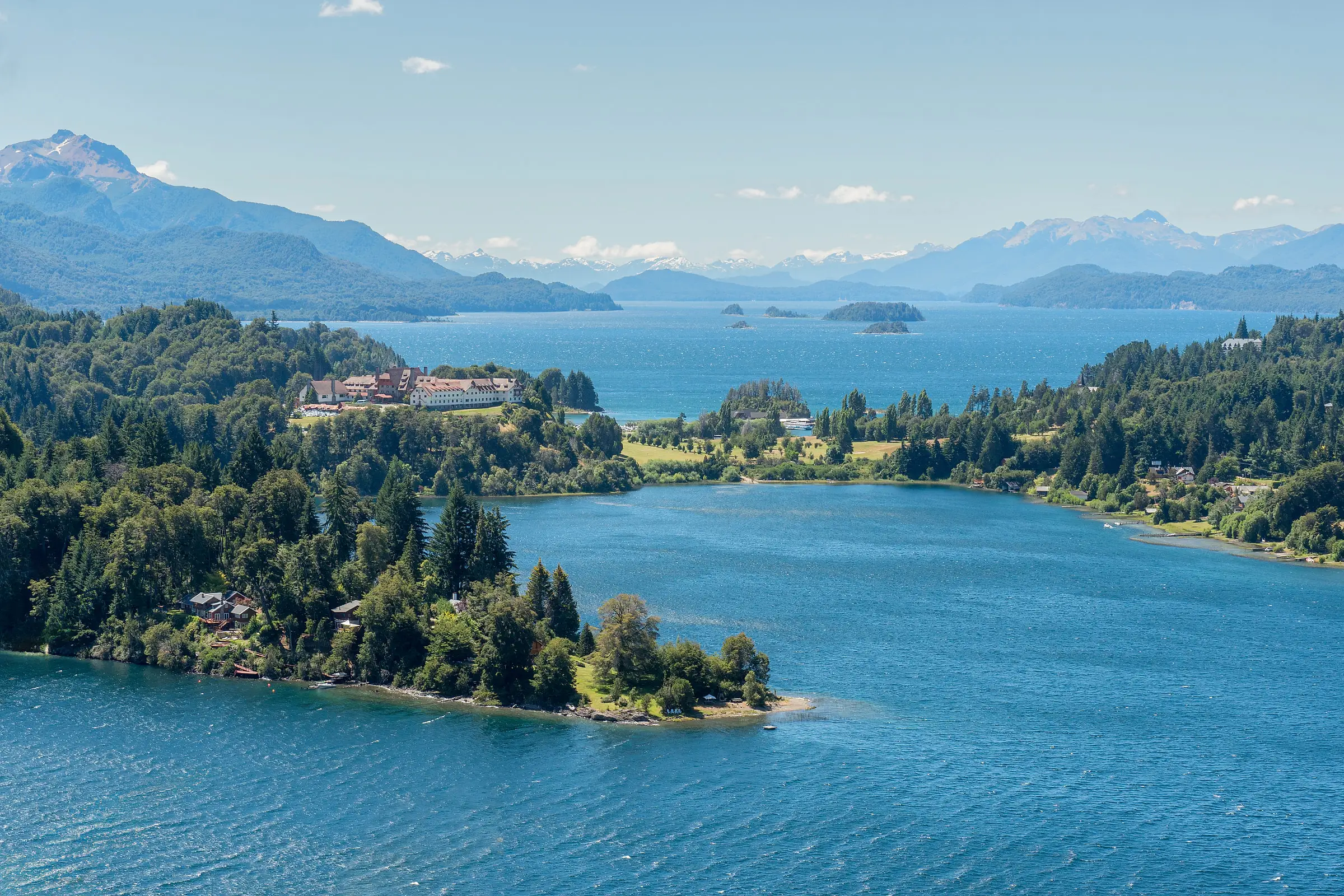
The Llao Llao peninsula between lakes Moreno and Nahuel Huapi, Bariloche, January 2023. Photo by Fernando, CC BY-SA 4.0, via Wikimedia Commons.

The glaciers, around El Calafate
9. Watch the Perito Moreno glacier, then sail Lago Argentino
The Perito Moreno is 80 km from El Calafate on Route 11, about an hour and a half by car, according to the portal’s glacier page. In front of it, the parks service has built more than 4.5 km of walkways and viewpoints, and boats leave from the same area to sail below its face. From Puerto Punta Bandera, 47 km from town, other boats go to the Upsala and Spegazzini glaciers. Los Glaciares has been a UNESCO site since 1981. The fare is ARS 50,000, and at the glacier gate you can pay by card, in pesos or online.
This is the centre of our 10-day Buenos Aires, glaciers and Iguazu trip, which gives the glacier a whole day and the boats to the Upsala and Spegazzini another, between three nights in the city and three at the falls. For when to go and how to get there, see the best time to visit Patagonia and how to get to Patagonia.
El Chaltén, the walking village
10. Walk to the lakes below Fitz Roy
El Chaltén is about three hours by road north of El Calafate, and its trails start at the edge of the village. The day walks go to Laguna de los Tres, under Fitz Roy, and to Laguna Torre, under Cerro Torre. The parks service gives the first as 25 km and eight to nine hours there and back. Remember that tickets for this northern sector of the park are online only and paid by card.
The multi-day treks in this area are a different trip, covered by Andes Trekking. For the day walks and the season, see item 3 of our things to do in Patagonia guide, and our Patagonia itinerary for how many nights to give the village.
Ushuaia, at the end of the road
11. Sail the Beagle Channel and walk in the national park
Ushuaia is 3,084 km by road from Buenos Aires, according to the portal’s Ushuaia page, which recommends two to four days there, and almost everyone flies in. Boats sail the Beagle Channel past the Les Eclaireurs lighthouse, and the national park, where the forest comes down to the sea, starts just outside the city. The park charges ARS 40,000 and, according to its hours page, opens 08:00 to 21:00 from December to February, 08:00 to 20:00 in March, October and November, and 09:00 to 18:00 from April to September.
The Atlantic coast, for wildlife
12. Watch southern right whales at Península Valdés, and the penguins of Punta Tombo
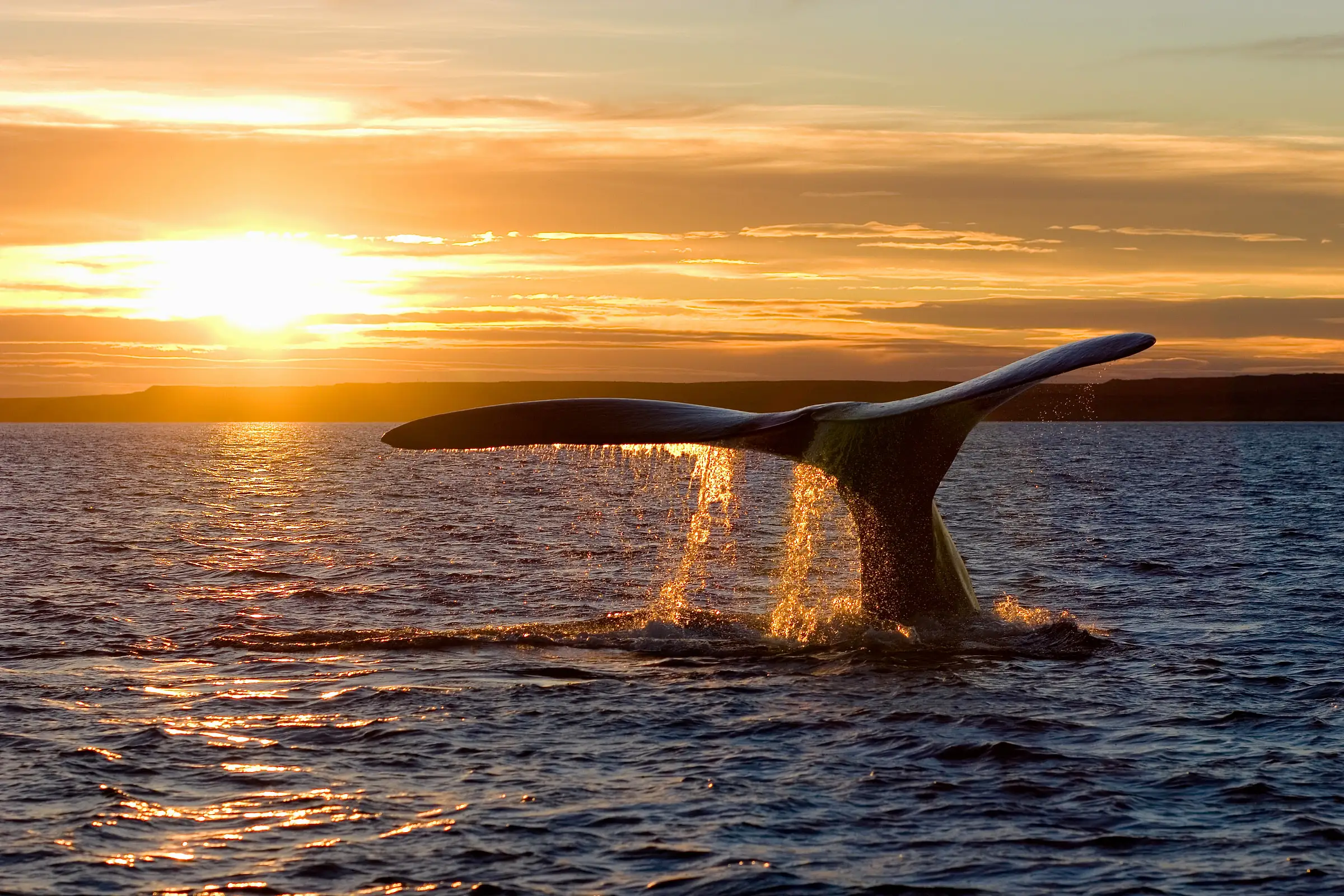
A southern right whale diving in Golfo Nuevo, Península Valdés, 2007. Photo by Naturedata, CC0, via Wikimedia Commons.

Southern right whales come to breed in the bays of Península Valdés from June to December. Six companies take boats out to them from Puerto Pirámides, the only town on the peninsula, according to Chubut’s tourism office. The national portal gives a narrower June to October, so the middle of the season is the safer bet. The peninsula is 56 km from Puerto Madryn and has been a UNESCO site since 1999. Its own administration charges foreign adults ARS 50,000 a day, and half that for children aged 6 to 11.
Further south, Punta Tombo, 110 km from Trelew, has Magellanic penguins from September to April. The province’s Punta Tombo page says the first males arrive in early September, the chicks hatch in mid-November and the colony is fullest at the end of January. The last 12 km of the road are gravel.
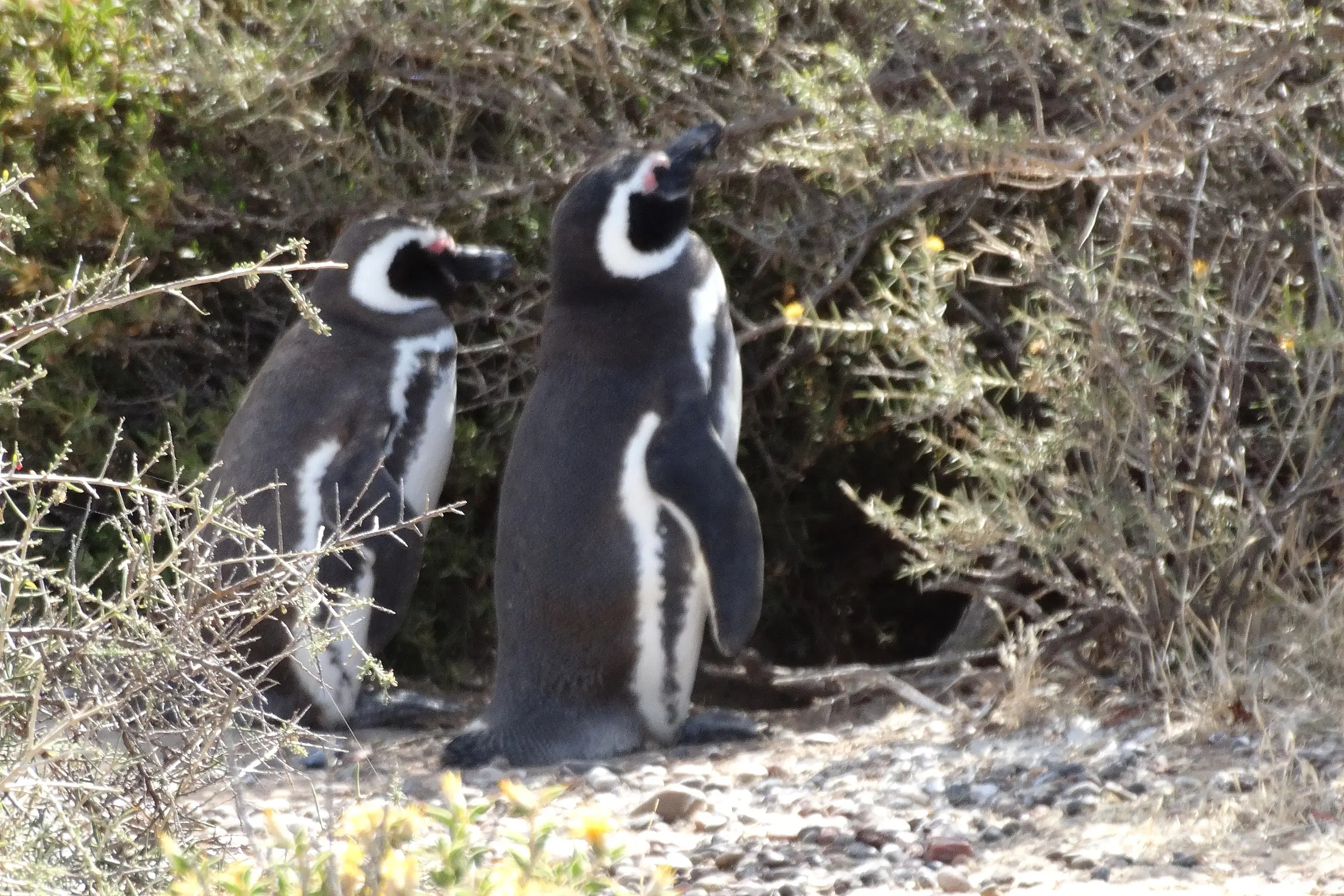
Magellanic penguins by their burrow at Punta Tombo, Chubut, February 2023. Photo by Ariel Eberle, CC0, via Wikimedia Commons.

October is the one month when both are on: the whales are still in the bays and the penguins are back at Punta Tombo.
How many of these fit in one trip
Ten days covers numbers 1, 2, 3 and 9: Buenos Aires, the estancia, Iguazu and the glaciers, with about three nights in each base. That is the shape of our flagship trip. Two weeks adds one more region, either the northwest (4 to 6) or Mendoza (7). Three weeks lets you add the lakes, El Chaltén, Ushuaia or the coast, and use the direct flights between regions instead of going back to Buenos Aires each time. Our Argentina itinerary has the flight map and what each extra region costs in days.
The seasons pull against each other. Patagonia is best from November to March, and the northwest from April to June, so a trip that wants both usually settles on April or accepts a compromise at one end. If you also want Torres del Paine, our Chile and Argentina tours cross the border by road from El Calafate. If you have more time still, the wetlands of the Esteros del Iberá, the rock formations of Ischigualasto and Talampaya, and the Jesuit estancias of Córdoba (both UNESCO sites since 2000) are worth a look. For everything we run in the country, see our Argentina tours.
The questions we get on this
- What is Argentina best known for?
- For Buenos Aires and tango, for its beef and its Malbec, and for two natural sights at opposite ends of the country: Iguazu Falls in the subtropical north-east and the Perito Moreno glacier in Patagonia. The coloured valleys of Jujuy and the whales of Península Valdés are less famous abroad and just as worth the trip.
- What is the most beautiful place in Argentina?
- Most travellers would name one of three: Iguazu Falls, where the river drops about 80 m along almost 3 km; the Perito Moreno glacier, seen from more than 4.5 km of walkways; or the Quebrada de Humahuaca in Jujuy, a 155 km valley of striped hills that UNESCO listed in 2003.
- Should I visit Patagonia in the same trip as Buenos Aires?
- Yes, and in practice you will pass through Buenos Aires anyway, because most flights to the glaciers leave from its domestic airport. Ten days covers Buenos Aires, El Calafate for the Perito Moreno glacier and Iguazu Falls, with about three nights in each.
- Argentina or Chile, where should I go?
- If you can only pick one, Argentina gives you more variety: a capital city, the Iguazu falls, the northwest and the glaciers. Chile wins for Torres del Paine and the Atacama desert. In Patagonia you do not have to choose, since El Calafate and Torres del Paine are joined by road across the border.
- What are the most popular foods in Argentina?
- The asado, beef and sausages grilled slowly over wood or charcoal, is the national meal. Empanadas, small baked or fried pastries, change filling from province to province, and dulce de leche turns up in almost every dessert. To drink, Malbec from Mendoza and torrontés, the white wine of Cafayate.
- Is the Devil's Throat at Iguazu Falls open?
- It was closed on the Argentine side when we checked in October 2026. The walkway to the Devil's Throat shut on 3 August 2026 ahead of forecast high water, and the park's concession had published no reopening date by 29 October. The Upper and Lower circuits were open. The Brazilian walkway in front of the same drop also closed, on 13 October 2026, as the river rose. Check both parks' news pages before you go.
- When is the best time to see whales in Argentina?
- Southern right whales come to Península Valdés from June to December, according to Chubut's tourism office, and six companies take boats out to them from Puerto Pirámides, the only town on the peninsula. Argentina's national tourism portal gives a narrower June to October window.