South America · Travel guide
Best Time to Visit Patagonia: Month by Month (2026)

The best time to visit Patagonia is November to March. Month by month, with official weather, park winter rules and penguin and whale dates.
This is the reasoning we use when we date a trip, not an article written to fill a blog. The itineraries it feeds are here.

The best time to visit Patagonia is November to March, and December to February is the core of it. Those are the months when the trails in Torres del Paine and around El Chaltén are free of snow, the Perito Moreno glacier keeps its long summer hours, and the penguin colonies on both sides of the border are occupied. October and April are the quiet edges, colder but open. May to September is winter: still possible, but the parks change their rules, and the trip has to change with them.
Patagonia weather by month: the official numbers
There is no single Patagonia climate. The two places most trips depend on, El Calafate in Argentina and Punta Arenas in Chile, behave differently: El Calafate sits in the dry lee of the Andes, while Punta Arenas, on the Strait of Magellan, gets more than twice its rain.
These are the World Meteorological Organization climate normals for 1991-2020, compiled from data that Argentina’s Servicio Meteorológico Nacional and the Dirección Meteorológica de Chile submitted for each airport station. The El Calafate record covers about twenty years of that period rather than the full thirty.
El Calafate, Argentina
| Month | High / low | Rain |
|---|---|---|
| January | 19.1 / 7.2 °C | 6.9 mm |
| February | 19.2 / 6.8 °C | 13.7 mm |
| March | 16.6 / 4.7 °C | 16.7 mm |
| April | 12.9 / 1.1 °C | 19.5 mm |
| May | 8.7 / −1.7 °C | 20.3 mm |
| June | 5.5 / −3.7 °C | 14.6 mm |
| July | 5.2 / −4.4 °C | 13.6 mm |
| August | 6.9 / −2.8 °C | 14.2 mm |
| September | 11.1 / −0.8 °C | 11.4 mm |
| October | 13.5 / 1.3 °C | 13.5 mm |
| November | 15.8 / 4.0 °C | 6.9 mm |
| December | 17.9 / 6.2 °C | 9.5 mm |
Punta Arenas, Chile
| Month | High / low | Rain |
|---|---|---|
| January | 15.3 / 6.9 °C | 38.1 mm |
| February | 14.8 / 6.6 °C | 31.5 mm |
| March | 13.0 / 5.4 °C | 42.9 mm |
| April | 10.1 / 3.5 °C | 45.1 mm |
| May | 6.9 / 1.5 °C | 36.9 mm |
| June | 4.3 / −0.5 °C | 31.3 mm |
| July | 4.2 / −0.7 °C | 30.9 mm |
| August | 5.7 / 0.1 °C | 29.5 mm |
| September | 8.3 / 1.4 °C | 24.5 mm |
| October | 10.8 / 2.7 °C | 24.6 mm |
| November | 12.9 / 4.5 °C | 23.1 mm |
| December | 14.3 / 5.8 °C | 31.8 mm |
Three things stand out. Summer is cool, not warm: the warmest month barely reaches 19 °C on the Argentine side and 15 °C on the Chilean side. The difference between November and March is small, about two degrees. And the sun is the real seasonal swing: the same normals give El Calafate 289 hours of sunshine in January and 92 in June.
Wind is the question everyone asks, and here we have to be honest: neither weather service publishes a monthly wind normal for these stations, so we will not put a number on it. Plan for wind in every month, and for days when a boat does not sail or a viewpoint is closed.
Daylight: the season you can plan around
The length of the day changes more than the temperature. Argentina’s naval hydrographic service publishes sunrise and sunset tables for the far south. For 2026 at Río Gallegos, the closest station on the same latitude as El Calafate, the sun rises at 05:15 and sets at 21:54 on 21 December, about 16 hours 40 minutes of daylight. On 21 June it rises at 09:44 and sets at 17:33, under 8 hours.
At Ushuaia, further south, the same tables give about 17 hours 20 minutes in December and 7 hours 13 minutes in June. A summer day leaves room for a morning boat, an afternoon walk and an evening viewpoint. A winter day holds one of the three.
The best time to go to Patagonia, season by season
Summer, from December to February
The best time to go to Patagonia for most first trips. All the trails are open, the days are longest and the average highs are at their peak. It is also the busiest stretch, and the Argentine and Chilean school holidays fall in it, so the lodges inside Torres del Paine and the boats on Lago Argentino fill first. We book these months furthest ahead.
Patagonia in December has the longest days of the year and the full summer timetable. Patagonia in January is the sunniest month in the official normals and, with February, the warmest. February is almost identical to January at El Calafate, a fraction cooler at Punta Arenas.
The shoulder months, November and March
The two months we recommend most. Patagonia in November is spring: the El Calafate normals show the same 6.9 mm of rain as January, highs around 16 °C, and the Magellanic penguins are already back at their colonies. Patagonia in March is early autumn: highs around 17 °C at El Calafate and 13 °C at Punta Arenas, every trail still open, and the parks quieter once the summer holidays end.
The edges: October and April
October brings the summer opening hours back to the Perito Moreno glacier, which start on 1 September, but snow can linger on the higher trails. In Torres del Paine, CONAF has announced that the O circuit stays closed initially until 31 October 2026, so October is not a month for the long treks. April is autumn colour, the season in the photograph at the top of this page, with lows near freezing at El Calafate and the last weeks of the penguin colonies.
Winter: May to September
Patagonia in winter is open, quiet and cold, and the rules change on both sides.
In Torres del Paine, CONAF lists snow risk on the park’s trails from May to September; several sections of the W can be walked only with a guide in the winter period, and the O circuit closes from May, according to the park’s page.
At Los Glaciares, Argentina’s parks service warns that from May to September the paths have ice, mud and snow, and that poles and crampons are compulsory; registering with the park before walking its trails is also required in those months.
The Perito Moreno glacier stays open all year, on winter hours from 1 May to 31 August, 09:00 to 16:00 with visitors allowed to stay until 18:00, against 08:00 to 18:00 in summer.
The glacier in winter is a fine short trip on its own. A full trip across both sides, with walking, is a November to March plan.
Best time to visit Torres del Paine, and the Argentine side
The best time to visit Torres del Paine and the best time to visit Patagonia in Argentina are almost the same window, but each side has its own deciding detail.
| Chile: Torres del Paine | Argentina: El Calafate and El Chaltén | |
|---|---|---|
| Best months | November to March | November to March |
| Deciding factor | Snow on the trails May to September; W sections guided-only in winter | Crampons compulsory on trails May to September |
| Open all year? | The park road and viewpoints, with winter limits | The Perito Moreno walkways, with winter hours |
| Rain at the nearest station | Punta Arenas: 389 mm a year | El Calafate: 161 mm a year |
If your dates are fixed outside summer, the Argentine side is the more forgiving one, because the glacier works in any month. If you want the granite towers of Paine on a long walk, summer is the safe choice. Our 10-day Chile and Argentina Patagonia trip runs both sides in that window, and also comes as an eight-day version with short walks only.
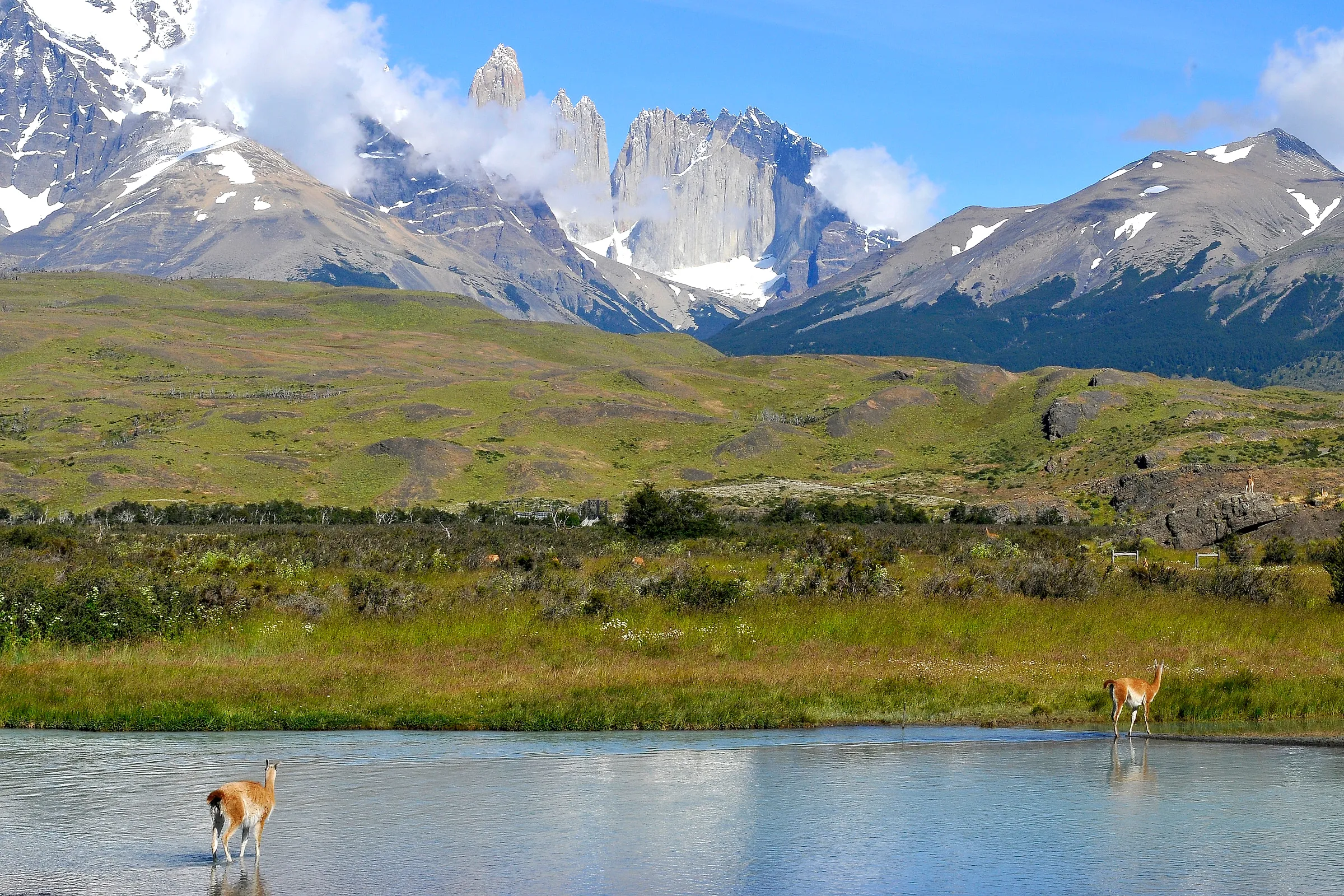
Guanacos in the Paine river, Torres del Paine, Chile. Photo by LBM1948, CC BY-SA 4.0, via Wikimedia Commons.

Wildlife: when the animals are there
For many travellers the calendar is set by animals, not weather. These are the dates the official sources publish:
| What | Where | When |
|---|---|---|
| Magellanic penguins | Isla Magdalena, Chile | October to mid-April (CONAF) |
| Magellanic penguins | Punta Tombo, Argentina | Mid-September to mid-April (Argentina’s tourism ministry) |
| Southern right whales | Península Valdés, Argentina | June to early December (argentina.travel) |
| King penguins | Bahía Inútil, Tierra del Fuego, Chile | August to May (chile.travel) |
The overlap is the useful part. October and November are the months when the Valdés whales and both Magellanic penguin colonies coincide, which makes them the best months to visit Patagonia if wildlife is the point of the trip, with November the warmer of the two. CONAF also notes that the Isla Magdalena monument closes for the winter, and it currently carries a bird-flu notice, so check its page before you book a landing.
The best month to visit Patagonia, by what you want
Our view, built from the dates above:
| If you want | Best month | Why |
|---|---|---|
| The warmest, sunniest days | January | Highest averages, with February, and the most sunshine in the normals |
| Long walks with fewer people | March | Trails open, summer holidays over |
| Penguins and whales together | November | Whales and both penguin colonies overlap in October and November; November is warmer |
| Autumn colour | April | The lenga forests turn red, as in the photo above |
| The glacier without crowds | June to August | Perito Moreno is open all year, on winter hours |
So the best time of year to visit Patagonia depends on the trip, but the safe answer for a first visit across both countries is the same: between November and March. For how many days that trip needs and how to join the two sides, see our Patagonia itinerary, and for the Argentine flights between Buenos Aires and the south, our Argentina itinerary.
Why Patagonia costs more than you expect
It is one of the questions most asked about the season, and the answer is mostly geography. Puerto Natales, the base for Torres del Paine, is 250 km by road from Punta Arenas, and the park is another 80 km beyond, according to CONAF. Aerolíneas Argentinas flies from El Calafate to five Argentine cities and none in Chile, so crossing between the two parks takes a day by road. Argentina’s park fees for foreign visitors at Los Glaciares are 50,000 pesos since June 2026. And because almost everyone travels between November and March, the lodges and boats that operate in those months price for a short season. For what a whole South America trip costs, see our South America travel cost guide.
Asked before booking
The questions we get on this
- When is the best time to visit Patagonia?
- November to March, with December to February as the most reliable months. That is when the trails in Torres del Paine and around El Chaltén are clear of snow, the Perito Moreno glacier keeps its long summer hours and the penguin colonies are occupied. October and April work for travellers who accept colder days in exchange for fewer people.
- What is the best month to go to Patagonia?
- January or February for the warmest days, about 19 °C on average at El Calafate and 15 °C at Punta Arenas, with January the sunniest month of the year. If you would rather trade a few degrees for quieter parks, March is our pick: average highs of about 17 °C at El Calafate and 13 °C at Punta Arenas, and every trail still open.
- Can you visit Patagonia in winter?
- Yes, but it is a different trip. From May to September the parks report snow and ice on the trails, Argentina makes crampons mandatory at Los Glaciares, several sections of the W in Torres del Paine can only be walked with a guide, and the O circuit closes. The Perito Moreno glacier stays open all year, with shorter visiting hours.
- Why is a Patagonia trip so expensive?
- Mostly distance and a short season. The parks are a long way from the airports, and Chilean and Argentine Patagonia are not linked by scheduled flights, so moving between them costs a day by road. Most travel happens between November and March, which is when lodges and boats fill. National park fees add to the bill.