Argentina · Travel guide
Patagonia Itinerary: 7, 10 or 14 Days, and Which Side

A Patagonia itinerary decided in the right order: Chile, Argentina or both, the road between them, how many days each needs and when to go.
This is the reasoning we use when we date a trip, not an article written to fill a blog. The Argentina itineraries it feeds are here.

A Patagonia itinerary comes down to three decisions, in this order: which side, Chile or Argentina, or both; how many days; and when. With ten days, do both: three nights at Torres del Paine in Chile, one day on the road across the border, and three nights at El Calafate for the Perito Moreno glacier. With seven, pick one side. With fourteen, add El Chaltén and the walks below Fitz Roy. The one thing that shapes every version is a gap in the map: there is no scheduled flight between the Chilean and the Argentine parks, so the two halves are joined by road, and that road costs you a day.
Chile or Argentina: what each side of Patagonia gives you
Patagonia is one region and two countries, and the sights most people come for sit on different sides of the border.
| Chile | Argentina | |
|---|---|---|
| The park | Torres del Paine | Los Glaciares |
| The landmark | The granite towers and the Cuernos | The Perito Moreno glacier, and Fitz Roy at El Chaltén |
| The base | Lodges in or beside the park, or Puerto Natales | El Calafate, and El Chaltén for Fitz Roy |
| The way in | By road from Puerto Natales, or from Punta Arenas | El Calafate’s airport |
Chile’s forest service, CONAF, describes Torres del Paine as a park created in 1959 around the Paine massif, which rises to 3,050 m, with lakes and glaciers fed by the Southern Patagonian Ice Field, 13,500 km² of ice. Argentina’s Los Glaciares National Park, on the other side of the same ice, was created in 1937 and has been a UNESCO World Heritage Site since 1981. Its current fees, in force since 1 June 2026, are 50,000 pesos for foreign visitors at both the glacier and El Chaltén; at El Chaltén the ticket is sold online only and cash is not accepted.
The short version, in our view: Chile is mountains and walking; Argentina is ice and boats, with El Chaltén as Argentina’s mountain answer to Torres del Paine. Most first trips want both, which is why the crossing matters so much.
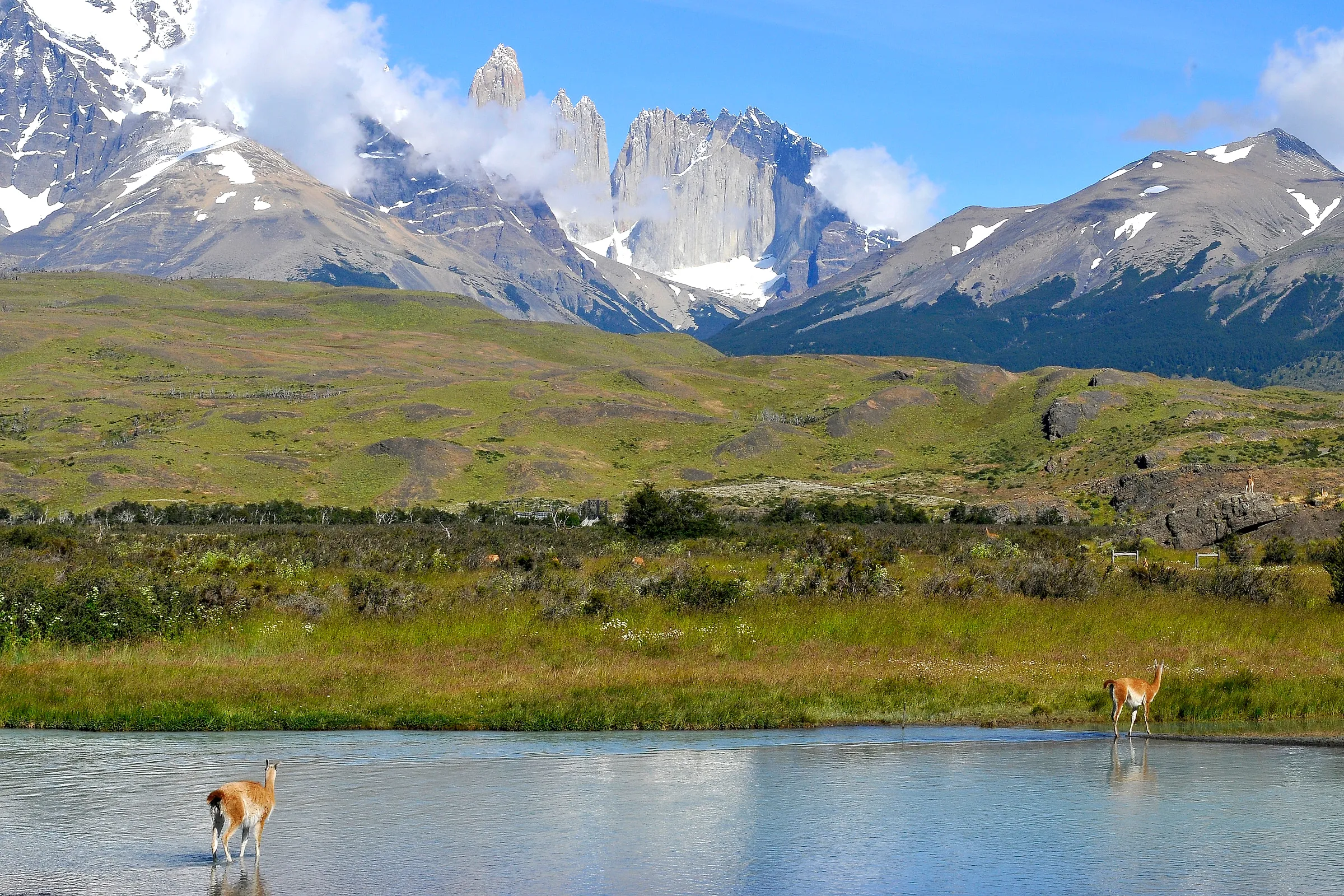
Guanacos in the Paine river, with the towers behind them, in Torres del Paine, Chile. Photo by LBM1948, CC BY-SA 4.0, via Wikimedia Commons.

The crossing: the day that shapes every Patagonia trip itinerary
Every Patagonia trip itinerary that covers both sides has the same hinge. Aerolíneas Argentinas flies direct from El Calafate to Bariloche, Ushuaia, Trelew, Buenos Aires and Córdoba, and to nowhere in Chile. Going between the parks by air would mean flying back through both capitals. So you go by road.
Two border crossings serve the route, and Chile’s border authority lists both in its daily status page, last updated on 7 April 2026, so check it again before you travel, because hours change with the season:
- Río Don Guillermo, at Villa Cerro Castillo, 52 km from the park’s Sarmiento gate according to CONAF. Open for entry to Chile from 08:00 to 20:00 and for exit from 08:00 to 21:30.
- Dorotea. Chile lists it from 08:00 to 22:00 for entry and to 21:30 for exit; Argentina’s migration service lists its own office at Dorotea from 08:00 to 17:00. When two countries publish different hours for one crossing, plan for the shorter.
The scheduled bus between Puerto Natales and El Calafate takes about five hours, according to torresdelpaine.com, which sells the Bus Sur service, which adds that border procedures and weather can change that. Our advice, and our practice: put nothing else on that day.
How many days in Patagonia
How many days in Patagonia depends on how many sides you visit, and this is our opinion, built from the distances above:
| Days | What fits | What you give up |
|---|---|---|
| 7 | One side, done properly: Torres del Paine, or El Calafate and El Chaltén | The other side |
| 10 | Both sides: three nights at Torres del Paine, the road, three nights at El Calafate | El Chaltén |
| 14 | Both sides plus El Chaltén for the walks below Fitz Roy | Nothing in the far south |
| 21 | Patagonia plus a second region: the Atacama Desert, or Iguazu | Very little |
Three nights on each side is the number we hold to, because a day of wind on the lake or cloud on the towers is normal, and with two nights it costs you the sight you came for. At El Chaltén we use three for the same reason.
Remember the long flights at the ends. If you fly in overnight, a night in Santiago or Buenos Aires before going south is part of the count, not extra.
Patagonia itinerary 10 days: both sides, in this order
A Patagonia itinerary of 10 days that covers both countries has one shape that works, and the order is decided by the flights: in through Santiago, south to Torres del Paine for three nights, the road to El Calafate, three nights there, and out through Buenos Aires. You fly in to one capital and home from the other, so the long-haul ticket is an open jaw.
Reversing it works too, starting in Buenos Aires and ending in Santiago, if the international fares point that way. What does not work is a round trip from one capital, because it means doubling back across the border or over the Andes.
That is exactly the route of our 10-day Chile and Argentina Patagonia trip, which also comes as an eight-day version with short walks only and a thirteen-day one with three nights at El Chaltén. The day-by-day plan, the lodges and the price are on that page; this one is for deciding whether it is the right shape for you.
If you would rather stay on one side, we sell both of those too: Chile alone, with the Atacama Desert at the other end of the country, in our Atacama and Patagonia route, and Argentina alone, with the Iguazu falls in the north, in our Buenos Aires, glaciers and Iguazu trip.
What to do in Patagonia, side by side
What to do in Patagonia depends on which park you are in. These are the main things on each side, with the measurements the parks themselves publish.
At the Perito Moreno glacier. The glacier is 80 km from El Calafate by road, and it is seen from more than 4.5 km of walkways through the forest to the front of the ice, according to Argentina’s parks service, with options for reduced mobility. Boats run below the face, guided walks go out on the ice itself, and there is a two-hour kayak trip in front of it.
On Lago Argentino. From Puerto Bandera, 47 km from El Calafate, boat trips go up the north arm of the lake to the Upsala and Spegazzini glaciers. Some of these boats, the parks service notes, are the only way into the heart of the park.
At El Chaltén. The walk to Laguna de los Tres, the closest viewpoint to Fitz Roy, is 25 km and eight to nine hours, rated medium to high. Laguna Torre, below Cerro Torre, is 18 km there and back, three to four hours each way. The Chorrillo del Salto waterfall, 6 km from the village, is the half day for everyone else.
In Torres del Paine. The park road and its viewpoints show the Cuernos and the towers without a long walk; catamarans cross Lago Grey and Lago Pehoé, CONAF notes. The day walk to the foot of the towers is the big one: by CONAF’s figures for each section, it is about 9.4 km and four and a half hours on the way up from the Hotel Las Torres, with the last 1.4 km rated demanding. The W and the O, the park’s multi-day treks, are a different kind of trip with their own rules, and not what this page plans.
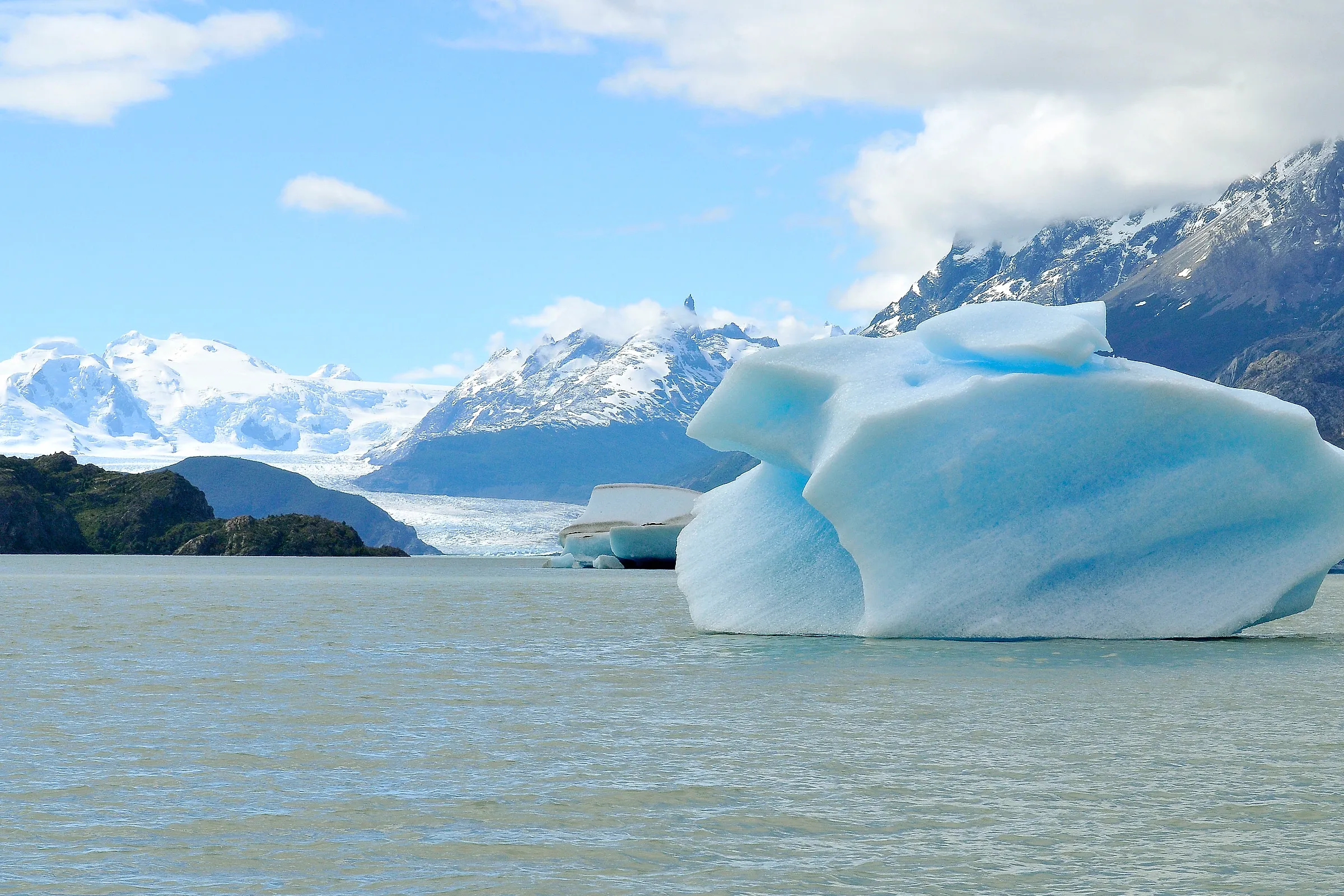
An iceberg on Lago Grey, with the Grey glacier behind it, in Torres del Paine, Chile. Photo by LBM1948, cropped, CC BY-SA 4.0, via Wikimedia Commons.

And the wildlife on both. CONAF lists guanaco, fox, rhea, swan and condor among the species that are easy to see in Torres del Paine, and the guanacos are hard to miss from the road.
When the itinerary works: the season in four dates
Patagonia is open all year, but the trip changes shape between May and September. These are the dates the parks and operators publish:
- 1 May. Access to the Perito Moreno walkways goes from summer hours, 08:00 to 18:00, with visitors allowed to stay until 20:00, to winter hours of 09:00 to 16:00, according to the park’s own page. Summer hours return on 1 September.
- May to September in Torres del Paine. CONAF marks snow risk on the park’s trails for those months, and several sections of the W can be walked only with a guide in the winter period.
- May to September at Los Glaciares. Registering with the park before walking its trails becomes compulsory, and the central zone between El Calafate and El Chaltén opens only in spring and summer.
- 1 May to 31 August on Lago Grey. The boat to the Grey glacier runs on Wednesdays and Saturdays only, according to torresdelpaine.com, which sells it.
That is why we plan Patagonia trips for October to April: none of the four restrictions above applies then. For both sides month by month, with the official weather and the wildlife dates, see our guide to the best time to visit Patagonia; for the rest of Argentina, the best time to visit Argentina.
Getting there and away
Chile. Puerto Natales is the main base town for Torres del Paine, and CONAF describes the Y-290 road from there to the park as 80 km. Punta Arenas is 250 km of paved road south of Puerto Natales. Scheduled buses leave Puerto Natales for the park twice a day, at 07:30 and 14:30.
Argentina. El Calafate has the airport, with Aerolíneas flights to Buenos Aires in under three hours. El Chaltén is 220 km north by paved road, according to the park’s directions, with daily buses between the two. Buses from El Calafate also run to Punta Arenas and Puerto Natales, which is the crossing again.
For how Patagonia fits into a longer trip, with Machu Picchu or the Atacama, our South America itinerary shows what three weeks hold. For Argentina alone, the Argentina itinerary lays out one, two and three weeks.
Asked before booking
The questions we get on this
- How many days do you need in Patagonia?
- Ten days covers both sides: three nights at Torres del Paine in Chile, a day on the road across the border, and three nights at El Calafate for the Perito Moreno glacier, with a night at each end for the long flights. Seven days fits one side well. Fourteen adds El Chaltén and the walks below Fitz Roy.
- Is 10 days enough for Patagonia?
- For Torres del Paine and the Perito Moreno glacier, yes. Ten days leaves three nights on each side and one day for the road between them, which takes about five hours by the scheduled bus. It is not enough to add El Chaltén as well without cutting a night from one of the other two.
- Is Patagonia better in Chile or Argentina?
- Neither; they are different trips. Chile has Torres del Paine, the granite towers and the boat to Grey glacier. Argentina has the Perito Moreno glacier, the boat trips to Upsala and Spegazzini, and El Chaltén below Fitz Roy. With ten days or more, do both: the two parks are joined by a road, not a flight.
- How do you get from Torres del Paine to El Calafate?
- By road, through Puerto Natales or straight across the border at Cerro Castillo. There is no direct flight: Aerolíneas flies from El Calafate to five Argentine cities and none in Chile. The scheduled bus from Puerto Natales takes about five hours including the border; a private transfer from the park is a full day with nothing else planned.
- Can you do Patagonia if you are not a hiker?
- Yes. The Perito Moreno glacier is seen from more than 4.5 km of walkways, the lakes by boat, and the Torres del Paine massif from the park road and its viewpoints. The long day walks, such as the 25 km to Laguna de los Tres below Fitz Roy, are optional, and the multi-day treks are a different trip altogether.