Argentina Countryside: Estancias, Gauchos and the Pampa
The Argentina countryside by region: the pampa, Córdoba, Mendoza, Jujuy and Patagonia, what an estancia day or night includes, and when to go.

The Argentina countryside is what Argentines call el campo: the flat cattle and grain country of the pampa, which starts about an hour outside Buenos Aires, and further out the estancias of the Córdoba hills, the vineyards of Mendoza and Cafayate, the farming villages of the Quebrada de Humahuaca and the sheep ranches of Patagonia. Most visitors see it in one day at an estancia, a working ranch, with an asado lunch and a show of horsemanship. A night there shows you more, because the work with the animals happens early and late, after the day visitors have gone.
If you have a single day, go to San Antonio de Areco, the gaucho town on the pampa north-west of Buenos Aires, or to an estancia near it. With two weeks or more, sleep out there at least once, and choose the region by what you want from it: horses and the gaucho tradition on the pampa, wine in Mendoza, old farming villages in Jujuy, sheep country and glaciers in the south.
This guide covers the five kinds of countryside a trip can reach, what a day and a night at an estancia usually include, how to choose one and get there, San Antonio de Areco and its gaucho festival, and the Argentine villages on the UN Tourism list. Each figure links to the official source we read it in, between 29 October and 16 November 2026.
Five kinds of Argentine countryside
The pampa around Buenos Aires
The pampa is the grassland that spreads west and south of Buenos Aires. It is flat, green for most of the year and cut into fields of cattle and grain, with a line of eucalyptus or a windmill on the horizon. This is the country of the gaucho and of the old estancias, and the one closest to the city.
San Antonio de Areco is the town to see it from. It is 113 km from the city of Buenos Aires, about an hour and a half by car on the Panamericana and Route 8, according to the town’s tourism office. Argentina’s national tourism portal suggests one or two days there, and describes the estancias around the town as stylish ranches with luxury amenities, where guests can join in herding, milking, riding and sulky rides. Areco has a section of its own below.
The plain carries on west into La Pampa province, the one that took its name. The portal’s page on estancias in La Pampa gives it two to four days: rides across the plain and through the woods, visits to the milking sheds and the livestock, local craftsmen, and country families who share their customs with guests. It is a long way from the usual routes, with its airport at Santa Rosa, the provincial capital.
The hills of Córdoba and the Jesuit estancias
Córdoba, in the middle of the country, has some of the oldest estancias you can visit. For more than 150 years, across the 17th and 18th centuries, the Jesuits ran a chain of farming estates in the province to support their college and university in the city. Five of those estancias, together with the Jesuit Block in Córdoba, became a World Heritage Site in 2000, and UNESCO’s listing gives the distance of each from the city: Alta Gracia 36 km, Caroya 44 km, Jesús María 48 km, Santa Catalina 70 km and La Candelaria 220 km.
Each had a church, the priests’ house, quarters for the enslaved and indigenous people who worked there, mills, irrigation channels and wide land for cattle. Santa Catalina and La Candelaria are still in open country. Alta Gracia became the centre of a town. North of the city, the sierras also have small colonial villages of their own, and one of them, Villa Tulumba, is on the UN Tourism list further down.
Wine country: Mendoza and Cafayate
In the west, the countryside is vineyards under the Andes. The Uco Valley lies south of Mendoza city along Route 40, between 900 and 1,700 m, with about 28,000 hectares of vineyards and wineries, according to the portal’s Uco Valley page. It recommends two to five days and staying in the valley itself, among its country restaurants and luxury hotels.
In the north, Cafayate is 183 km from Salta on Route 68, at 1,683 m. The portal’s Cafayate page calls it the land of high-altitude wine and gives it two to four days. Torrontés is the white grape of these valleys. A night on a wine estate gives you the vineyard at its quietest hours, and dinner where the wine is made.
The northwest: the Quebrada de Humahuaca
Further north, in Jujuy, the countryside is a narrow, dry mountain valley farmed for thousands of years. UNESCO listed the Quebrada de Humahuaca in 2003 as a corridor 155 km long that has been a trade route for 10,000 years, and it singles out the stone-walled terraces at Coctaca, about 1,500 years old and still farmed today. Two of its villages, Purmamarca and Humahuaca, were declared historic places by national decree in 1975.
Route 9 runs up the valley, 42 km from San Salvador de Jujuy and 165 km from Salta, between 1,600 and 4,500 m, according to the portal’s Quebrada de Humahuaca page. It suggests five to seven days, with horse and mule rides that usually set off from Tilcara, and llama caravans in Tilcara and Maimará. Country life here is in the villages and their terraced fields more than on ranches, and Maimará, below the Painter’s Palette, is one of the villages on the UN Tourism list further down.
The estancias of Patagonia
In the far south, the ranches are sheep stations on the steppe, and some now take guests. Inside Los Glaciares National Park, the parks service lists two. Estancia Cristina is reached on a boat trip that includes the Upsala arm of Lago Argentino, and it offers day and overnight programmes with the history of the ranch, farm work, walks, riding, 4x4 trips and fishing. Estancia Helsingfors takes guests for the night or for the day, and a trail of 10 km there and back runs from the house to Laguna Azul, facing the Alfredo glacier.
On our Chile and Argentina tours, the full day by boat on Lago Argentino becomes an estancia day on the steppe if the boat is cancelled for weather.
Outside the park, the Patagonia tourism board counts more than 30 estancias in Santa Cruz province. Huyliche is 3 km from El Calafate on the south shore of Lago Argentino and Alta Vista is near the town, while Monte Dinero sits on the Strait of Magellan, 120 km from Río Gallegos. Across Patagonia, the board lists the farm work guests can watch or join: shearing, the marking of the lambs, the branding of the cattle and the moving of the herds.
On Tierra del Fuego, the big sheep estancias are on the plains in the north of the island, around Río Grande, and the provincial tourism board gives their season as October to April. You can drive out to María Behety, which the Patagonia board says has one of the largest shearing sheds in the world: it has no tourist services, but you can photograph the main house. Smaller estancias sit in the centre of the island, where the steppe turns to forest, and one of them, Las Hijas, takes visitors round the farm and serves Fuegian lamb roasted on a spit. In March the island holds the Shepherd’s Festival, a contest for the dogs that herd the flocks.
In the north of Patagonia, the Lake District has ranches of its own. The board places most of Neuquén’s estancias near towns such as San Martín de los Andes, Junín de los Andes and Aluminé, among mountain rivers and forest. For the rest of the south, see our guide to things to do in Patagonia.
At a glance
| Countryside | Where to stay, and for how long | What you go for |
|---|---|---|
| The pampa | San Antonio de Areco, 113 km from Buenos Aires: 1 to 2 days | Estancias and gaucho tradition |
| La Pampa province | Estancias near Santa Rosa: 2 to 4 days | Ranch life far from the tourist routes |
| The Córdoba hills | Córdoba city: day trips, 36 to 70 km, except La Candelaria | The Jesuit estancias |
| Mendoza | The Uco Valley: 2 to 5 days | Wine estates at 900 to 1,700 m |
| Salta | Cafayate, 183 km from Salta: 2 to 4 days | High-altitude wine |
| Jujuy | The Quebrada, 42 km from Jujuy city: 5 to 7 days | Farming villages and old terraces |
| Patagonia | El Calafate: a day, or a night at the estancia | Estancias in and around Los Glaciares |
| Tierra del Fuego | Around Río Grande, October to April | Sheep estancias and shearing |
The lengths of stay are the national portal’s. It gives none for Córdoba or Patagonia, so those rows show the distances, the formats and the season that UNESCO, the parks service and the Tierra del Fuego tourism board describe.
A day or a night at an estancia
A día de campo, the country day, follows much the same shape across Buenos Aires province. You arrive in the late morning and lunch is a long asado with wine. Afterwards the gauchos show their skills on horseback, there is folk music and dancing, and there is time for a ride or a carriage round the fields. The tourism office in Areco lists the same parts for the estancias around the town on its page on living the tradition: horsemanship, asado with wine, and folk music with the traditional dances. You are back in the city by evening.
A night changes the hours you see. The day visitors leave in the late afternoon and the estancia goes back to being a farm: the horses come in, the light runs long and low across the fields, and dinner is in the house. In the morning comes the milking and the work with the cattle, which the portal lists among what guests can join in Areco. Its La Pampa page adds the starry nights, and with no town nearby, the sky is properly dark.
A day is enough when the countryside is one part of a city stay. A night or two makes sense if the countryside is a reason for the trip, if you ride, or if you want to see a working estancia after the show has finished.
On our Buenos Aires, glaciers and Iguazu trip, day three is a country day of this kind: out to a working estancia in Buenos Aires province for an asado lunch, horsemanship and a short ride or a carriage, and back to the city hotel by late afternoon. It comes after the guided day in the city and before the flight south to the glaciers. The eight-day version of the trip leaves it out.
Choosing an estancia
The range is wide, from ranches the portal describes as stylish with luxury amenities to small family farms with a few rooms. The Patagonia tourism board’s page on rural tourism shows the same spread in the south, from estancias more than 200 years old and larger than 100,000 hectares to small chacras and farms. Pick the region first, for what you want to do there, and the estancia second.
What a stay includes changes from one house to the next, so ask before you book. Are the meals, the wine and the rides in the rate or charged apart? How long are the rides, and for what level of rider? Is there Wi-Fi or a phone signal? Some of the remote ranches have neither. If you do not ride, ask about a carriage or a walk instead, and if you do not eat meat, say so early, since the main meal of the day is an asado.
Getting there from Buenos Aires
Areco is the easy one. The Panamericana and Route 8 take about an hour and a half and the Acceso Oeste through Luján about an hour and 45 minutes, according to the tourism office’s directions, and the national portal says several bus lines run there from the city. The estancias are further out on country roads, so settle the transfer when you book.
Every other region starts with a flight. Córdoba, Mendoza, Salta, Jujuy, El Calafate and Río Grande all have airports with flights from Buenos Aires, and the estancias and wine estates are a drive from each. In Patagonia that drive can be long, so ask how far the ranch is from the airport before you choose it.
San Antonio de Areco and the gaucho tradition
Areco is a working country town, and its gaucho culture is part of ordinary life there, from the weekend dances to the craftsmen. Its centre is low and colonial, with the old bridge over the Areco River, and since a decree of 1999 part of it has been protected as a site of national historic interest.
The Parque Criollo, 97 hectares on the edge of town, holds the Ricardo Güiraldes museum, named after the author of Don Segundo Sombra, the novel of the gaucho drover. The museum opened on 16 October 1938, and the house and the old general store beside it, the Pulpería La Blanqueada, were declared National Historic Monuments in 1999, according to the town’s museum circuit. The same page lists Museo Las Lilas, with the paintings of Florencio Molina Campos (1891 to 1959), whose gauchos ended up on advertising for the Alpargatas company, and two small museums of gaucho painting run by the Gasparini family of painters. The portal also lists the Draghi silverware museum.
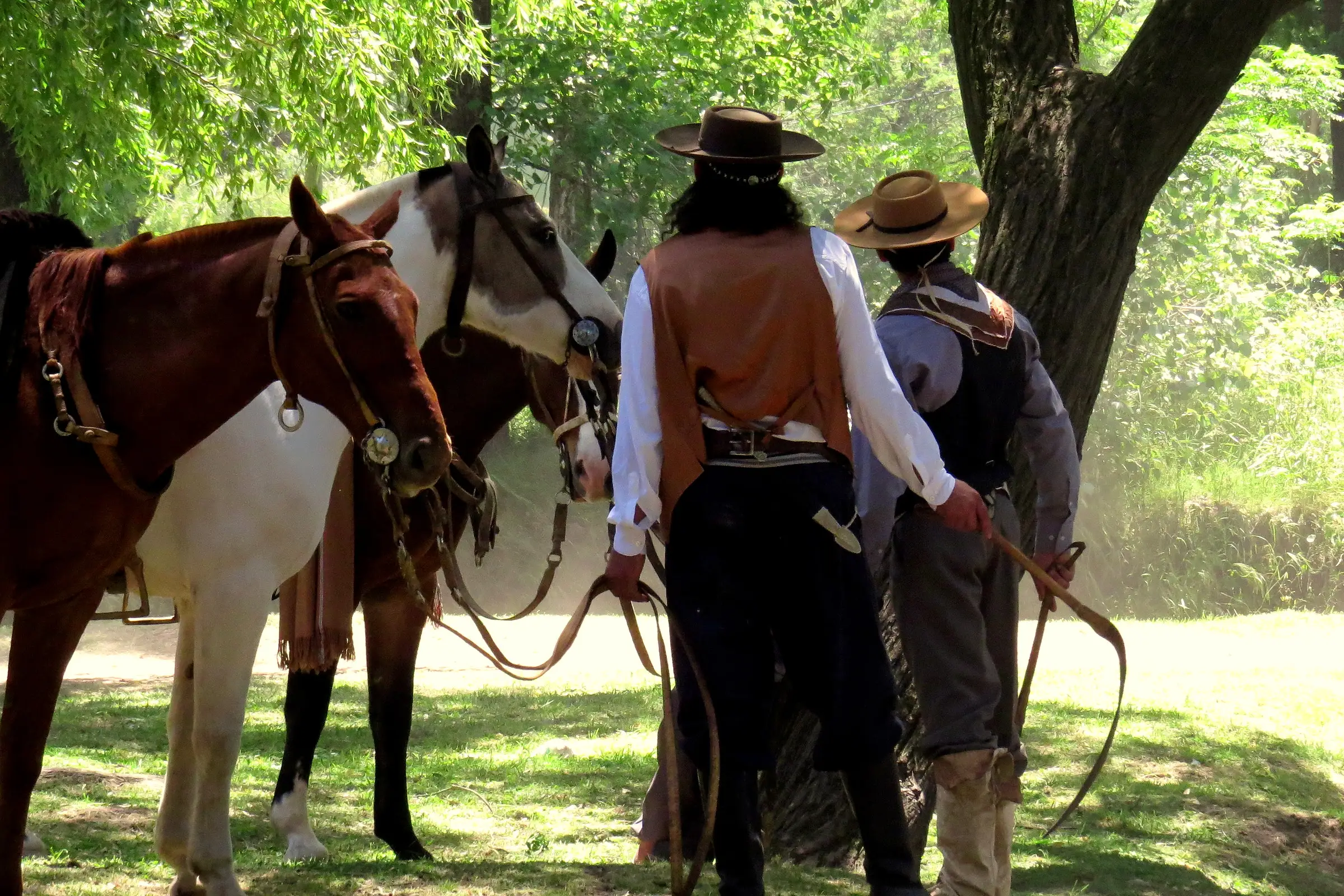
Gauchos and their horses at the Fiesta de la Tradición, San Antonio de Areco, November 2017. Photo by AnselmoesMaciel, CC BY-SA 4.0, via Wikimedia Commons.

The Fiesta de la Tradición in November
The tourism office calls it the oldest criollo festival in the country, and it is the biggest week of the year in Areco. The official day is 10 November, but the celebrations run through the whole week, with music, folk dancing and craft stalls. The main events are the parade of paisanos, country people from the town and from across Argentina, the horsemanship and the peña, a gathering for folk music, in the Parque Criollo, and the fair of local craftsmen.
The date is national. Law 21.154 of 1975 made 10 November the Day of Tradition across Argentina, and the government’s note on the day explains that it is the birthday of José Hernández, whose Martín Fierro poems pay homage to the gaucho. The town’s tourism site gave no programme with dates when we checked on 16 November 2026, so confirm the days with the tourism office before you fix yours.
What life in rural Argentina is like
Quiet, early and organised around the animals, the weather and the town square. The railway shaped these towns. In Areco, the station at Vagues, which opened in 1894 and closed in 1992, is now an interpretation centre about what the train meant for work and daily life in the district. Many of the families came from Europe, a story the Los Rostros de la Pampa museum tells inside one of the first brick houses in Villa Lía, an outlying village.
The pulpería, the old general store and bar, was where people met, bought supplies and heard the news, and the portal lists Areco’s general stores among the things to visit. At weekends, the town’s Bailecitos Criollos bring neighbours and visitors to the patio of the tourism office to dance the huella, zambas and other traditional dances, with mate and pastelitos, the fried pastries filled with quince or sweet potato jam.
Food follows the land. In La Pampa province the portal lists asado cooked over piquillín wood, cured pork, and stews of hare or vizcacha, a large burrowing rodent of the plain. Around Buenos Aires the asado belongs to Sunday, cooked slowly by whoever in the family keeps the grill, and it is the meal an estancia day is built around.
The villages UN Tourism has recognised
UN Tourism adds rural villages to its Best Tourism Villages list each year, and its map of recognised villages shows eight in Argentina, from 2021 to 2025. The details in the last column come from each village’s own page on the same site.
| Village | Province, year | What it is |
|---|---|---|
| Caspalá | Jujuy, 2021 | Mountain village at 3,100 m, about 240 km from San Salvador de Jujuy |
| La Carolina | San Luis, 2023 | Old gold-mining village of stone houses on one cobbled street |
| Villa Tulumba | Córdoba, 2024 | Colonial village founded in 1585, 150 km north of Córdoba city |
| Gaiman | Chubut, 2024 | Valley town on Route 25, 180 km from Península Valdés |
| Trevelin | Chubut, 2024 | Farming valley at the foot of the Andes, settled by the Welsh in 1885 |
| Caviahue-Copahue | Neuquén, 2024 | Two villages at 1,600 m and 1,800 m, with a volcano and hot springs |
| Colonia Carlos Pellegrini | Corrientes, 2025 | Village of 1,120 people, the main gateway to the Esteros del Iberá |
| Maimará | Jujuy, 2025 | Farming village in the Quebrada de Humahuaca, below the Painter’s Palette |
For 2026, the national tourism portal named eight Argentine candidates on 1 June: Villa Sanagasta (La Rioja), Mar de las Pampas (Buenos Aires), Cachi (Salta), El Trapiche (San Luis), Puerto Pirámides (Chubut), Villa General Belgrano (Córdoba), Tafí del Valle (Tucumán) and Zenón Pereyra (Santa Fe). UN Tourism had not published the 2026 results when we checked again on 16 November 2026.
Some of these sit on routes that trips already use. Maimará is on Route 9 through the Quebrada de Humahuaca, and Puerto Pirámides is where the whale-watching boats leave from on Península Valdés, both covered in our guide to things to do in Argentina.
When to go to the Argentine countryside
Around Buenos Aires, the comfortable months are October and November, and March and April. Those are the windows our guide to the best time to visit Argentina gives for the city, with the monthly temperatures from the national weather service. January and February are the hot months, and a long asado lunch in the midday sun is harder work then. November adds the Fiesta de la Tradición in Areco, in the week of the 10th.
In the wine valleys, the end of summer is harvest time, the busiest and most interesting season in the vineyards. Mendoza celebrates it with the Fiesta Nacional de la Vendimia, whose main night falls on Saturday 6 March in 2027. In the Quebrada de Humahuaca, summer is the wet season. The rains fall from December to March, and the portal gives April to November, the dry months, as the time to go.
In Patagonia the season is short and follows the boats and the trails, so plan any estancia day there inside the months set out in our guide to the best time to visit Patagonia. For its estancias, the Tierra del Fuego tourism board gives October to April, and March brings the Shepherd’s Festival.
How the countryside fits into an Argentina trip
In ten days, a country day from Buenos Aires is the realistic way in, which is how our trip does it: three nights in the city, one of the days spent on the pampa. Our Argentina itinerary guide shows what fits in one, two and three weeks, and our guide to things to do in Buenos Aires sets out the city days around it.
With two weeks or more, there is room for a night in the campo: in Areco or on an estancia nearby before the flights south, on a wine estate in the Uco Valley, in a village of the Quebrada de Humahuaca, or at an estancia on Lago Argentino near El Calafate. Each of these is a stay of its own, and the time to give each one is in the table above. For every private trip we run in the country, see our Argentina tours, and for the regions beyond the campo, our guide to the best places to visit in Argentina.
Distances, festival dates, UNESCO and UN Tourism listings and the suggested lengths of stay were checked against the sources linked above on 29 October 2026. The Quebrada de Humahuaca, the Patagonian and Fuegian estancias, the routes to Areco and the UN Tourism list were checked on 16 November 2026.
The questions we get on this
- What is life like in rural Argentina?
- Quiet, early and organised around the animals, the weather and the town square. In the pampa towns around Buenos Aires the work with cattle and horses starts at first light, the old general store, the pulpería, was where people met, and folk music still fills the weekends. In San Antonio de Areco, neighbours and visitors dance zambas and other traditional dances in the patio of the tourism office at weekends, with mate and pastelitos.
- What is an estancia in Argentina?
- An estancia is a large country ranch, usually raising cattle or sheep, with a main house, stables and the land around them. Many in Buenos Aires province, Córdoba and Patagonia now take visitors, either for a day with an asado lunch, horsemanship and a ride, or for one night or more. Some of the oldest you can visit are the Jesuit estancias of Córdoba, farming estates of the 17th and 18th centuries that UNESCO listed in 2000.
- What are the pampas in Argentina?
- The pampas are the flat grasslands that spread west and south of Buenos Aires, today mostly farmland and cattle country. They are the home of the gaucho and of the traditional estancias. San Antonio de Areco, 113 km from the city, is a pampa town that keeps the gaucho tradition, and La Pampa province carries the name further west.
- Is San Antonio de Areco worth visiting?
- Yes, if you want to see gaucho tradition in a working country town. It is 113 km from Buenos Aires, about an hour and a half by car. The Parque Criollo holds the Ricardo Güiraldes museum and the old pulpería La Blanqueada, and the town has museums of gaucho art and silverwork, with estancias around it. The national tourism portal suggests one or two days, so a night there is better than a rushed day trip.
- When is the Fiesta de la Tradición in San Antonio de Areco?
- In November. The national Day of Tradition is 10 November, set by a law of 1975, and the tourism office of San Antonio de Areco says the celebrations run through that whole week, with a parade of country people, horsemanship and a folk music peña in the Parque Criollo, and a fair of local craftsmen. Confirm the programme for the year with the tourism office before you book.
- What are gaucho ranches called?
- Estancias. An estancia is a large ranch where gauchos, the horsemen of the Argentine plains, work the cattle and sheep; smaller farms are chacras or campos. The gaucho is the cattle hand who lived and worked on horseback, and the word now covers the tradition around him too: the horsemanship, the asado and the music. José Hernández paid homage to the gaucho in his poem Martín Fierro, and 10 November, the day he was born, is the national Day of Tradition.
- Can you take a day trip to an estancia from Buenos Aires?
- Yes. Estancias in Buenos Aires province offer a día de campo, a country day with a long asado lunch, horsemanship, folk music and a ride or a carriage, and you are back in the city by evening. San Antonio de Areco, the usual base, is 113 km from Buenos Aires, about an hour and a half by car, and bus lines run there from the city. The national tourism portal suggests one or two days for Areco, and a night lets you see the early and late work with the animals.
- Can you stay at an estancia near El Calafate?
- Yes. Inside Los Glaciares National Park, the parks service lists Estancia Cristina, reached on a boat trip up the Upsala arm of Lago Argentino, with programmes for the day or with an overnight stay, and Estancia Helsingfors, where you can sleep or spend the day and walk a 10 km round trip trail to Laguna Azul, facing the Alfredo glacier. Outside the park, the Patagonia tourism board lists Huyliche, 3 km from El Calafate on the south shore of Lago Argentino.