11 Best Places to Visit in Argentina: North to South
The best places to visit in Argentina, north to south: who each one suits, how many nights it needs, the months that work and how to join them.

The best places to visit in Argentina for a first trip are Buenos Aires, Iguazu Falls and the Perito Moreno glacier, three places a flight apart from each other. Most travellers then add one region that suits them: the coloured valleys of Jujuy and Salta, the vineyards of Mendoza, the lakes around Bariloche, the whales of Península Valdés or Ushuaia at the end of the road.
Choosing is the hard part, because of the distances. Argentina’s foreign ministry gives the country as 3,694 km from north to south, and the national tourism portal puts El Calafate 2,800 km from Buenos Aires. So we list eleven places in map order, from the Andes of Jujuy down to Tierra del Fuego. For each one we say who it suits, how many nights we plan there, which months work and which direct flights join it to the others. For what to do once you arrive, our guide to the things to do in Argentina goes experience by experience.
The 11 places to visit in Argentina at a glance
| Place | Best for | Nights and best months |
|---|---|---|
| Quebrada de Humahuaca | Colour and Andean villages | 3 nights, April to June |
| Salta and Cafayate | A colonial city and high vineyards | 3 to 4 nights, April to June |
| Iguazu Falls | Every first trip | 2 to 3 nights, any month |
| Esteros del Iberá | Wildlife | 2 to 3 nights, April to October |
| Mendoza | Wine and the high Andes | 3 nights, all year |
| Buenos Aires | Every first trip | 3 nights, spring or autumn |
| Bariloche | Lakes, short walks, families | 3 to 4 nights, December to March |
| Península Valdés | Whales and sea mammals | 2 to 3 nights, June to December |
| El Chaltén | Day hikes | 2 to 3 nights, November to March |
| El Calafate | The glaciers | 3 nights, September to March |
| Ushuaia | The end of the road | 2 to 3 nights, November to March |
The nights are the ones we plan for each place. The months are explained place by place below, and the full calendar is in our guide to the best time to visit Argentina.
1. The Quebrada de Humahuaca, in Jujuy
The Quebrada is a long valley of striped hills in the far northwest, and it is where we send travellers who want colour, adobe villages and Andean culture more than famous sights. UNESCO inscribed the Quebrada de Humahuaca as World Heritage in 2003. Route 9 runs up it from San Salvador de Jujuy, and three villages make good bases. Purmamarca, 65 km from the provincial capital, sits at 2,324 m under the Hill of Seven Colours. Tilcara, at 2,465 m, has a pre-Hispanic hill fort. Humahuaca is 126 km up the road, at 3,012 m. The heights and distances come from the national tourism portal, on its Purmamarca, Tilcara and Humahuaca pages.
We plan three nights, the first of them in Purmamarca or lower, because the height adds up quickly; our South America altitude guide explains how to pace it. Go between April and June. The portal warns that the rains fall from December to March and that summer storms can bring mudslides that block the roads. The salt flat of Salinas Grandes and the striped range of Hornocal are both day trips from these villages.
2. Salta and Cafayate
Salta is the colonial city of the north, at 1,152 m, and the airport most trips to the northwest use. By road it is 1,500 km from Buenos Aires, so you fly. It is also well connected: Aerolíneas Argentinas flies direct from Salta to Buenos Aires, Iguazu, Mendoza and Córdoba, which lets a trip join the northwest to the falls or to the wine country without going back to the capital.
South of the city, Route 68 runs 183 km to Cafayate, a wine town at 1,683 m in the Calchaquí Valleys. On the way it crosses the red rock of the Quebrada de las Conchas, the gorge in the photograph at the top of this page. This is the part of the north for travellers who like food, wine and a slower pace. We plan one or two nights in Salta and two in Cafayate, in the same April to June window as Jujuy, so the whole northwest takes six or seven nights.
3. Iguazu Falls
Iguazu is the one place almost every first trip includes, and the visitor numbers agree. Argentina’s parks service welcomed the 1,500,000th visitor of 2025 to the park in late December, a record. The national portal describes 275 falls up to 80 m high, with the park entrance 17 km from the town of Puerto Iguazú, and UNESCO listed Iguazú National Park in 1984.
Two nights give you a full day on the Argentine walkways. Three let you add the boat ride under the falls or a day on the Brazilian side, which our guide to the Iguazu Falls Brazil side compares, and our Iguazu Falls vacation guide plans night by night. Any month works; what changes the visit is the river. The walkways to the Devil’s Throat, the biggest drop, were removed in August 2026 as a precaution against high water, according to a parks service note from September, which adds that, in the days before, the Brazilian park had closed its own viewpoint over the Devil’s Throat as the river rose. In mid-October the concession that runs the visitor area reported the park open again after the river rose once more. On 29 October the walkways to the Devil’s Throat were still closed on both sides, so check the state of the circuits in the week you travel.
Iguazu has direct flights to Buenos Aires, Salta, Córdoba and Rosario, and none to El Calafate, so pairing the falls with the glaciers costs a day of travel through Buenos Aires.
4. The Esteros del Iberá
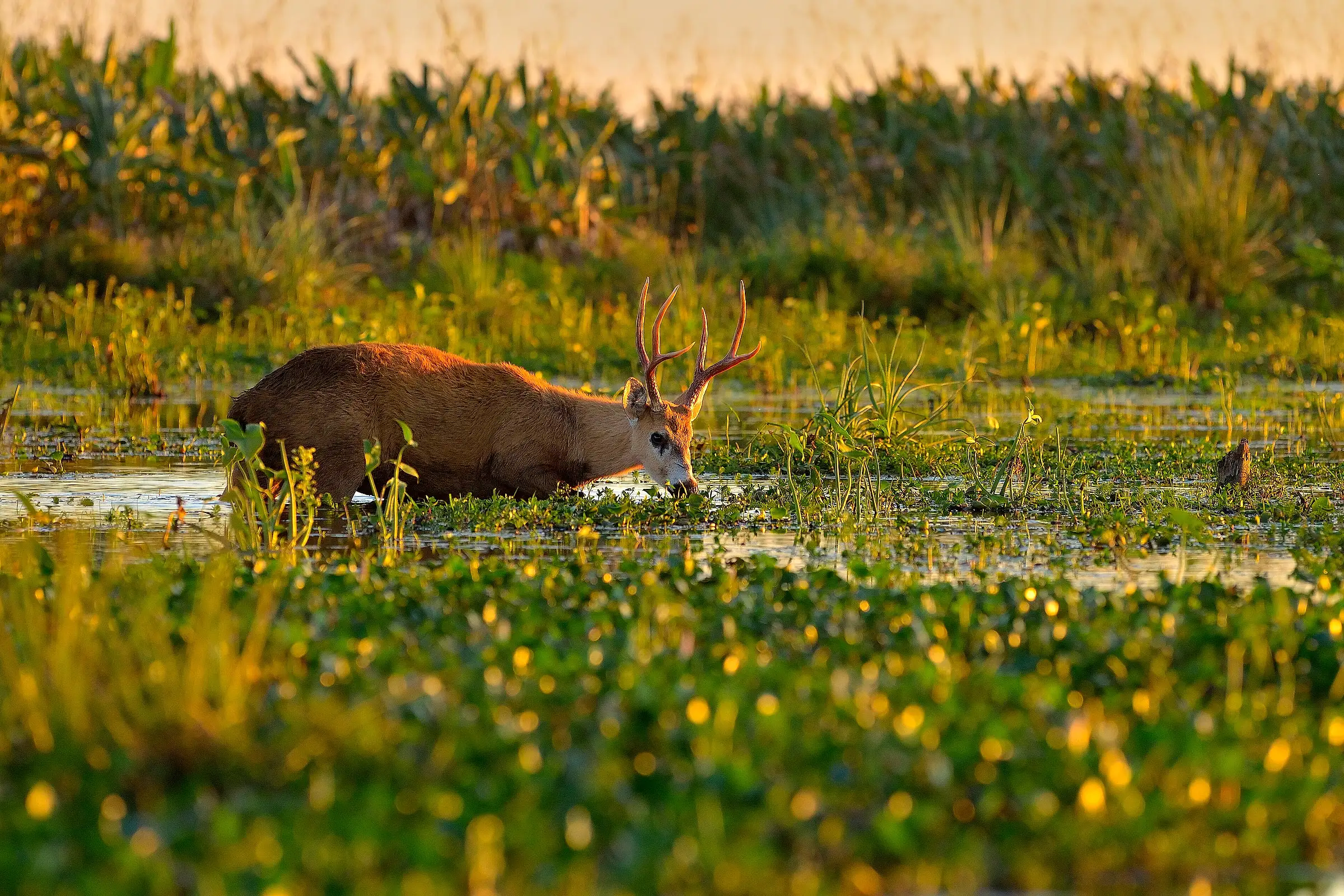
A marsh deer feeding in the Esteros del Iberá, April 2016. Photo by Papa Pic, CC0, via Wikimedia Commons.

Iberá is the place for wildlife, and the least known of the eleven. Argentina’s parks service describes the Esteros del Iberá as one of the great freshwater wetlands of the planet, with more than 380 species of birds, and names the marsh deer, the pampas deer and the maned wolf among the animals that live there. The national park, in the province of Corrientes, protects more than 195,000 hectares of it.
It takes some reaching. You enter through one of several portals, and the parks service’s access page puts the Cambyretá portal near Ituzaingó, a town 85 km from Posadas airport, and the Laguna Iberá portal at the village of Colonia Carlos Pellegrini, 120 km from Mercedes, 80 of them on gravel and dirt. The same page warns that heavy rain makes the dirt roads difficult, and the parks service describes a humid subtropical climate with very hot, rainy summers. We plan two or three nights at a lodge, between April and October. Iberá fits best next to Iguazu, in the same corner of the country.
5. Mendoza
Mendoza is the wine province and the place to see the high Andes without climbing them. The Uco Valley, south of the city, has 28,000 hectares of vineyards according to the national portal, which also describes its climate as dry, with little rain, so the wineries work in any month. West of the city, Route 7 climbs 185 km to the Horcones entrance of Aconcagua Provincial Park, at 2,800 m, where you look up at the 6,962 m summit of the highest mountain in the Americas. The portal gives the park season as November to March.
We plan three nights, two of them at a winery in the Uco Valley. Mendoza is also a useful link between regions: it has direct flights to Bariloche, Salta and Córdoba as well as to Buenos Aires, so it can sit between the northwest and the lakes.
6. Buenos Aires
Almost every trip starts here, because international flights land at Ezeiza and most domestic flights leave from Aeroparque, in the city. Give it three nights: one to recover from the flight, one full day with a guide through the old centre, San Telmo and La Boca, and one for the neighbourhoods at your own pace or a day at an estancia out on the pampas, which our guide to the Argentina countryside describes. The city is at its best in spring and autumn, October and November or March and April, when it is warm enough to walk all day without the summer heat. Our guide to the things to do in Buenos Aires goes neighbourhood by neighbourhood.
The city is also the hub that joins the three places most first trips want. Our 10-day Buenos Aires, glaciers and Iguazu trip gives three nights to each: the city, El Calafate for the Perito Moreno glacier, and Puerto Iguazú for the falls, with one declared travel day between the ice and the falls.
7. Bariloche and the Lake District
Bariloche sits at 893 m inside Nahuel Huapi National Park, on the lake of the same name, and it is the gentlest part of Patagonia: forest, lakes, chocolate shops and short walks with long views. The national portal says the town is visited in winter and in summer, and gives the range: up to 33 °C in summer and down to −15 °C in winter. It suits families and travellers who want mountains without long hikes.
From December to March the lakes are the reason to come, and in winter Bariloche turns into a ski town. We plan three or four nights. North of the town, the Seven Lakes Road runs a little over 110 km to San Martín de los Andes past a chain of glacial lakes, which makes a good one-way drive. The boat crossing to Chile is in our guide to the things to do in Patagonia. Bariloche has direct flights to El Calafate, Mendoza and Córdoba as well as Buenos Aires, so the lakes connect north to the vineyards and south to the glaciers.
8. Península Valdés, for the whales
The peninsula on the Atlantic coast is where Argentina’s sea mammals come close to shore, and UNESCO listed Península Valdés in 1999. Southern right whales come into its bays from June to December, and Chubut’s tourism office counts six companies that take boats out to them from Puerto Pirámides. The national portal’s Valdés page adds elephant seals from September to November and a better chance of orcas from February to May.
The base is Puerto Madryn, 56 km from the peninsula, with flights to Puerto Madryn itself or to Trelew, 66 km away. We plan two or three nights. September to November is the time to see the most at once: the whales are still in the bays, the elephant seals are on the beaches, and the Magellanic penguins are back at Punta Tombo, 110 km from Trelew, where the colony stays from September to April. Trelew has direct flights to El Calafate and Ushuaia, so the coast can go straight on to the glaciers.
9. El Chaltén
El Chaltén is the walking village under Fitz Roy and Cerro Torre, in the northern part of Los Glaciares National Park, and the national portal calls it the capital of trekking. The trails start at the edge of the village, and the classic day walks go to Laguna de los Tres, below Fitz Roy, and to Laguna Torre. It is for travellers who want to walk most days. The nearest airport is El Calafate, and the village is reached by road from there.
We plan two or three nights, between November and March. The portal describes a summer with less rain and more wind, and from May to September the parks service makes poles and crampons compulsory on the park’s trails. How to fit the walks into a trip is in our Patagonia itinerary.
10. El Calafate and the Perito Moreno glacier
El Calafate is the town for the glaciers of Los Glaciares National Park, which UNESCO listed in 1981. The Perito Moreno glacier is 80 km away on Route 11, about an hour and a half by car, and boats on Lago Argentino reach the Upsala and Spegazzini glaciers on another day. It is the sight in the far south that asks least of you physically: the portal notes that the walkways in front of the ice are accessible to people with reduced mobility.
We plan three nights: the arrival, a day at the glacier and a day on the boats. The portal recommends September to March and says the glacier can be visited in any month. El Calafate has direct flights to Buenos Aires, Bariloche, Ushuaia, Trelew and Córdoba, but none to Iguazu. Across the border, Torres del Paine in Chile is a road journey away, and our Chile and Argentina tours join the two parks. For the season and the flights in, see the best time to visit Patagonia and how to get to Patagonia.
11. Ushuaia and Tierra del Fuego
Ushuaia is the southern end of the road: Route 3 reaches it 3,084 km from Buenos Aires, and the national portal calls the city the gateway to Antarctica. You come for the Beagle Channel, for the forest and coast of Tierra del Fuego National Park, and for the feeling of standing at the bottom of the continent. We plan two or three nights between November and March; in winter the Cerro Castor ski area opens above the town. It works as the last stop of a Patagonian trip, with direct flights from El Calafate and Trelew as well as Buenos Aires.
Two more for a second trip: Córdoba and Ischigualasto
Córdoba, in the middle of the country, is easy to overlook and easy to use. Its Jesuit Block and Estancias have been a UNESCO World Heritage Site since 2000, and the city is the other hub of the domestic network: Aerolíneas Argentinas flies direct from Córdoba to El Calafate, Bariloche, Iguazu, Salta, Mendoza and Ushuaia, among other cities. One or two nights there can replace a return to Buenos Aires between the north and the south.
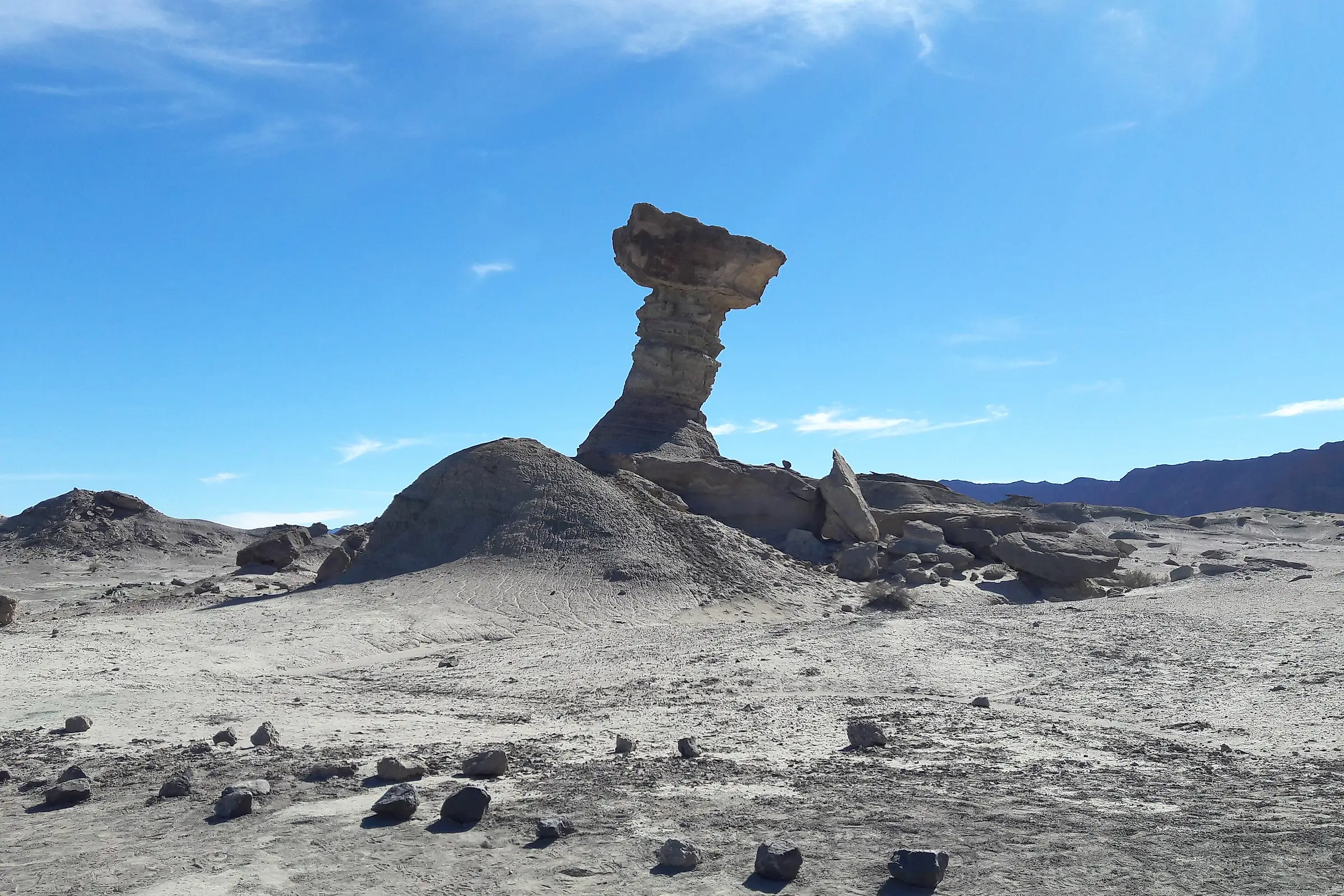
El Hongo, a rock shaped by wind and water in Ischigualasto Provincial Park, San Juan, July 2017. Photo by Candela Villani, CC BY-SA 4.0, via Wikimedia Commons.

Further west, between San Juan and La Rioja, Ischigualasto and Talampaya are two neighbouring desert parks that UNESCO listed together in 2000 for their fossils from the Triassic period. They are reached from the small towns of San Agustín del Valle Fértil and Villa Unión. The national portal’s Ischigualasto page says visits are allowed only with authorised vehicles and guides, and recommends March to June and September to November. Two nights, ideally as part of a road trip between Mendoza and Salta.
The top 5 Argentina tourist attractions
If you only have time for five, these are the ones we would choose. Three of them have the parks service’s own counts behind them: over the long weekend of November 2025, Iguazu, Los Glaciares and Nahuel Huapi were the three most visited national parks in the country.
- Iguazu Falls, for the 275 falls and the walkways above and below them.
- The Perito Moreno glacier, in Los Glaciares National Park near El Calafate.
- Buenos Aires, the city that every trip passes through.
- The lakes of Nahuel Huapi National Park, around Bariloche.
- The Quebrada de Humahuaca, our own pick for fifth place, for its colour and its villages.
Península Valdés and Ushuaia would be next. They miss the five only because they sit further from the route most travellers take.
Places to go in Argentina by season
The regions peak at different times, so the month you travel decides part of the list. If you want one answer to the best month of the year to visit Argentina, it is October or November, or March or April. Those are the windows when Buenos Aires, Iguazu, the northwest and Patagonia all work in the same trip, and our guide to the best time to visit Argentina sets out the weather data behind them. If the trip is mostly Patagonia, go between November and March.
| Months | Places to go in Argentina at their best |
|---|---|
| December to February | El Chaltén, El Calafate, Ushuaia and the lakes around Bariloche |
| March to May | Buenos Aires, Mendoza, Ischigualasto, and the northwest from April |
| June to August | Iguazu, Iberá, the first whales at Península Valdés and the snow at Bariloche |
| September to November | Península Valdés, Buenos Aires, Iguazu, Ischigualasto and El Calafate |
The summer list and the winter list barely overlap. The northwest has its rains from December to March, Iberá is very hot in summer, and the trails around El Chaltén need crampons from May to September, so a trip that wants the north and the far south usually settles on April or on the spring months.
How to combine them in one Argentina trip
Argentina is too big for one trip to hold all eleven places. These are the shapes we plan most:
| Trip length | What fits | What you leave out |
|---|---|---|
| 7 days | Buenos Aires plus Iguazu, or Buenos Aires plus El Calafate | The other half of the classic route |
| 10 days | Buenos Aires, El Calafate and Iguazu, three nights each | The northwest, Mendoza and the lakes |
| 14 days | The 10-day route plus El Chaltén, or plus Salta and Jujuy on the direct flight from Iguazu | Valdés, Ushuaia and Iberá |
| 21 days | The northwest and Patagonia in one trip, with Mendoza or Bariloche between them | Usually Iberá or Valdés |
Our Argentina itinerary sets out each of those lengths day by day, with the flight times. For the trips we run, see our Argentina tours. If the northwest, Mendoza, Iberá or Valdés is the trip you have in mind, tell us your dates and we will put a route together from scratch.
The questions we get on this
- What is the most beautiful part of Argentina?
- For mountains and ice, southern Patagonia, where Los Glaciares National Park holds the Perito Moreno glacier near El Calafate and the Fitz Roy range above El Chaltén. For colour, the northwest, where the Quebrada de Humahuaca and the road from Salta to Cafayate cross striped and red rock. The two are at opposite ends of a country 3,694 km long, so most travellers pick one.
- What are the top 5 tourist attractions in Argentina?
- Iguazu Falls, the Perito Moreno glacier, Buenos Aires, the lakes around Bariloche and the Quebrada de Humahuaca. Iguazu, Los Glaciares and Nahuel Huapi were the three most visited national parks over the long weekend of November 2025, according to the parks service, and Iguazu alone received 1.5 million visitors in 2025, a record for the park.
- What is the best month of the year to visit Argentina?
- October or November, and March or April, are the months when Buenos Aires, Iguazu, the northwest and Patagonia all work in the same trip. If the trip is mostly Patagonia, go between November and March. If it is mostly the northwest, go between April and June, after the summer rains.