Argentina · Travel guide
Things to Do in Buenos Aires: 21 Picks by Neighbourhood
Things to do in Buenos Aires by neighbourhood: the Teatro Colón, Recoleta, the San Telmo Sunday fair, La Boca, tango and the river reserve.
This is the reasoning we use when we date a trip, not an article written to fill a blog. The Argentina itineraries it feeds are here.

The things to do in Buenos Aires that justify the trip fit into two or three days: the Teatro Colón, the Recoleta Cemetery, San Telmo’s Sunday fair, Caminito in La Boca, and a night of tango. Most of the 21 picks below come from the city’s own list of must-see attractions, grouped by neighbourhood so that each group fills a morning or an afternoon. Every opening time and price quoted here was read on the official source on 1 October 2026; for privately run places we name the place and leave the hours to them, because those change without notice.
Plaza de Mayo and Monserrat: where the country began
The historic centre is one square and the streets off it, and it is the place to start.
1. The Casa Rosada. The pink palace on the Plaza de Mayo is the seat of the national government. The city’s tourism board, in its guide to Buenos Aires for free, says free guided tours in English run on Saturdays, Sundays and public holidays at 2.30pm, booked in advance, and that the Casa Rosada Museum behind it is free, Wednesday to Sunday and on holidays, from 10am to 6pm.
2. The Cabildo. The colonial town hall, first built in 1580 and rebuilt in the 18th century, witnessed the May Revolution of 1810 and now houses its museum. The city’s page on the Cabildo gives its hours as 10.30am to 5pm on Tuesdays, Wednesdays and Fridays, to 8pm on Thursdays, and to 6pm at weekends and on holidays. Entry is free, as at many museums run by the national government.
3. The Metropolitan Cathedral. Across the square, where Pope Francis said mass as Archbishop of Buenos Aires. Inside are the mausoleum of General San Martín, guarded by grenadiers, and a small museum of the Pope’s personal objects.
4. Café Tortoni. The city’s list of must-see attractions calls it the oldest café in Buenos Aires. It is a private business, so check its own hours before you go.
5. Palacio Barolo. On Avenida de Mayo, an office building inspired by Dante’s Divine Comedy. Opened in 1923, it was the tallest building in South America until 1935, and a private operator runs guided tours up to the lighthouse at the top.
The Teatro Colón and the Obelisco
6. A tour of the Teatro Colón. If you do one thing indoors, make it this. The theatre opened in 1908 and is counted among the great opera houses of the world. The theatre’s own tour page lists guided visits every day from 10am to 4.45pm, 50 minutes long, through the foyer, the gallery of busts, the Golden Hall and the main hall. Tours in English leave at 11am, 12pm, 1pm and 3pm, and the general ticket is 34,000 Argentine pesos. Better still, if your dates allow, is a performance: the season is on the same site.
7. The Obelisco. The city’s landmark, built for the fourth centenary of its first foundation. It is a photograph rather than a visit, and you will pass it anyway.
San Telmo: Sunday is the day
8. The Sunday fair in Plaza Dorrego. On Sundays, San Telmo’s square and Calle Defensa fill with the antiques and crafts fair. The city’s page on Plaza Dorrego counts some 250 to 300 stalls, from soda siphons and vinyl records to furniture from the old mansions, with tango and street music around them. If your days in Buenos Aires include a Sunday, give it to San Telmo.
9. The comic-strip trail. At the corner of Defensa and Chile, a bench holds a statue of Mafalda, one of Argentina’s best-loved comic characters. It is the start of the Paseo de la Historieta, a trail of statues of comic characters that ends at the Humour Museum in Puerto Madero.
La Boca: Caminito and the Bombonera
10. Caminito. The painted street of wood and corrugated-metal houses. According to the city’s page on Caminito, the street was abandoned until the 1950s, when neighbours and the painter Benito Quinquela Martín began to use the old tenements as a canvas. The city’s free-activities guide puts the craft fair there every day from 11am, to 6pm in winter and 8pm in summer.
11. La Bombonera. Boca Juniors’ stadium, inaugurated on 25 May 1940, is a few streets from Caminito, with the club’s museum. Watching a match there is a different thing from a visit, and the city’s page calls the atmosphere among the most intense in the world.
12. The Usina del Arte. A former power station in La Boca, now a cultural centre that, like the CCK in the old central post office, holds free concerts, shows and exhibitions.
We would see La Boca in daylight and with company, and that is how our 10-day Buenos Aires, glaciers and Iguazu trip does it: a full private day with a guide through Recoleta, Plaza de Mayo, San Telmo and La Boca, before the flight south to the glaciers.
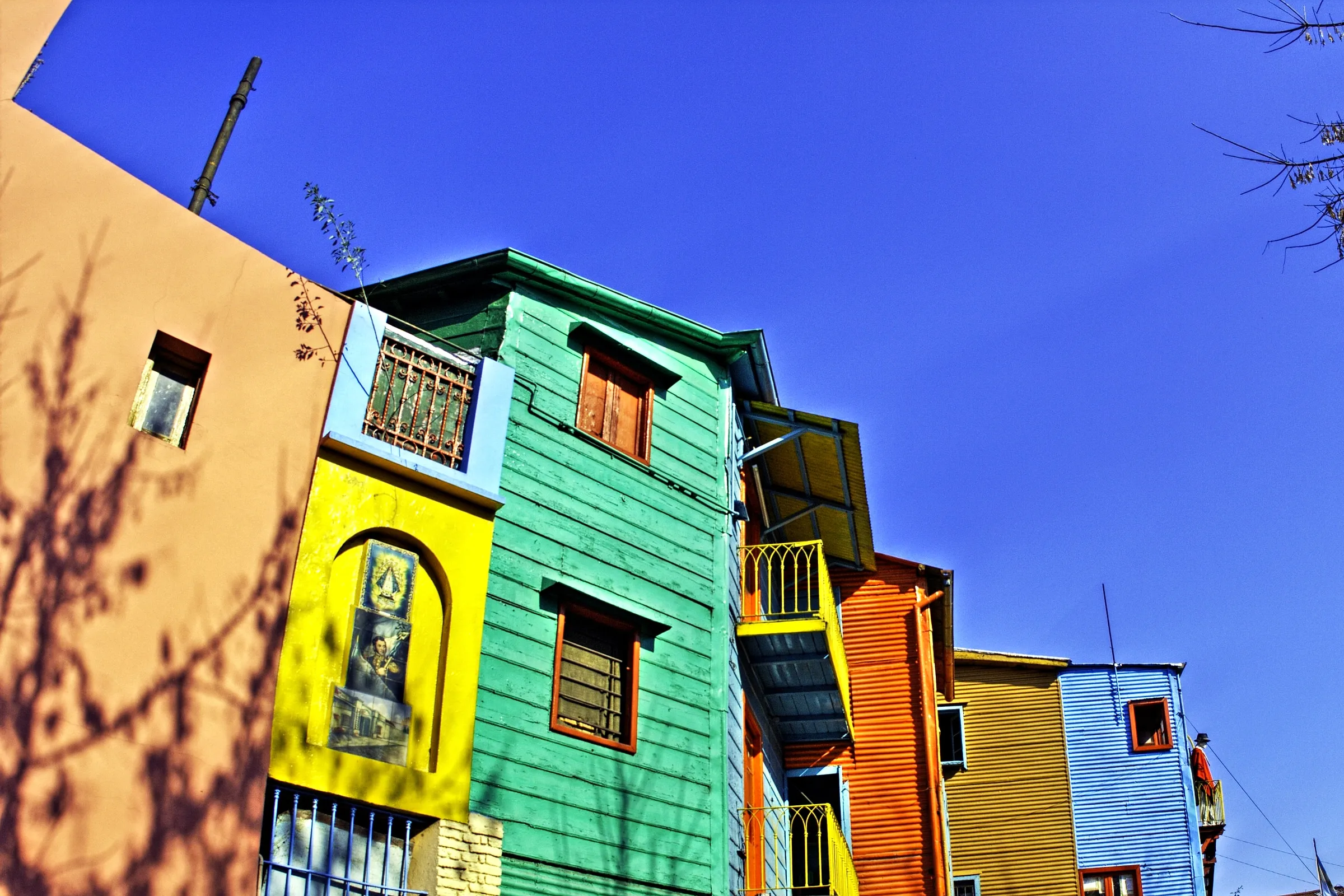
The houses of Caminito, in La Boca, in July 2008. Photo by Luis Argerich, cropped, CC BY 2.0, via Wikimedia Commons.

Recoleta: the cemetery and the museums
13. Recoleta Cemetery. The city’s first public cemetery, opened in 1822, holds more than 6,400 statues, sarcophagi and crypts, and more than 90 of its tombs are national historic monuments, according to the city’s page on the cemetery. Eva Perón is here, in the Duarte family vault. It is open every day from 8am to 6pm, with free guided tours in Spanish at 11am and 2pm from Tuesday to Friday, and at 11am and 3pm at weekends and on holidays.
14. The Museo Nacional de Bellas Artes. Also in Recoleta, the national fine arts museum holds the largest collection of Argentine art. Its own site gives the hours: closed on Mondays, 11am to 7.30pm Tuesday to Friday, and 10am to 7.30pm at weekends.
15. Floralis Genérica. A 20-metre steel and aluminium flower in the Plaza de las Naciones Unidas, given to the city by the architect Eduardo Catalano in 2002. Its petals open at 8am and close at midnight, and stay closed in high winds.
16. El Ateneo Grand Splendid. A theatre of 1919 turned into a bookshop in 2000, with its painted dome preserved and about 120,000 books, a short taxi ride up Avenida Santa Fe. It is a shop, so its hours are its own.
Palermo: the parks
17. The Palermo rose garden. In the Parque Tres de Febrero, the city’s rose garden, finished in 1914, has more than 18,000 roses around a lake, with a poets’ garden of 26 busts. Our hotels in Buenos Aires are in Palermo or Recoleta, so it is the easy morning before a late lunch.
Puerto Madero and the river
18. The Puente de la Mujer. The rotating footbridge in Puerto Madero, the first work in Latin America by the Valencian architect Santiago Calatrava, drawn as a couple dancing tango.
19. The Costanera Sur Ecological Reserve. Behind the towers of Puerto Madero is the city’s largest green space: 350 hectares of lagoons and pampas grass by the Río de la Plata, where up to 340 species of birds have been recorded, according to the city’s page on the reserve. You can walk around it in about an hour.
Tango, and the city on a Sunday
20. A milonga, or a show. The city’s tourism board, in its guide to tango, separates the two: the stage show, often with dinner and an orchestra, and the milonga, the social dance where locals go night after night. Many milongas give a class before the dancing starts, which is the way in for a visitor. And every August the city hosts its International Tango Festival and World Cup, with free shows, classes and milongas.
21. The Feria de Mataderos. Half an hour from the centre, a Sunday fair of gaucho crafts, folk music and regional food such as locro and empanadas, with up to 700 stands. The city’s page gives it as Sundays and public holidays from 11am to 8pm, from April to December; its free-activities guide says March. Check before you go in March.
What to do in Buenos Aires in two or three days
What to do in Buenos Aires depends on how long you have, and this is our view of how the 21 fit:
| Days | What fits |
|---|---|
| 1 | Plaza de Mayo and the Cabildo, the Teatro Colón tour, Recoleta Cemetery |
| 2 | Day one, plus San Telmo and La Boca, and tango at night |
| 3 | Both, plus Palermo and the river reserve, or a day out of the city on an estancia |
Two things decide the order. Sunday belongs to San Telmo, for the fair, or to Mataderos. And the Teatro Colón tours stop at 4.45pm and the cemetery closes at 6pm, so the indoor sights go first and the walking neighbourhoods later.
If Buenos Aires is the last stop of a Patagonia trip, it gets fewer days: the 10- and 13-day versions of our Chile and Argentina Patagonia tours end with two nights here and one guided day. For how the city fits into a longer Argentina trip, including why you should not land and fly south on the same day, see our Argentina itinerary, and for the city’s seasons, the best time to visit Argentina.
Asked before booking
The questions we get on this
- What is Buenos Aires known for?
- Tango above all: the tourism board of the city describes it as a music and dance born in the working-class immigrant neighbourhoods of Buenos Aires in the mid-19th century. Then the Teatro Colón, an opera house opened in 1908; its historic cafés; and football, with Boca Juniors' Bombonera stadium in La Boca.
- Can you visit the Casa Rosada?
- Yes. According to the tourism board of the city, free guided tours in English run on Saturdays, Sundays and public holidays at 2.30pm and must be booked in advance. The Casa Rosada Museum behind the palace is free and opens Wednesday to Sunday and on public holidays, 10am to 6pm.
- Is Recoleta Cemetery open on Sunday?
- Yes, every day from 8am to 6pm, according to the tourism board of the city. On Saturdays, Sundays and public holidays it runs free guided tours in Spanish at 11am and 3pm; on weekdays they are at 11am and 2pm, Tuesday to Friday. Pick up a map at the entrance.
- Is La Boca worth visiting?
- For a first visit, yes, and in daylight. Caminito, the painted street of corrugated-iron houses, has a craft fair every day from 11am, the Bombonera stadium is a few streets away, and the Usina del Arte, a former power station, holds free concerts. We give it half a day.
- What can you do in Buenos Aires in August?
- Tango. Every August the city hosts its International Tango Festival and World Cup, with free shows, classes, milongas and the dance contest, according to the city's tourism board. August is winter in Buenos Aires, so it is also the month for the Teatro Colón, the museums and the cafés.
- What should you do in Buenos Aires in 2 days?
- Day one: Plaza de Mayo, the Cabildo and the cathedral in the morning, the Teatro Colón tour after lunch, Recoleta Cemetery before it closes at 6pm. Day two: San Telmo, ideally on a Sunday for the fair in Plaza Dorrego, then Caminito in La Boca, and a milonga or a tango show at night.