Argentina · Travel guide
Iguazu Falls Brazil Side or Argentina Side, or Both?

Iguazu Falls Brazil side or Argentina side: the panorama or the walkways, the visa that decides it, and how many days to give the falls.
This is the reasoning we use when we date a trip, not an article written to fill a blog. The Argentina itineraries it feeds are here.

The Iguazu Falls Brazil side is the panorama: one short trail, about two hours, with a wide view of the falls from the opposite bank. The Argentine side is the inside view, two walkway circuits over and under the water that, in our experience, take most of a day. If you have two days, do both, Argentina first and sleeping in Puerto Iguazú. If you hold a US, Canadian or Australian passport, the Brazilian half needs an e-visa before you travel, and that, more than the view, is what usually decides it. One more thing changes the answer this season: the Argentine walkway to the Devil’s Throat has been closed since early August 2026, when the concession began dismantling it on 3 August, with no reopening date.
Brazil side or Argentina side: the two halves side by side
The river is the border. Argentina has the walkways that run over and beneath the falls; Brazil has the opposite bank and the panoramic view. Here is what each park offers, from the two park operators’ own pages, read on 1 October 2026.
| Argentine side | Brazilian side | |
|---|---|---|
| Base town | Puerto Iguazú, 18 km away | Foz do Iguaçu |
| Opening hours | 08:00 to 18:00 daily, last entry 16:00 | Weekdays 09:00 to 16:00, weekends from 08:30; you can stay until 17:30 |
| Walking | Upper circuit 1,850 m, no stairs; lower circuit 1,750 m, with stairs; Macuco trail 7 km | One trail, about 1 to 1.5 km, with a lift |
| Time it takes | Most of a day | About two hours for the classic visit |
| Devil’s Throat | Walkway closed since early August 2026 | Seen from the walkway at the end of the trail |
| Tickets | 60,000 pesos (the general fare, which foreign visitors pay) | Online only, for a set day and time |
| Border | None for most visitors | An international bridge, and a visa for some passports |
The short version: Argentina is where you spend the day, Brazil is where you see the whole thing at once. Neither replaces the other, which is why the answer for most people is both.
Iguazu Falls Argentina side: three circuits and a train
On the Argentinian side, Iguazu Falls are something you walk over and then under. Argentina’s national parks service, which runs the Iguazú National Park, describes a park created in 1934 that protects more than 67,000 hectares of Paraná forest and has been a UNESCO World Heritage Site since 1984. Its list of activities gives the measurements that shape your day:
- The Upper Circuit, 1,850 m one way, with no stairs, along the top of the falls. It is the walk that anyone can do.
- The Lower Circuit, 1,750 m, with stairs, close enough to the falls that you feel the spray.
- The Devil’s Throat circuit, a 1,100 m walkway across the upper river to the biggest drop, reached by the park’s train. Closed at the moment; more on that below.
- The Macuco trail, 7 km there and back, through the forest and away from the crowds.
The park’s hours page puts the gates open every day from 08:00 to 18:00, with entry until 16:00 and the last train to the Devil’s Throat at 15:30. The concession that runs the visitor area gives a slightly earlier cut-off for the circuits themselves, so arrive well before 16:00. In practice, an afternoon arrival gets you one circuit, not the park.
The park’s current fees, in force since 1 June 2026, are 60,000 Argentine pesos, the general fare that foreign visitors pay, 25,000 for Argentine residents and 8,000 for residents of Misiones. The ticket covers the train, the three circuits, the Macuco trail and the visitor centre. The boat that runs in under the falls, Gran Aventura, is not in that list: it is run by a separate operator and is only for people over 12.
The Devil’s Throat walkway is closed, and that changes the answer
This is the fact that most pages about the two sides have not caught up with. On 3 August 2026 the Argentine concession, Iguazú Argentina, began removing the floors and railings of the Devil’s Throat walkways, a job it said would take 40 days, because forecasts pointed to high river levels in September and October. It said then that there was no date set for reopening. On 1 October 2026 the circuit’s own page still read “closed”, and the concession had published no reopening notice since.
Everything else on the Argentine side is open: the upper and lower circuits, the Macuco and Verde trails and the visitor centre.
What it changes for you is the Brazilian side. The Brazilian park’s description of its trail ends at the walkway with a view of the Devil’s Throat. While the Argentine walkway is shut, the Brazilian walkway is, in our reading, the way to stand in front of the biggest drop; from the end of Argentina’s lower circuit you see it at a distance, as in the photograph below. We check where the closure stands for every booking on our 10-day Buenos Aires, glaciers and Iguazu route, which gives the falls three nights, and tell you before you fly.
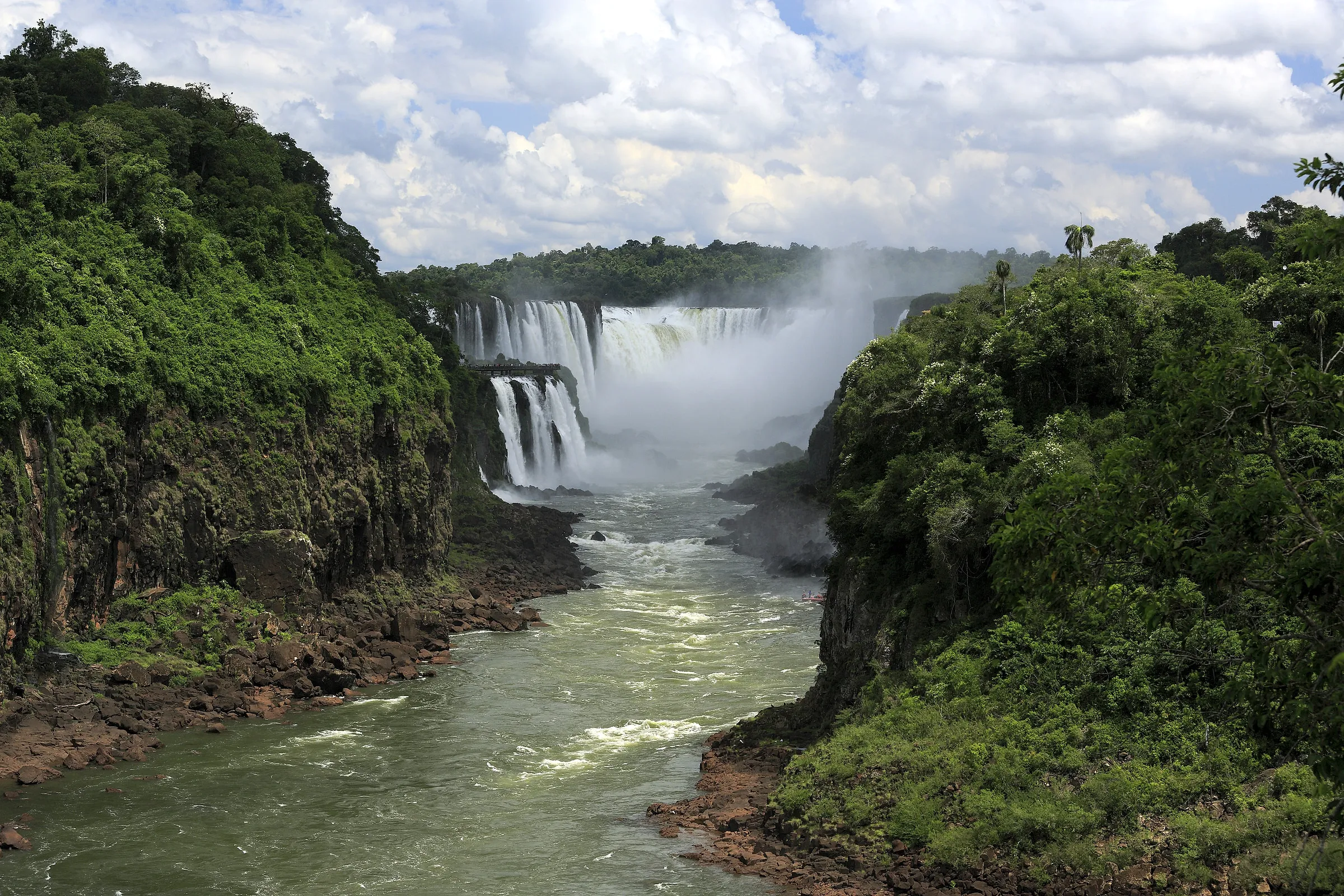
The Devil’s Throat from the easternmost viewpoint of the Argentine lower circuit, in January 2020. The walkway on the ledge at the left is the Brazilian one; the forested bank on the right is San Martín island. Photo by Falk2, CC BY-SA 4.0, via Wikimedia Commons.

The Brazilian side: one trail and the whole panorama
The Brazilian bank is the Iguaçu National Park, run by Brazil’s federal conservation agency, ICMBio, with visits managed by a concession, Urbia Cataratas. According to its description of the park, it protects about 185,000 hectares of Atlantic forest in the state of Paraná. It was created on 10 January 1939 and became a UNESCO World Heritage Site in 1986. The visitor centre is on the BR-469 road at kilometre 18, outside Foz do Iguaçu.
The visit is simple, and that is its point. Private cars cannot drive in: a park bus covers about 12 km there and back between the visitor centre and the start of the trail, and the trail itself is short. The concession calls it 1 km of walking on its general information page and about a kilometre and a half on its home page, with lifts, the walkway and the main viewpoints included. It puts the classic visit at about two hours.
Hours are shorter than in Argentina: 09:00 to 16:00 on weekdays, 08:30 to 16:00 at weekends, and once inside you can stay until 17:30. The ticket reserves an entry time, not an exit time.
Iguazu Falls Brazil tickets: online only, for a day and a time
Iguazu Falls Brazil tickets are not sold at the gate. The concession’s ticket page says they are limited and sold exclusively online, with a booked day and time. Three things are worth knowing before you buy:
- There are price categories by nationality. Brazilian and Mercosur citizens (Argentina, Paraguay, Uruguay and Venezuela) pay 10% less than the full fare, which is what other foreign visitors pay.
- Children up to 6 enter free; from 7 they pay the full fare. There is no half-price ticket, as the concession’s discounts page explains.
- A two- or three-day pass exists, which the concession says saves up to 50%, with dates you can change twice.
We do not quote the price here. The concession publishes it only inside its booking system, which we could not read in a form we can cite, and a number we cannot source is a number we do not print. When we build the day into your trip, we book the slot and show you the fare.
Crossing to Brazil from Puerto Iguazú
The two towns are joined by the Tancredo Neves bridge. Argentina’s migration service lists the Iguazú border centre on the bridge as open 24 hours, and recommends checking the destination country’s hours too. Crossing it means leaving Argentina and entering Brazil, even for an afternoon, and doing the same in reverse on the way back.
That makes your passport the first question, not the view. Brazil’s foreign ministry publishes a table of entry visas, last updated on 26 August 2026. For a tourist visit it lists:
| Passport | Brazil’s rule for a visit |
|---|---|
| United States | Visa required |
| Canada | Visa required |
| Australia | Visa required |
| United Kingdom | No visa, up to 90 days |
| Ireland | No visa, up to 90 days |
| New Zealand | No visa, up to 90 days |
For the three that need one, there is an e-visa. Brazil’s consulate in Miami explains that it has been required since 10 April 2025, is applied for on the official VFS portal, and carries a fee of US$80.90. The page says it arrives “in a few days” if the requirements are met; we would not leave it to the last week.
Any other passport: check the same table before you plan the day. Rules like these change, and the table carries its own date for that reason.
How many days, and which side first
This is our opinion, built from the hours above. Give the falls two full days from Puerto Iguazú.
- Day one, the Argentine side, from opening. It opens an hour before the Brazilian park on weekdays and needs the whole day: the upper circuit, the lower circuit, the Macuco trail, and the Devil’s Throat if it has reopened.
- Day two, the Brazilian side in the morning, then the boat under the falls or a slow afternoon. If you cannot or do not want to cross, day two becomes the boat and the parts of Argentina you missed.
One day for both is possible on paper and poor in practice: two border crossings and two parks, each cut short. Three nights is the comfortable version, because the night you arrive is rarely any use. That is how our 10-day Buenos Aires, glaciers and Iguazu route is built: three nights at the falls, the Argentine side from the inside on the first full day, and the Brazilian side as a swap for the boat day, settled by your passport when you book rather than at the bridge.
Where to sleep follows from the order. Puerto Iguazú is 18 km from the Argentine park, the side that needs the long day, and sleeping in Argentina keeps the Brazilian half as a single crossing you can drop without unpicking the trip.
Buenos Aires to Iguazu Falls
Almost everyone arrives by air. Aerolíneas Argentinas flies Buenos Aires to Iguazu nonstop in under two hours, and from Iguazu it flies direct to Buenos Aires, Córdoba, Salta and Rosario only. Two consequences follow:
- Aerolíneas Argentinas has no direct flight between Iguazu and the glaciers. If your trip pairs El Calafate with the falls, one day of it goes through Buenos Aires, and it is a whole day. Our Argentina itinerary guide lays out what fits around it in one, two and three weeks.
- Buenos Aires has two airports, and they are not connected airside. If you land at Ezeiza from abroad and your Iguazu flight leaves from Aeroparque, plan the cross-city transfer as its own half-day.
The airport on the Argentine side is the Cataratas del Iguazú international airport. From the town, the park is 18 km by road. Puerto Iguazú’s bus terminal takes services from across the country, so the bus from Buenos Aires exists, but we have no official journey time to give you and would not plan a short trip around it.
If Iguazu is part of a wider Argentina trip, the regional seasons are in our best time to visit Argentina guide.
Asked before booking
The questions we get on this
- Is the Brazilian side of Iguazu Falls worth it?
- Yes, if your passport lets you cross easily. It is the panorama: one trail of about a kilometre to a kilometre and a half, about two hours in all by the concession's own estimate, with a wide view of the falls, and it ends on a walkway with a view of the Devil's Throat. While the Argentine Devil's Throat walkway stays closed, that view matters more than usual.
- Which side of Iguazu Falls is better, Argentina or Brazil?
- They are not rivals; they are two halves. The Argentine side has the walkways over and under the falls, a 1,850 m upper circuit and a 1,750 m lower one, and needs most of a day. The Brazilian side is a short trail with the wide view across the river. If you only have one day, our view is Argentina; with two, do both.
- Do you need a visa to visit the Brazilian side of Iguazu Falls?
- It depends on your passport. The foreign ministry of Brazil lists the United States, Canada and Australia as visa required, and has since 10 April 2025; the e-visa is applied for online and costs US$80.90. British, Irish and New Zealand passports are exempt for up to 90 days. A day trip from Puerto Iguazu is still an entry into Brazil.
- Can you see the Argentina and Brazil sides of Iguazu Falls in one day?
- On paper, yes: the Argentine park opens at 08:00 and the Brazilian one at 09:00 on weekdays. In practice you would cross an international bridge twice and rush both. The Argentine side alone needs most of a day, so we give the falls two full days from Puerto Iguazu.
- Is Iguazu Falls in Brazil or Argentina?
- Both. The falls sit on the Iguazu River between the Brazilian city of Foz do Iguaçu, in the state of Paraná, and the Argentine town of Puerto Iguazú, in Misiones. Each country protects its bank as a national park: Argentina's, created in 1934, and Brazil's, created in 1939.
- Is it better to stay on the Argentina or the Brazil side of Iguazu?
- For most travellers, Argentina. Sleeping in Puerto Iguazu puts you 18 km from the Argentine park, the side that needs the full day, and keeps the Brazilian half as a single crossing you can drop if your passport needs a visa you did not get in time.