Peru · Travel guide
13 Best Places to Visit in Peru, in Route Order (2026)

The best places to visit in Peru in the order a good route meets them, from Lima and the Sacred Valley to Titicaca, Colca and the Nazca Lines.
This is the reasoning we use when we date a trip, not an article written to fill a blog. The Peru itineraries it feeds are here.

The best places to visit in Peru are spread over three very different regions: the coast, the Andes and the Amazon. For most first trips the core is the southern Andes, with the Sacred Valley, Machu Picchu and Cusco, and the question is what you add to it: Lake Titicaca, the Colca Canyon and Arequipa to the south, the desert coast on the way back to Lima, or the rainforest at Tambopata.
The order matters as much as the list. Cusco sits at 3,399 m and its airport takes you there straight from sea level, while the Sacred Valley and Machu Picchu are lower. So we list these places to visit in Peru in the order a good route meets them, starting in Lima, going down into the valley before the city, and coming back to the coast at the end. Distances, altitudes and dates come from Peru’s national tourism inventory, UNESCO and the park service, linked where we use them.
The 13 places at a glance
| Place | Region | How you get there | Days we give it |
|---|---|---|---|
| Lima | Coast | You land here | 1 to 2 |
| Sacred Valley | Andes | Flight to Cusco, then down into the valley | 2 |
| Machu Picchu | Andes | Train from the Sacred Valley | 1 |
| Cusco | Andes | Road from the valley | 2 to 3 |
| Lake Titicaca | Andes | Road or train from Cusco to Puno | 2 |
| Colca Canyon | Andes | Road from Puno or Arequipa | 2 |
| Arequipa | Andes | 151 km by road from the Colca | 2 |
| Nazca Lines | Coast | Road or flight, then a light aircraft | 1 |
| Huacachina | Coast | 5 km from Ica | 1 |
| Paracas | Coast | 259 km by road from Lima | 1 to 2 |
| Tambopata | Amazon | Flight to Puerto Maldonado | 3 |
| Huaraz | Andes | Road from Lima | 3 |
| Chan Chan and the north | Coast | Flight to Trujillo | 2 |
1. Lima, the food city on the coast
Lima is where almost every trip starts, and it is worth more than the night between two flights. The Historic Centre of Lima has been a UNESCO World Heritage Site since 1988. In Miraflores, between the apartment blocks, stands Huaca Pucllana, an adobe ceremonial centre built by the Lima culture between about 400 and 700 AD. And in Pueblo Libre, the Larco Museum lets you walk between shelves holding 30,000 catalogued pieces of ancient pottery.
Lima is a food city, not a beach city. Between June and September it sits under grey cloud, and in the whole of August it records about 28 hours of sunshine; the station data are in our guide to the best time to visit Peru. Two days are enough, and our guide to the things to do in Lima puts them in order, with the fees and closing days.
2. The Sacred Valley, before Cusco
We send travellers from Cusco airport straight down into the valley, without stopping in the city. Ollantaytambo is an Inca town built under Pachacútec, still lived in, at 2,851 m. Up the valley, Pisac has its market in the town at 2,950 m and its ruins on the hill above at about 3,300 m. On the plateau between them are Moray, three huge circular depressions of terraces, and the salt pans of Maras, which have been worked since before the Incas.
The reason to start here is the altitude. The valley is several hundred metres lower than Cusco, and the US CDC’s guidance is that two to three nights at 2,450 to 2,750 m before going higher is “markedly protective”. Two nights are what we plan. The heights of every stop are in our South America altitude guide.
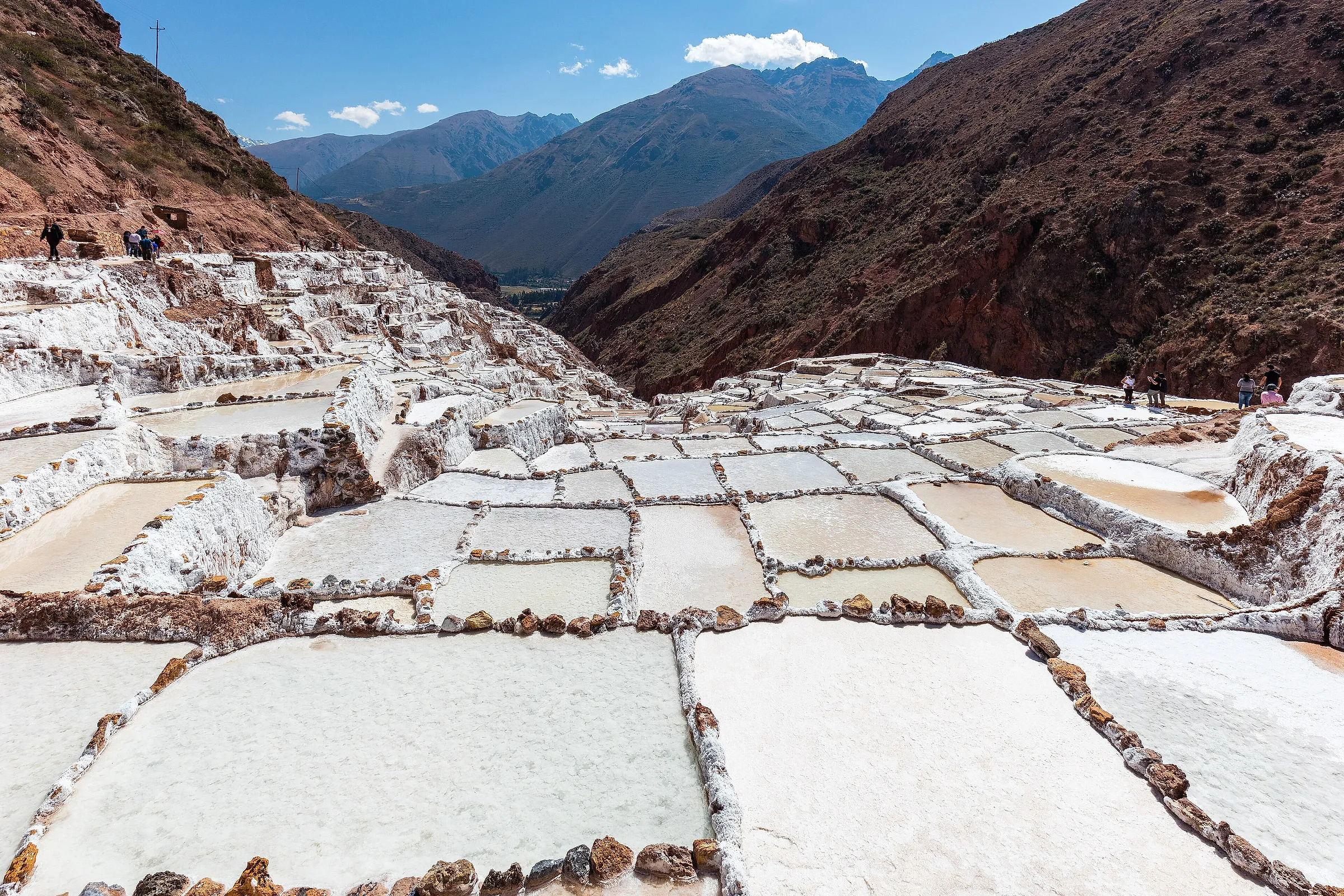
The salt pans of Maras in the dry season. Photo by Diego Delso, CC BY-SA 4.0, via Wikimedia Commons.
3. Machu Picchu
Machu Picchu is lower than most people expect: UNESCO puts the citadel at 2,430 m, almost 1,000 m below Cusco, and lists the Historic Sanctuary as a mixed cultural and natural site since 1983. The train from Ollantaytambo puts it at the natural end of the valley. That makes it the low day of the Andean leg, which is why we place it here and not at the end.
The constraint is not the altitude, it is the ticket. The daily cap is 4,500 for most of the year and 5,600 from 19 June to 2 November 2026. Our guide to the best time to visit Machu Picchu has the caps and the rain at the site month by month, and how to get to Machu Picchu compares the train, the road and the trails. Most of our travellers do this whole stretch, valley, citadel and city, on our Machu Picchu tour packages, of eight days from Lima or eleven with the Amazon.
4. Cusco
By the time you reach Cusco you have had two or three nights to get used to the height, and it shows. The City of Cuzco has been on the UNESCO list since 1983: the Spaniards kept the plan of the Inca city and built Baroque churches and palaces over its ruins. The city sits at 3,399 m according to PromPerú. Two or three days let you see the cathedral, Qorikancha and the four ruins above the city without rushing.
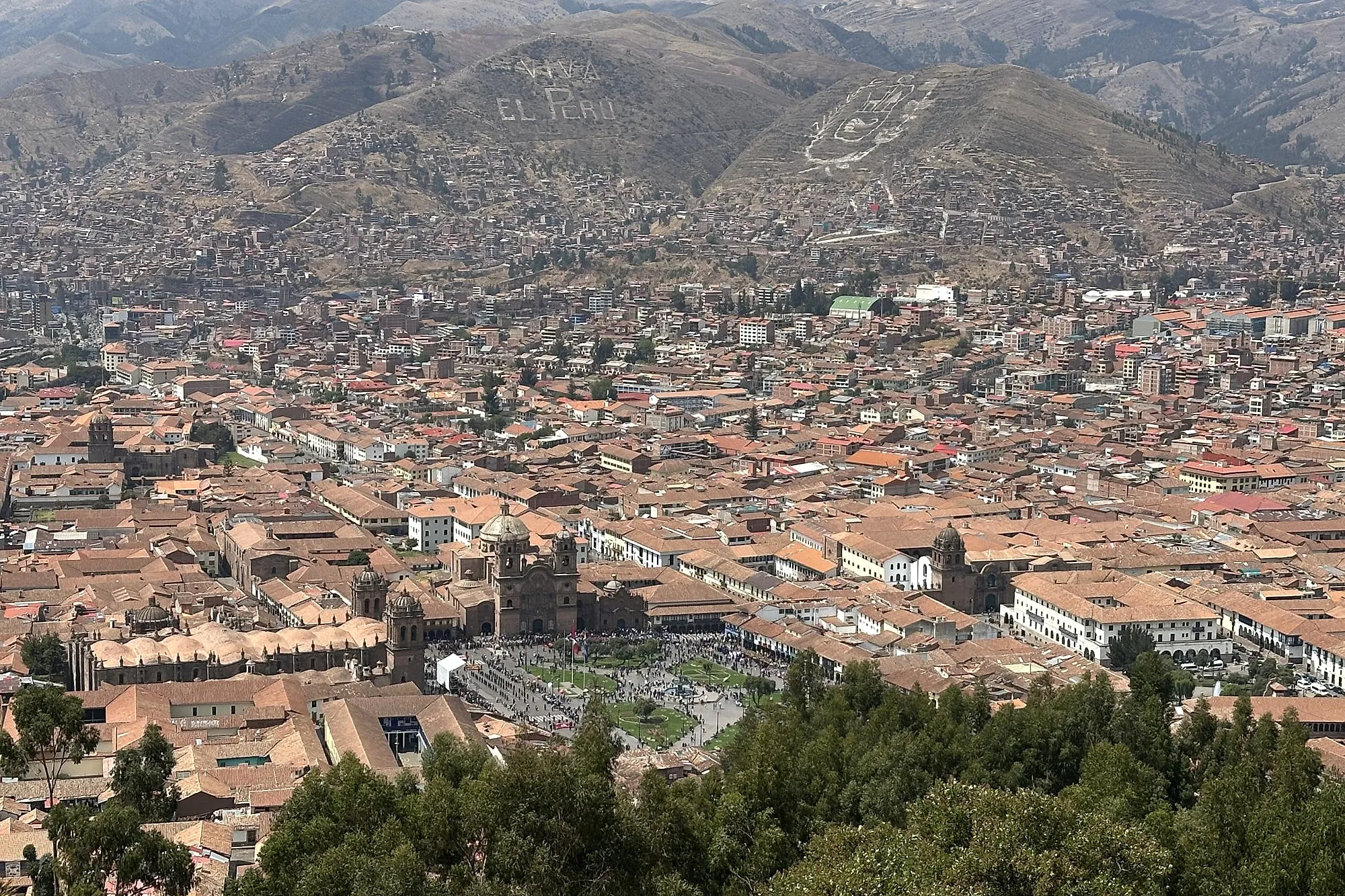
Cusco’s Plaza de Armas from the hills above the city. Photo by Simon P. Toaquiza.
5. Lake Titicaca
From Cusco the road and the train go south to Puno, on a lake whose surface lies at 3,810 m. Just off Puno are the Uros islands, built from totora reed and anchored with eucalyptus poles. Further out, Taquile is known for a textile tradition that UNESCO lists as intangible cultural heritage. Two days is the minimum, and the lake is also the border crossing if the trip continues into Bolivia, which our Peru and Bolivia guide covers. Whether to stop at the reed islands or spend a night on Amantaní is in our guide to the Uros floating islands.
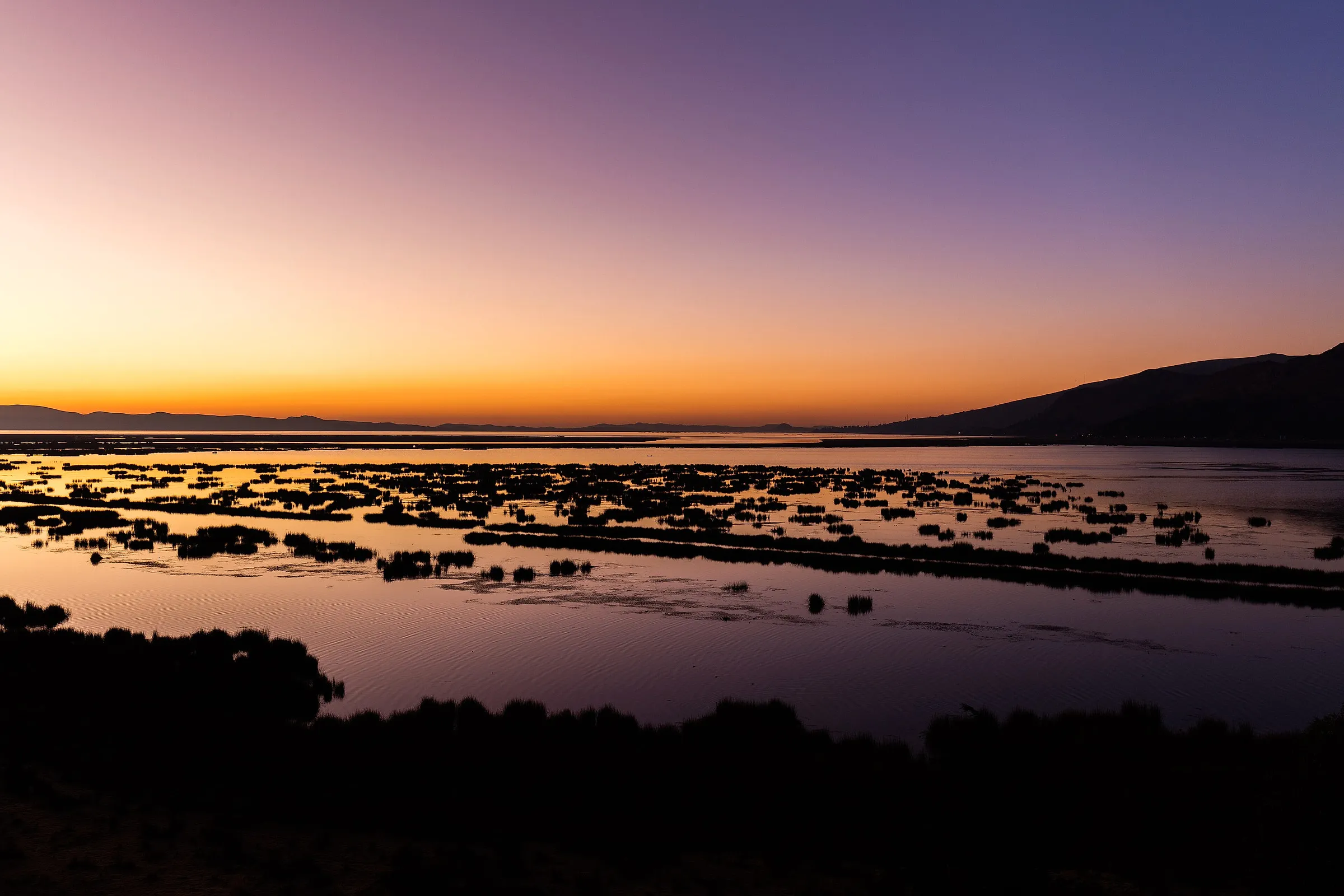
Sunrise on Lake Titicaca near Puno, Peru. Photo by Diego Delso, CC BY-SA 4.0, via Wikimedia Commons.
6. The Colca Canyon
Between Puno and Arequipa, the Colca is where most people see the Andean condor. The viewpoint is Cruz del Cóndor, at 3,780 m, above a drop of more than a thousand metres to the river. The village of Chivay, the usual base, is 151 km from Arequipa, about three hours by road. We give it two days and one night, so that you are at the viewpoint early in the morning.
7. Arequipa
Arequipa is lower than the Colca and gentler than Cusco, which makes it a good place to come down to after the high part of the route. Its historic centre, built mostly in white or pink volcanic stone called sillar, has been a UNESCO site since 2000, and the Santa Catalina Monastery, founded in 1579, is a walled town of lanes and cloisters inside the city. Two days.
8. The Nazca Lines
The Lines and Geoglyphs of Nasca and Palpa, inscribed by UNESCO in 1994, are best seen from the air. Light aircraft fly from the María Reiche aerodrome in Nazca, and the flight lasts about 55 minutes. If you would rather not fly, the Ministry of Culture has a viewing tower beside the Pan-American Highway that shows a few of the figures. One day, ideally combined with the next stop. Our guide to a trip to Nazca Lines country compares the flight and the viewpoints.
9. Huacachina
Huacachina is a small lagoon ringed by sand dunes, 5 km from the city of Ica. People come for the dunes, and sandboarding is the official activity listed for the site. One night is plenty, and it sits on the road between Nazca and Paracas.
10. Paracas and the Ballestas Islands
The last stop before Lima is the coast at Paracas, 259 km and about three and a half hours south of the capital by road according to the park service. The boat to the Ballestas Islands takes under two hours and passes colonies of South American sea lions, boobies and, at a point called Saltadero, the area’s main penguin colony. On land, the Paracas National Reserve, created in 1975, is desert running straight into the Pacific. For warm water, though, you have to go north: our guide to Peru beaches explains why.
11. Tambopata, the Amazon in the south
Peru’s Amazon is two different places. Iquitos, in the north, has no dry season: its driest month still brings 170 mm of rain, more than Cusco’s wettest, in the station normals our best time to visit Peru guide uses. Puerto Maldonado, in the south, has one from June to August, and it is close to Cusco: SKY puts the flight at about 50 minutes. From there boats go up river into the Tambopata National Reserve, created in 2000. Plan three nights at a lodge, because the first and the last are mostly travel. How Tambopata compares with Iquitos and Manu is in our guide to the Amazon rainforest in Peru.
12. Huaraz and the Cordillera Blanca
Huaraz, north of Lima, is the base for the Cordillera Blanca and Huascarán National Park, a UNESCO site since 1985. The day walk most people come for is Laguna 69, a turquoise lake at 4,604 m. That height is the reason Huaraz goes after the southern Andes in a trip, never before them. The multi-day treks of the range, such as the Santa Cruz, are a different kind of trip from the ones we plan. Our guide to Huaraz, Peru puts the day trips in order of altitude.
13. Chan Chan and the north
On the northern coast, 4.5 km from the centre of Trujillo, are the adobe walls of Chan Chan, the capital of the Chimú kingdom. UNESCO inscribed it in 1986 and has kept it on its List of World Heritage in Danger ever since, because its earthen architecture is fragile and exposed to extreme weather caused by El Niño.
Inland, in the cloud forest of Amazonas, Kuélap is a walled Chachapoya citadel at 3,000 m. Part of its wall collapsed in 2022; the southern wall circuit reopened in June 2026 and the site now takes 864 visitors a day. The north is a trip of its own, best added to a second visit to Peru.
How to combine them in one trip
Peru is big, and most of these places are a flight or a long road apart. These are the shapes we plan most:
| Trip length | What fits | What you leave out |
|---|---|---|
| 7 days | Lima, the Sacred Valley, Machu Picchu and Cusco | Everything outside the southern Andes |
| 10 days | The 7-day core plus Lake Titicaca, or plus Tambopata | The Colca, Arequipa and the coast |
| 14 days | Lima, the valley, Machu Picchu, Cusco, Titicaca, the Colca and Arequipa | The Amazon and the north |
| 18 days or more | The 14-day route plus the coast back to Lima, or plus Tambopata | Huaraz and the north |
If you are weighing up the risks, our guide to whether Peru is safe sets out the official travel advice of four governments. Our Peru itinerary guide sets out each of those lengths day by day, and the best time to visit Peru is not the same month for the Andes and the Amazon. For the trips we run, see our Peru tours.
Asked before booking
The questions we get on this
- What is the best part of Peru to visit?
- For a first trip, the southern Andes: the Sacred Valley, Machu Picchu and Cusco, which most travellers combine in five to seven days from Lima. Add Lake Titicaca if you have two more days. The rest of the country, from the Amazon to the northern coast, is for a second trip or a longer first one.
- What is the most beautiful part of Peru?
- It depends on the kind of landscape you want. For mountains and glacial lakes, the Cordillera Blanca above Huaraz. For terraces and Inca stonework in a green valley, the Sacred Valley and Machu Picchu. For a high lake with islands, Titicaca at 3,810 m. For desert and coast, Paracas and the oasis of Huacachina.
- What can you do instead of Machu Picchu?
- Visit it as well as other sites, rather than instead of it. In the Sacred Valley, Ollantaytambo and Pisac are Inca sites you can see without a daily cap like Machu Picchu's. In the north, Kuélap is a walled Chachapoya citadel at 3,000 m and Chan Chan, near Trujillo, was the capital of the Chimú. Both see a fraction of Machu Picchu's visitors.