Peru · Travel guide
Best Time to Visit Machu Picchu, Month by Month (2026)

Best time to visit Machu Picchu: May for dry days and calm, late June to October for all ten routes. The 2026 caps and rain, month by month.
This is the reasoning we use when we date a trip, not an article written to fill a blog. The Peru itineraries it feeds are here.

The best time to visit Machu Picchu is May to September, the dry months, and the right month inside that window depends on one thing: whether you want every route open or a quieter site. From 19 June to 2 November 2026 the daily cap rises to 5,600 and four extra routes go on sale, including the walk to the Sun Gate. In May the cap is 4,500, the rain has almost stopped, and those four routes are closed. This guide sets out the 2026 calendar, the rain at the citadel itself and how full each month really ran in 2025, so you can choose with the numbers in front of you.
The best month to visit Machu Picchu, in one table
Three things change across the year: the rain, the number of people, and which parts of the site you can buy. Here they are side by side.
| Month | Rain, share of year | Visitors a day, 2025 | Daily cap, 2026 |
|---|---|---|---|
| January | 15.5% | 3,598 | 4,500* |
| February | 16.0% | 2,850 | 4,500 |
| March | 16.0% | 3,297 | 4,500 |
| April | 9.2% | 4,563 | 4,500* |
| May | 3.0% | 4,486 | 4,500 |
| June | 2.1% | 4,360 | 4,500, then 5,600 from the 19th |
| July | 2.1% | 5,114 | 5,600 |
| August | 3.2% | 5,190 | 5,600 |
| September | 4.5% | 5,022 | 5,600 |
| October | 7.8% | 5,241 | 5,600 |
| November | 8.3% | 3,848 | 5,600 to the 2nd, then 4,500 |
| December | 12.3% | 3,034 | 4,500* |
A cap of 5,600 means high season: all ten routes are on sale. At 4,500, four of them are not. * The cap is also 5,600 on 1 January, 2 to 5 April and 30 to 31 December.
The rain column is the monthly share recorded at SENAMHI’s Machu Picchu station (details below). The visitor column divides each month’s total for the Machu Picchu Historic Sanctuary in the Ministry of Trade and Tourism’s 2025 report for Cusco by the days in the month. The caps and dates come from Ministerial Resolution 285-2025-MC, which fixes the 2026 calendar.
Read the table across and the year splits into four blocks:
- May: the driest month with the regular cap. The best single month if you can do without the Sun Gate and the Inca Bridge.
- 19 June to 2 November: dry or nearly dry, the larger cap, every route on sale. The busiest stretch of the year in absolute numbers.
- November and December, and April: shoulder rain, open site, fewer people than the dry season.
- January to March: the wet core, the quietest site, and the Inca Trail shut in February.
The 2026 calendar: two caps and four seasonal routes
Machu Picchu does not have one daily limit. It has two, and they decide what you can buy.
5,600 visitors a day on 1 January, 2 to 5 April, 19 June to 2 November and 30 to 31 December 2026. 4,500 a day on every other date. Tickets are sold through the Ministry of Culture’s platform, tuboleto.cultura.pe, which is the only channel the resolution names.
The extra 1,100 places are not spread evenly. They open routes. On the Ministry of Culture’s circuit page for the site, four of the ten routes are marked for high season only, and the annex to the resolution gives their daily allowance:
| Route | High season | Rest of the year |
|---|---|---|
| Intipunku, the Sun Gate | 100 a day | Not sold |
| Inca Bridge | 60 a day | Not sold |
| Great Cavern | 50 a day | Not sold |
| Huchuy Picchu | 40 a day | Not sold |
| Huayna Picchu mountain | 400 a day | 400 a day |
| Machu Picchu mountain | 350 a day | 350 a day |
So the two mountains are sold all year, in the same small numbers, and they are what sells out first. If Huayna Picchu matters to you, the month matters less than how early you book it.
One date to watch now: the site’s visit protocol requires the high-season periods to be set by ministerial resolution by 31 October each year, and the 2026 dates were signed on 30 October 2025. If the 2027 calendar follows the same rule, it is due within the month. Until it is published, any 2027 high-season date you read is a guess.
When the crowds really come
The usual advice says the shoulder months are quieter. At Machu Picchu, in 2025, that was only half true.
October was the busiest month of the year, at about 5,241 visitors a day, ahead of August at 5,190. February was the quietest, at 2,850. And May, at 4,486 a day, ran almost exactly at the 4,500 cap that applies in May. In plain terms: in May there are fewer people on the site than in August, but the tickets are just as hard to get, because the limit is lower.
There is also a correction to the official numbers. Peru’s Comptroller General reported in August 2026 that 91,836 people entered the citadel in 2024 and 2025 without being counted against the cap, because they were never registered on the ticket platform. The real crowd on the busiest days was larger than the table shows.
This is why we date every Machu Picchu trip from the ticket backwards, never from the flight. Our Machu Picchu tour packages, of eight or eleven days from Lima, are built that way: the entry slot is fixed first, and the train, the Sacred Valley nights and the flight are matched to it.
Machu Picchu is wetter than Cusco, and stays wet longer
Most weather advice for Machu Picchu is really advice for Cusco, and the two places do not share a climate. The citadel sits about a thousand metres lower, on the edge of the cloud forest.
SENAMHI, Peru’s weather service, publishes the series for its own station at Machu Picchu, at 2,563 m, in its agroclimatic study of the Cusco region: about 2,012 mm of rain a year. The World Meteorological Organization’s figures for Cusco, supplied by the same service, add up to roughly a third of that.
| Cusco | Machu Picchu station | |
|---|---|---|
| January | 145 mm | about 312 mm |
| April | 43 mm | about 185 mm |
| July | 4 mm | about 42 mm |
The Machu Picchu figures are our arithmetic: SENAMHI’s monthly percentages applied to its annual total. The pattern they show is the useful part. The driest months at the citadel get about ten times the rain of July in Cusco, so a light rain jacket is worth carrying in any month.
The same study defines a rainy-season month as one that brings at least 8.3% of the year’s rain. By that line, Machu Picchu’s rainy season runs from November to April, six months, and January to March alone deliver 47.5% of the annual total. April, at 9.2%, is still inside it. That is the one place where a Peru-wide calendar misleads you about the citadel: the Andes around Cusco are drying out in April, and Machu Picchu is not yet.
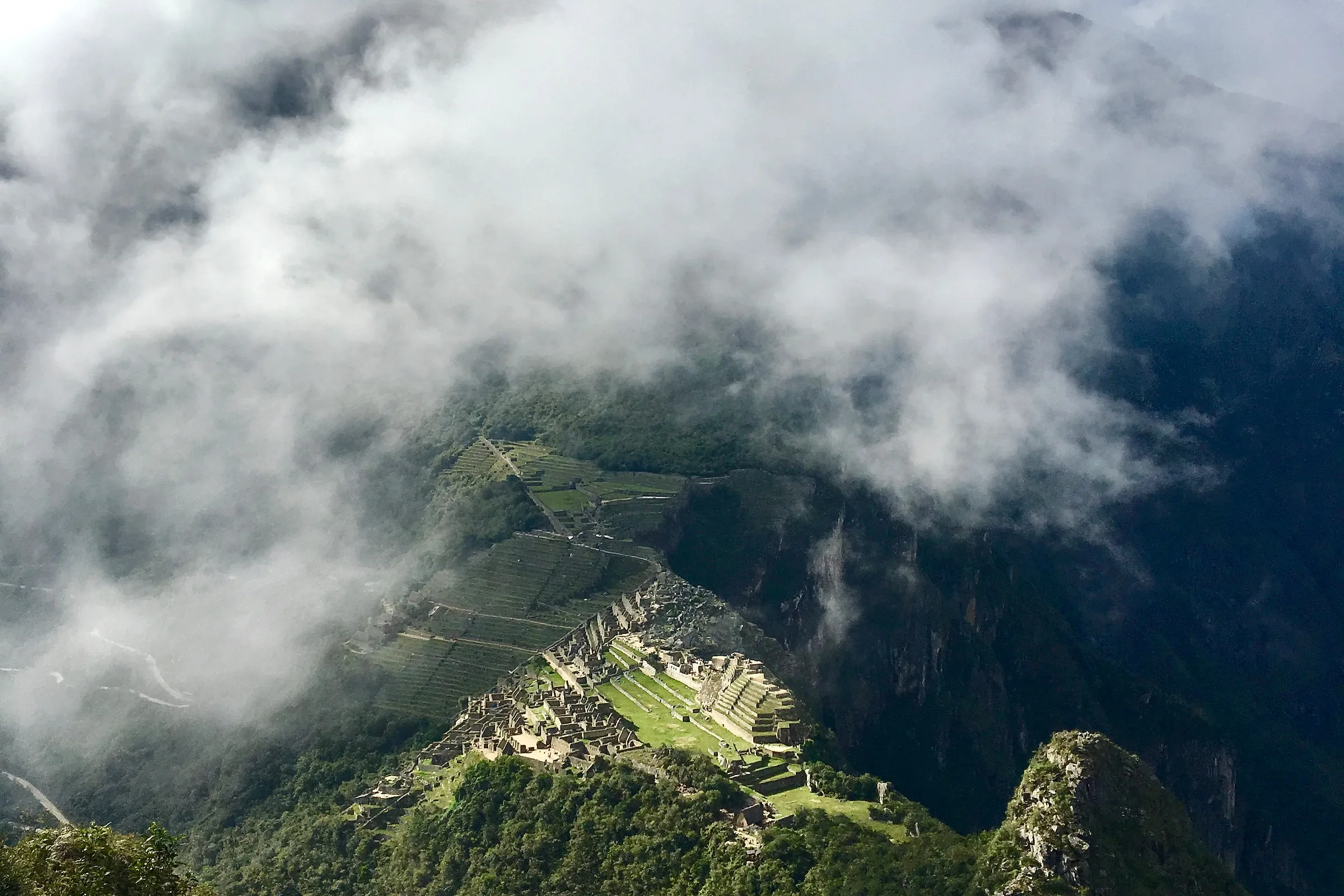
Clouds lifting off the citadel, seen from Huayna Picchu at 8 a.m. on 18 December, in the rainy season. Photo by Amy, CC BY-SA 4.0, via Wikimedia Commons.

Best time to go to Machu Picchu in the day
Entry is by the hour, from 06:00 to 15:00, and the slots are not the same size. In the annex to the 2026 resolution:
- 07:00 is the largest slot: 750 tickets in regular season, 870 in high season.
- 09:00 and 10:00 are the next largest, because Huayna Picchu and the Machu Picchu mountain are sold in the morning only.
- From 12:00 to 15:00, every slot is 375 tickets, or 455 in high season.
So an afternoon entry puts fewer people through the gate with you, and a morning entry is the only way to climb either mountain. Which one is better depends on what you came for; the weather by hour of the day is not something we have a measured series for, and we will not invent one.
If you want the earliest slots, sleep in Aguas Calientes the night before. Our guide on how to get to Machu Picchu covers the train and the bus up, and why the first train from Cusco arrives too late for the 06:00 entry.
February: the Inca Trail closes, the citadel does not
Every February the whole Inca Trail network shuts. It is not a custom but a rule: Article 10 of the park authority’s regulation for the trail network closes it for the month for ecosystem recovery and maintenance.
The citadel itself stays open. February 2025 still had 79,806 visitors, the lowest month of the year. If you can live with rain on most days and a closed trail, it is the emptiest Machu Picchu you will find. If you want to arrive on foot, February is the one month you cannot.
Dry season or wet season: what each one costs you
| If you want | Go in | What you give up |
|---|---|---|
| Dry weather and a calmer site | May | The four high-season routes; tickets as tight as August |
| Every route, including the Sun Gate | 19 June to 2 November | The busiest months of the year |
| The emptiest site | February | Heavy rain, and no Inca Trail |
| A compromise outside the peak | November or December | Rainy-season afternoons |
| Huayna Picchu | Any month, booked early | Nothing: it is 400 a day all year |
For most travellers the best time to visit Machu Picchu is May, or September if you want the high-season routes with slightly fewer people than October. Both are dry enough that rain is the exception, not the plan.
How the month fits the rest of the trip
Machu Picchu is rarely the whole journey, and the month that suits it may not suit the next stop. Our best time to visit Peru guide covers the coast, the Andes and the Amazon, which runs on a calendar of its own. If you are continuing south to Lake Titicaca and the salt flats, the best time to visit Bolivia guide explains why the Uyuni mirror wants exactly the wet months that Machu Picchu does not.
Our 13-day Peru and Bolivia route runs from the Sacred Valley to the salt flats and is usually dated around Machu Picchu first, for the reason this whole page makes: the citadel is the only stop on that route with a daily cap. Why the route runs in that order is explained in our guide to Peru and Bolivia in 13 days.
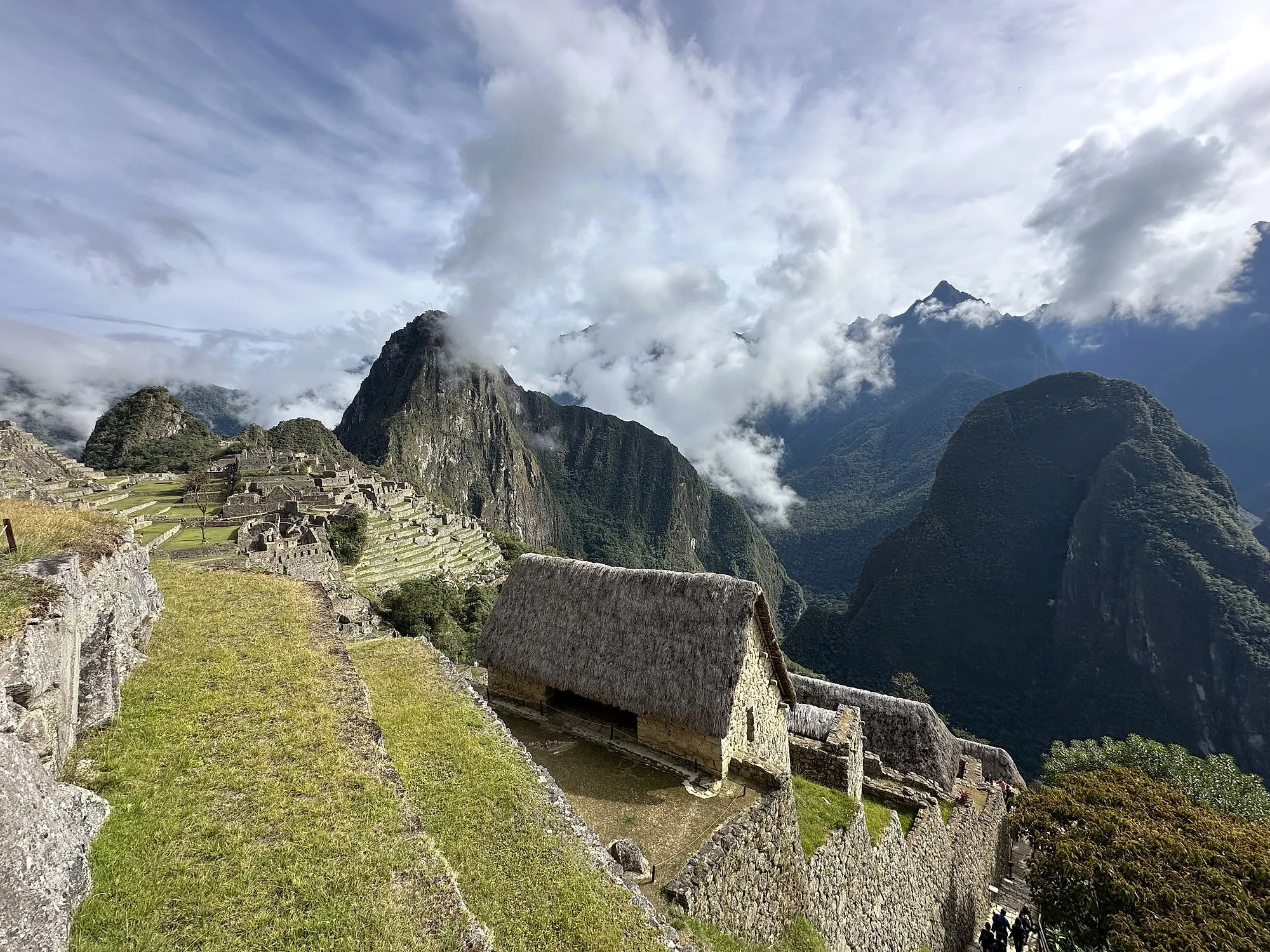
The upper terraces and Huayna Picchu, the mountain sold at 400 places a day all year. Photo by Simon P. Toaquiza.
Asked before booking
The questions we get on this
- When is the rainy season in Machu Picchu?
- November to April. The SENAMHI weather station at Machu Picchu, at 2,563 m, puts those six months above the service's own rainy-season line of 8.3% of the year's rain each; January to March alone bring 47.5% of about 2,000 mm a year. April still carries 9.2%, so the citadel stays wet for a month after Cusco has dried out. The driest stretch is May to August.
- Is May a good time to go to Machu Picchu?
- Yes, it is the best month for most people. May brings 3% of the year's rain at the Machu Picchu station, the cap is 4,500 visitors a day, and in 2025 the site averaged 4,486 a day in May, so tickets sell out: buy them as soon as your dates are fixed. The four high-season routes, including Intipunku and the Inca Bridge, are not sold in May.
- Is Machu Picchu open in February?
- The citadel is, the Inca Trail is not. The park authority of Peru closes the whole Inca Trail network every February for maintenance, but Machu Picchu itself stays open and is at its quietest: about 2,850 visitors a day in February 2025. It is also the wettest stretch of the year, with January to March bringing almost half of the annual rain.
- Can you visit Machu Picchu in December?
- Yes. December is in the rainy season, with about 12% of the year's rain at the Machu Picchu station, but the site is open and fairly quiet: about 3,034 visitors a day in December 2025. On 30 and 31 December 2026 the daily cap rises to 5,600 and the four high-season routes open for those two days.
- Is it better to visit Machu Picchu in the morning or afternoon?
- The morning has more places, not fewer people. Entry slots run every hour from 06:00 to 15:00, and the 07:00 slot is the largest, 750 tickets in regular season and 870 in high season. Every slot from 12:00 is 375, or 455 in high season. Huayna Picchu is sold only at 07:00 and 10:00, so if you want the mountain, the morning decides for you.