Peru · Travel guide
Amazon Rainforest Peru: Tambopata, Iquitos or Manu?

Amazon rainforest Peru trips start from one of three gateways. Here is how to reach each one and how many nights it needs.
This is the reasoning we use when we date a trip, not an article written to fill a blog. The Peru itineraries it feeds are here.

Amazon rainforest Peru trips go through one of three gateways, and they are not interchangeable. Tambopata, near Puerto Maldonado, is the closest to Cusco and the one most trips use. Iquitos, in the north, is where you get onto the Amazon River itself. Manu is the most remote, a national park that only authorised operators can take you into. The choice depends on how many days you have and which part of Peru the rest of your trip is in.
This guide puts the three side by side. Flight times come from the airlines, distances and rules from the park service, Peru’s tourism board and UNESCO, linked where we use them.
The three gateways to the Peru Amazon, compared
| Tambopata | Iquitos | Manu | |
|---|---|---|---|
| Region | Madre de Dios, south | Loreto, north | Cusco and Madre de Dios |
| Getting there | About 50 min by air from Cusco, then about 2 h by boat | Under 2 h by air from Lima, then road or river | The longest: road and river, through authorised operators only |
| Dry months | June to August | None | Depends on the zone: the park runs from 150 m to 4,200 m |
| Nights we plan | 3 | 3 to 4 | 5 or more |
| Best for | Adding the jungle to a Machu Picchu trip | The Amazon River and the flooded forest | Time to spare and a wish to go deep |
Tambopata, from Puerto Maldonado
Tambopata is where we send most travellers, for a simple reason: it is next to the rest of the trip. SKY puts the flight from Cusco to Puerto Maldonado at about 50 minutes, and from Lima PromPerú gives about 1 hour 40. From the town, the Tambopata National Reserve, created in 2000, is about two hours up river by boat, which is how you reach most of the lodges. PromPerú also names Lake Sandoval, where giant otters live.
What Tambopata has that the other two do not is the clay licks, river banks where macaws and parrots gather to eat clay. According to Andina, the state news agency, the Chuncho clay lick is about five hours by boat from Puerto Maldonado and the Colorado lick, the largest, more than six. They are early-morning visits, so they decide which lodge you stay at.
Our eleven-day Machu Picchu tour packages end with three nights in Tambopata for exactly this reason: Cusco and the lodge are one short flight apart.
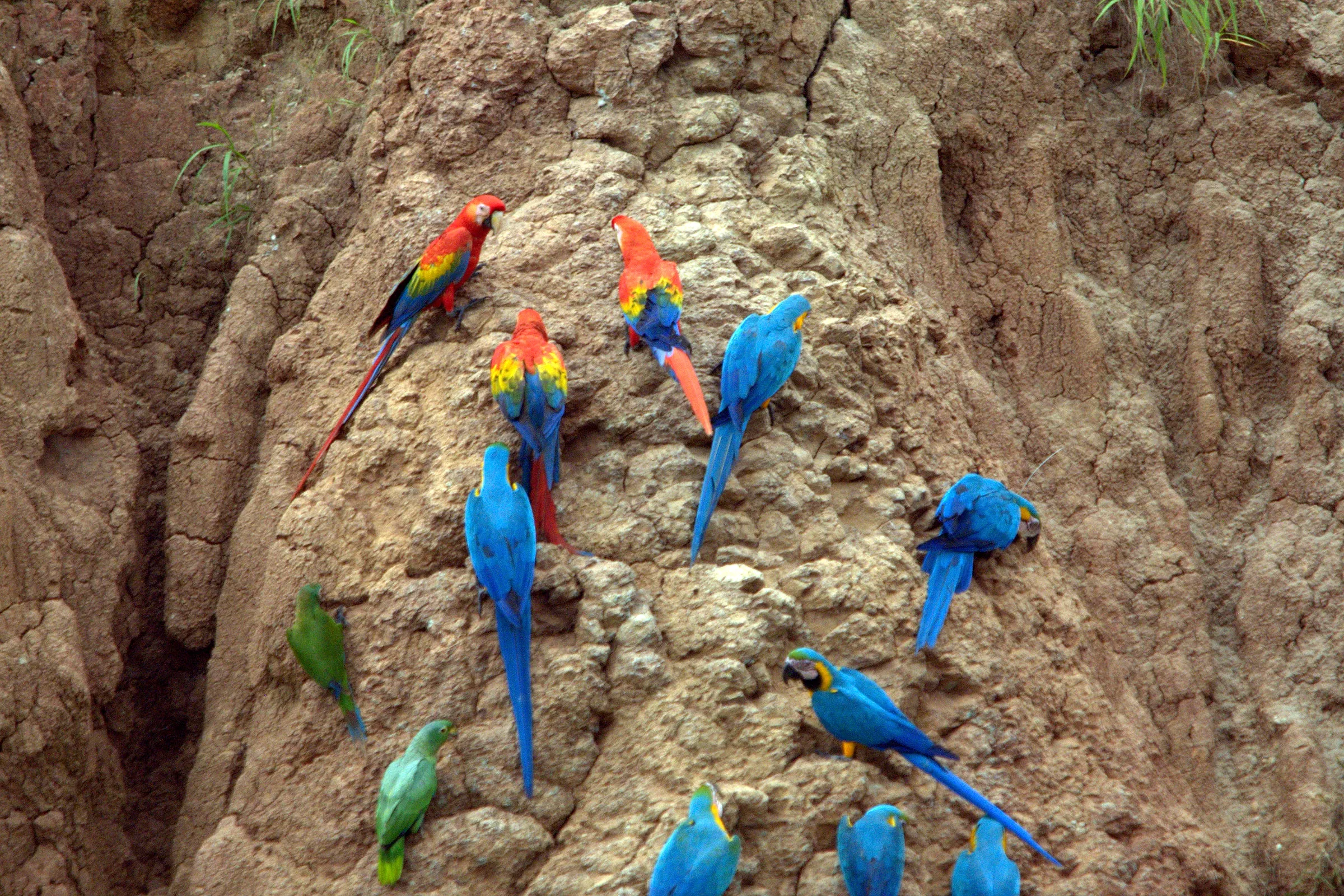
Macaws and parrots at a clay lick in the Tambopata National Reserve. Photo by Brian Ralphs, CC BY 2.0, via Wikimedia Commons.
Iquitos, on the Amazon River
Iquitos is the other Peruvian Amazon, and it feels like it. The city sits on the Amazon River itself, and the only road out of it stops at the town of Nauta, about 100 km away, which is why Guinness World Records lists it as the largest city without a major road connection. You fly in from Lima: LATAM puts the direct flight at about 1 hour 50, so under two hours.
From Iquitos, the lodges and river boats go up or down the Amazon, and the Pacaya-Samiria National Reserve is reached by road to Nauta, about two hours, and then about an hour by boat, according to PromPerú.
The catch is the weather. Iquitos has no dry season: even its driest month brings about 170 mm of rain, as our best time to visit Peru guide shows. That is not a reason to avoid it, but it is a reason not to choose it for the weather.
Manu National Park
Manu is the largest and the hardest to reach. UNESCO inscribed Manu National Park in 1987. It covers more than 1.7 million hectares and climbs from 150 m to 4,200 m, from lowland forest up to the Andean grassland. UNESCO counts some 850 species of birds there; PromPerú, on its own page, says more than 1,000.
Visitors only enter part of it. Under the park service’s tourism rules, reported by Andina, visits are guided and limited to set zones, and only agencies authorised by SERNANP can operate there. Getting in combines road and river, and it is the gateway that needs the most days. We plan it only for trips with time to spare.
When to go
The two areas you are most likely to visit behave differently. Puerto Maldonado and Tambopata have a dry season from June to August, which is also the high season in the Andes, so Tambopata sits neatly after Machu Picchu in those months. Iquitos has rain all year. In both, expect heat: PromPerú gives temperatures from 17 °C to 39 °C for Tambopata.
Health before you go
Two things are worth arranging with a travel doctor. The US CDC recommends the yellow fever vaccine for travellers going to areas below 2,300 m in a list of regions that includes Loreto and Madre de Dios. It is not required to enter Peru, and it is not needed if your trip stays in Cusco, Machu Picchu and the Inca Trail. The same page lists malaria in all areas below 2,500 m east of the Andes, including Iquitos and Puerto Maldonado.
How the Amazon fits a Peru trip
Choose by the rest of the route. If your trip is built around Cusco and Machu Picchu, Tambopata is the natural addition: one short flight, three nights, and back to Lima or on to the next country. If you want the Amazon River itself and have a spare day for the flights through Lima, Iquitos. If the jungle is the main reason for the trip, Manu.
For the rest of the country, see our guide to the best places to visit in Peru, and for the trips we run, our Peru tours.
Asked before booking
The questions we get on this
- Is the Amazon in Peru worth visiting?
- Yes, if you give it at least three nights. Peru's Amazon lodges are reached by boat, so the first and last days are mostly travel. With three nights in Tambopata, the closest area to Cusco, you get two full days for the river, the lakes and the early-morning outings the lodges plan around the wildlife.
- Where is the best place to see the Amazon rainforest in Peru?
- For most travellers, Tambopata, near Puerto Maldonado. It is about 50 minutes by air from Cusco, so it fits after Machu Picchu, and it has a dry season from June to August. Iquitos, in the north, is the way onto the Amazon River itself but has no dry season. Manu is the most remote and needs the most days.
- Do you need a yellow fever vaccine for the Peruvian Amazon?
- The US CDC recommends it for travellers aged nine months or more going to areas below 2,300 m in a list of regions that includes Loreto and Madre de Dios, where Iquitos and Puerto Maldonado are. It is not required to enter Peru. The CDC also lists malaria in the areas below 2,500 m east of the Andes, so see a travel doctor before you go.