Peru · Travel guide
Uros Floating Islands: Half a Day or a Night on the Lake?

The Uros floating islands are 30 minutes by boat from Puno. When half a day is enough, and when a night on Amantaní or Taquile is worth it.
This is the reasoning we use when we date a trip, not an article written to fill a blog. The Peru itineraries it feeds are here.

The Uros floating islands are about 30 minutes by boat from Puno, on Lake Titicaca, and most people see them in a morning. That is enough for the islands themselves. What a morning does not give you is the lake: for that you need a night with a family on Amantaní or Taquile, three hours further out. This guide sets out both, with the boat times side by side.
The lake surface is at 3,810 m, so Titicaca comes after Cusco in a Peru route, not before it. Distances and times come from Peru’s national tourism inventory, UNESCO and PeruRail, linked where we use them.
The islands and the boat times, side by side
| From Puno | Distance | Boat time | What it is |
|---|---|---|---|
| Uros | 6 km | About 30 min | Reed islands, a half-day visit |
| Taquile | 36 km | About 3 h | Textile island, a full day or a night |
| Amantaní | 40 km | About 3 h 30 | Family homestays, a night |
The figures come from the inventory records for the Uros, Taquile and Amantaní.
What the Uros islands are
These are the floating islands Peru is known for on Titicaca: the inventory counts about 200 artificial islands, built from layers of totora, the reed that grows in the shallows of the bay, and anchored with eucalyptus poles. The reed has to be renewed, and a visit usually includes a talk on how the islands are built and a ride in a reed boat.
The islands sit inside the Titicaca National Reserve, created in 1978 to protect the reed beds, the water birds and the giant Titicaca frog, according to Andina, the state news agency.
Uros islands or a night on Taquile and Amantaní
The Uros are close and quick, and that is their limit: a short visit among other boats. The two larger islands are where the lake slows down.
Taquile is known for its textiles. UNESCO lists Taquile and its textile art as intangible cultural heritage, and the weaving is done by the islanders themselves, part of everyday dress. Taquile island has community homestays, but most visitors come for the day.
Amantaní is the overnight island. According to its inventory record, most families have adapted their homes to receive visitors, across ten communities, and the island has two ceremonial hills, Pachamama and Pachatata.
Our choice for most travellers: the Uros on the way out, the night on Amantaní, and Taquile on the way back the next day.
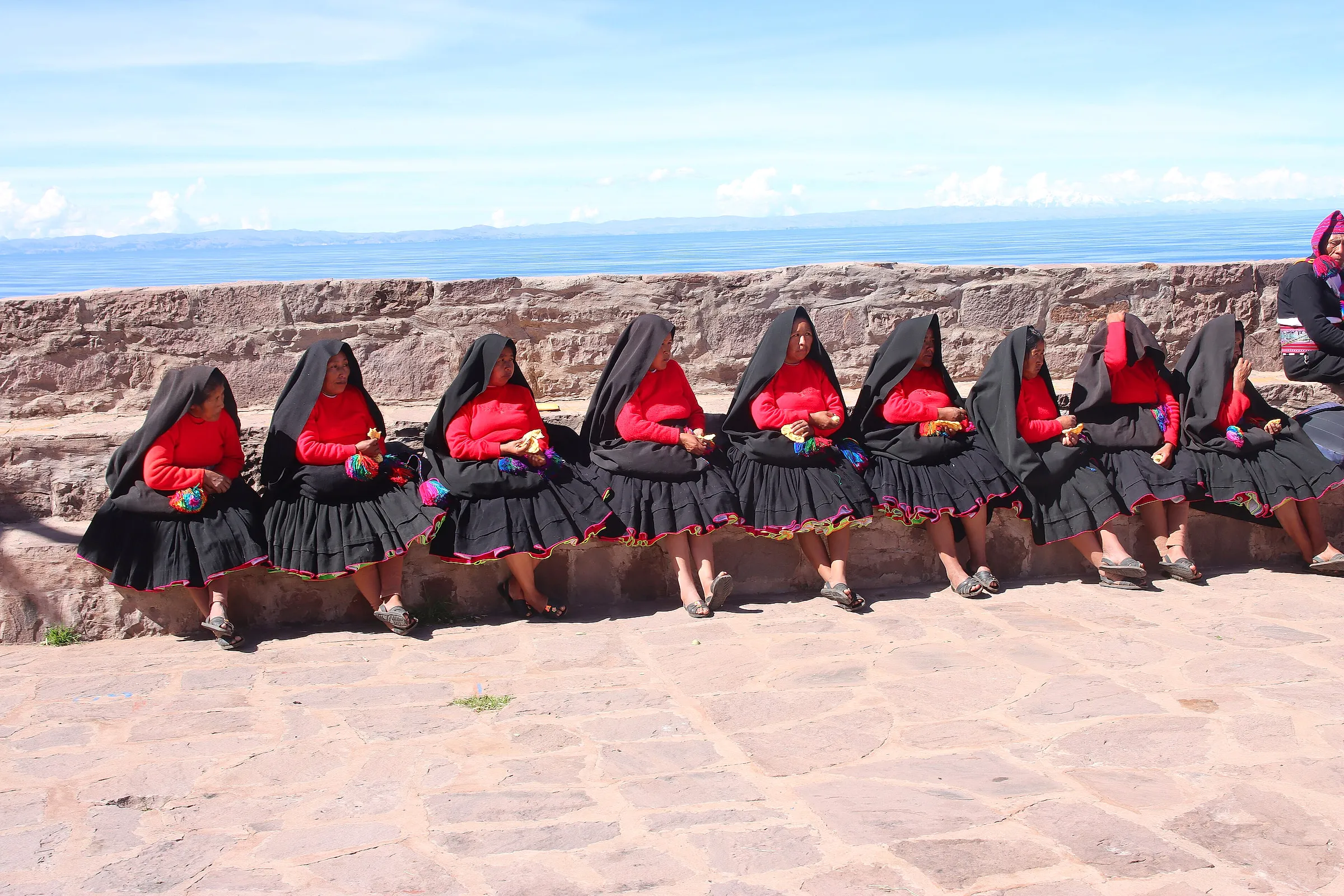
Women of Taquile above Lake Titicaca. Photo by Draceane, CC BY-SA 4.0, via Wikimedia Commons.
Sillustani, on the way to the airport
Sillustani, about 43 km and an hour from Puno, is a field of stone burial towers built by the Colla in the thirteenth century above Lake Umayo. It sits on the road towards Juliaca airport, which makes it the natural stop on the day you leave.
Getting to Puno
There are two ways. The PeruRail Titicaca train runs from Cusco to Puno in about ten and a half hours, with three departures a week in each direction: a slow day across the high plateau that is a reason to go in itself. The fast way is to fly from Lima to Juliaca, about 1 hour 40 according to PromPerú, and drive about 40 minutes to Puno.
If you are there in February, the Festivity of the Virgen de la Candelaria, on UNESCO’s list since 2014, fills the town with dancers and bands. Book early.
How Titicaca fits a Peru trip
Two nights at the lake are the minimum: one in Puno and one on Amantaní. From there the route either continues into Bolivia across the lake, which our Peru and Bolivia guide covers, or goes on to Arequipa and the Colca. Our Peru and Bolivia tour crosses here.
For where Titicaca sits in the whole country, see our guide to the best places to visit in Peru.
Asked before booking
The questions we get on this
- Is a visit to the Uros islands worth it?
- Yes, as a half-day from Puno, as long as you know what it is. The islands are about 30 minutes by boat from the town, and around 200 of them are built from totora reed. The visit is short and busy. If you want to understand life on the lake, add a night with a family on Amantaní or Taquile, three hours further out.
- How long is the boat ride from Puno to the Uros islands?
- About 30 minutes. Peru's national tourism inventory puts the Uros 6 km from Puno. Taquile is 36 km and about three hours away, and Amantaní 40 km and about three and a half hours, so those two are a full day or an overnight trip, not an add-on to the Uros.
- Can you stay overnight on the lake?
- Yes. On Amantaní, according to Peru's tourism inventory, most families have adapted their homes to receive visitors, across ten communities. Taquile also has community homestays. The tourism inventory lists rural lodging on the Uros as well, but most travellers stay on the larger islands.