Best Time to Visit Galápagos: Month by Month (2027)
Best time to visit Galapagos: May for warm water and fewer visitors, July to November for sea life. Sea data by month and the 2027 El Niño.

The best time to visit Galápagos for a first trip is May. The sea around Santa Cruz still averages 24.7 °C, a typical May brings about 4 mm of rain to Puerto Ayora, and the March and April peak of foreign visitors is over. If sea life matters more to you than warm water, go between July and November. If warm, calm water is the point of the trip, go from February to April.
The islands keep two seasons, and neither matches the mainland. The Charles Darwin Foundation calls December to May the warm season, with calm seas and warmer water, and June to November the cool season, rich in marine life. For 2027 there is one more thing to weigh. NOAA expects a strong El Niño to last into March, and El Niño changes the warm season more than anything else on this page.
The best time of year to visit Galápagos, month by month
Four numbers decide most trips: how warm the sea is, how hot the day gets, how much rain falls in town and how often it rains up in the hills.
| Month | Sea, °C | Day high, °C | Town rain, mm | Highland rain days |
|---|---|---|---|---|
| Jan | 24.5 | 28.6 | 22 | 10 |
| Feb | 25.4 | 30.4 | 49 | 10 |
| Mar | 25.7 | 31.1 | 40 | 7 |
| Apr | 25.5 | 29.9 | 8 | 6 |
| May | 24.7 | 28.3 | 4 | 6 |
| Jun | 23.5 | 26.7 | 10 | 9 |
| Jul | 22.3 | 25.4 | 13 | 15 |
| Aug | 21.5 | 24.4 | 13 | 18 |
| Sep | 21.5 | 24.3 | 11 | 16 |
| Oct | 21.7 | 24.8 | 9 | 14 |
| Nov | 22.3 | 25.5 | 9 | 13 |
| Dec | 23.2 | 26.8 | 12 | 14 |
All four columns are our own calculations from the daily records in the Charles Darwin Foundation’s climate database. The first three come from its station at Puerto Ayora, on the south coast of Santa Cruz, and cover 1991 to 2020. For rain we give the median, the middle year of the series, because El Niño years drag the average up: April averages 82 mm, but a typical April brings 8. The last column counts days with at least 1 mm of rain at Bellavista, 223 m up in the Santa Cruz highlands, from 1991 to 2019, when that record stops.
Read down the sea column and the year splits in two. From January to May the water stays above 24 °C; from July to November it stays below 23 °C. The rain columns tell a stranger story. The town is wettest in February and March, while the highlands get their most rainy days in August, the coolest month at sea. That is the garúa, the drizzle of the cool season, and it explains why the hills stay green while the coast is dry.
San Cristóbal shows the same split. The 1981-2010 normals of INAMHI, Ecuador’s weather service, give it 14 rainy days in August that add up to 9.8 mm, and 10 in February that add up to 107.4 mm.
December to May: the warm season
From January the southeast winds ease, according to the foundation’s climate team, and the cold water of the Humboldt Current and the equatorial upwelling loses its hold on the islands. Sea and air warm up, and the rain comes in showers. The sea peaks at 25.7 °C in March, when the day high averages 31.1 °C.
December can belong to either season. The foundation’s visitor page starts the warm season in December, while its climate database starts it in January and warns that both seasons change length from year to year. In the table December sits halfway, at 23.2 °C in the water.
For snorkellers this is the easy half of the year. From February to April the sea at Puerto Ayora averages 25.5 °C, and this is the season the foundation describes as calm. That counts on the public boats between islands, which take about two hours from Santa Cruz to Isabela or San Cristóbal. Our Galápagos itinerary has the crossings day by day.
The price of the warm season is rain and company. February is the wettest month in town, with 49 mm in a typical year, and March and April are the busiest months for foreign visitors.
June to November: the cool season
From June the southeast winds pick up and cooler water takes over again. The foundation describes what follows: a lasting layer of low cloud and steady drizzle on the higher slopes that face the wind, and almost no rain anywhere else. Puerto Ayora gets 9 to 13 mm a month in a typical year. Bellavista, about six kilometres inland, gets rain on 18 days of an average August.
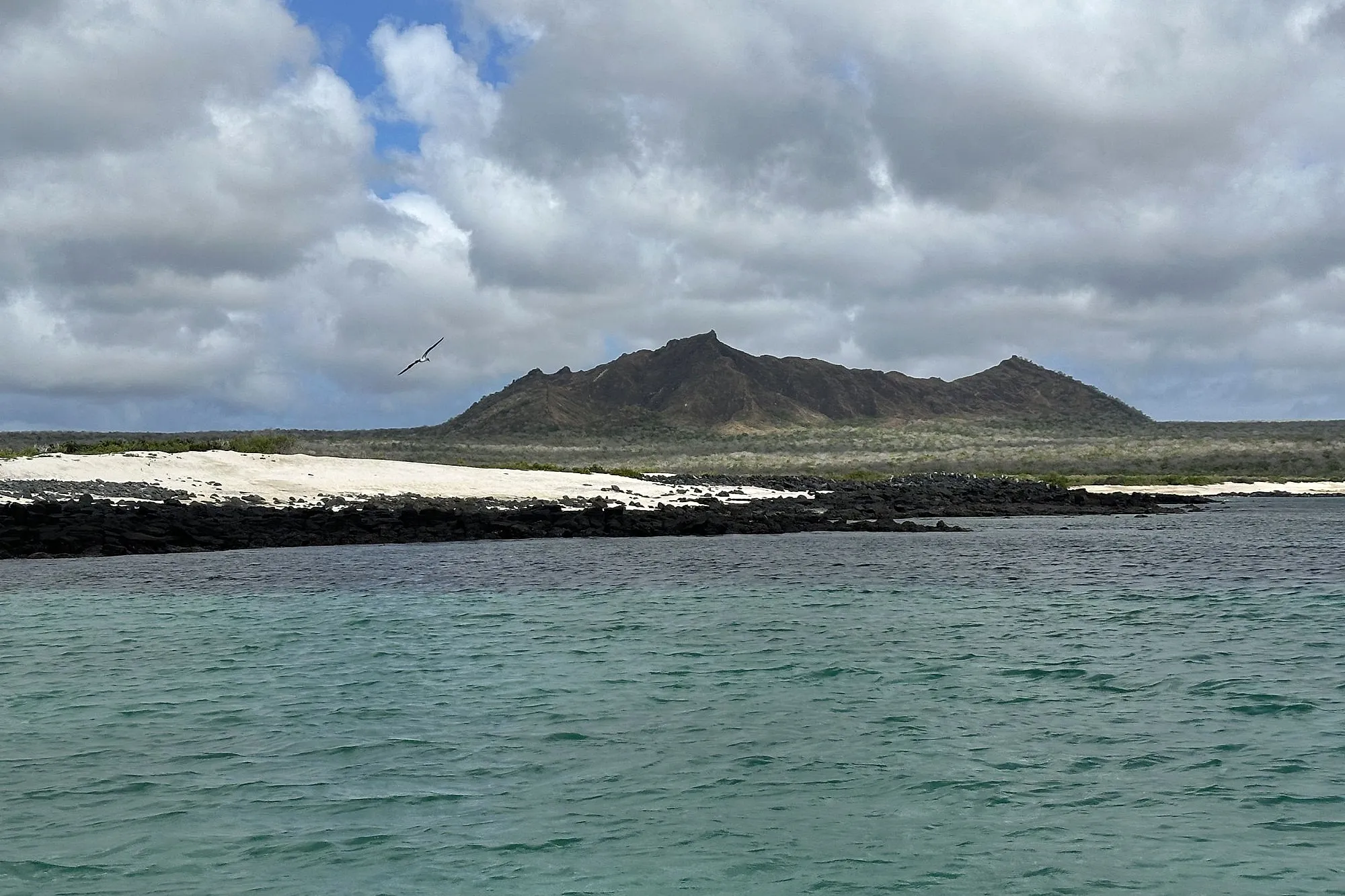
Cloud resting on a volcanic hill in the Galápagos. The foundation describes a layer like this over the higher ground through the cool season.
The sea is the big change. It averages 21.5 °C in August and September, about four degrees below March, and on roughly one August day in seven it reads below 20 °C. An hour of snorkelling at that temperature is cold without a wetsuit.
Cooler water is also richer water. Satellite records studied by Forryan and colleagues in Scientific Reports show more chlorophyll, a measure of plankton, wherever the sea around the archipelago runs cooler. Plankton feeds the fish, and it also clouds the water a little, so the cool season trades some clarity for more life.
Darwin and Wolf, far to the north, show this at its most extreme. In a 2026 study by the foundation, the weight of fish counted there in August was more than three times the March figure, and scalloped hammerheads went from about 5 to 21 tonnes per hectare. Whale sharks pass the same two islands from June to November, says the foundation’s guide to the sharks of the marine reserve, and the national park reports that 99% of those seen there are adult females. Both islands are for divers only: the foundation lists them as reachable on liveaboards of seven days.
Stronger wind also means a choppier sea on the open crossings, such as the boat to Isabela.
Best time to visit the Galápagos Islands for wildlife
The animals are there all year. What changes is what they are doing, and a few events are worth planning around.
| When | What happens | Where |
|---|---|---|
| Dec to May | Green turtles come ashore at night to nest | Quinta Playa (Isabela), Las Bachas (Santa Cruz) |
| Jan to Apr | Land birds build nests and raise chicks | Throughout the islands |
| Jan to Jun | Giant tortoises walk down to the lowlands | Santa Cruz |
| Apr to Dec | Waved albatrosses breed; chicks fly in Nov and Dec | Española |
| Jun to Nov | Whale sharks pass | Darwin and Wolf |
| Jul to Dec | Giant tortoises graze in the highlands | Santa Cruz |
On Santa Cruz the giant tortoises move with the seasons. A 2018 study in PLOS ONE describes a walk up to the highlands from July to December and back down to the lowlands in the rainy months from January. They lay their eggs in the hottest, driest lowland ground, between 6 and 165 m above the sea, the foundation found in its tortoise studies. Our Ecuador and Galapagos tours go from the Baltra flight across the Itabaca channel and up to a ranch in the Santa Cruz highlands where tortoises roam free. From July to December the migration brings them up to exactly that kind of farmland.
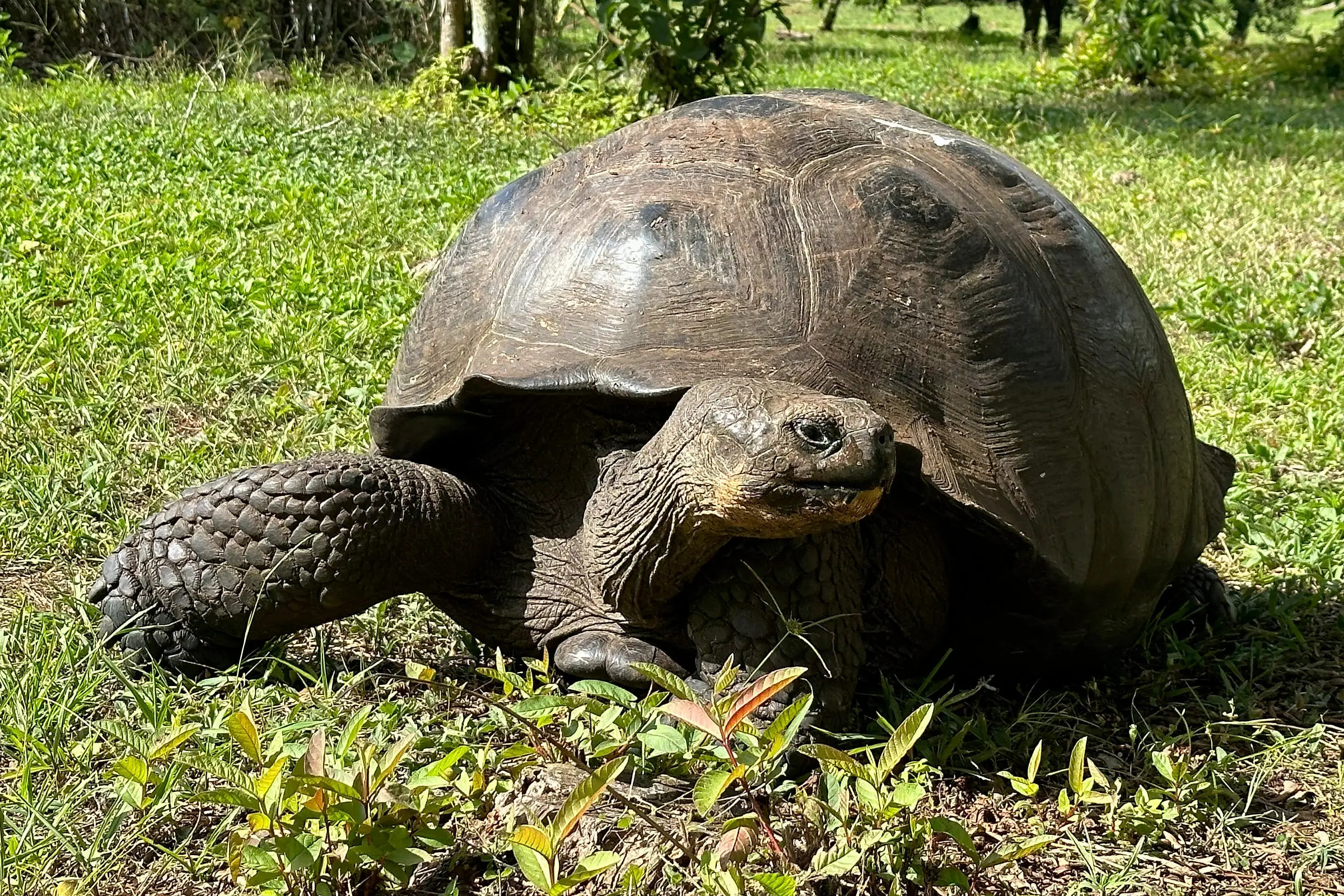
A giant tortoise on a highland ranch on Santa Cruz.
The national park counted 547 green turtles nesting in 2024. They dig at night between December and May, mostly at Quinta Playa on southern Isabela and at Las Bachas, a beach on the northwest of Santa Cruz that visitors reach on a day trip. Each nest holds about 80 eggs, and they take some 70 days to hatch.
For land birds, the foundation says nest building, egg laying and chick rearing fall from January to April in a typical year, the months of the heaviest rain.
Española is the island for waved albatrosses: 99.9% of them nest there. They start breeding in April, and the chicks are ready to fly in November and December.
When the islands are busiest
The national park’s visitor report for 2025 counted 290,404 arrivals. Foreign visitors, 62% of the total, peaked in March and April. Ecuadorians peaked in July and August, and the low point of the whole year was September. Eight in ten visitors slept on land, in hotels on the inhabited islands, and two in ten slept aboard a boat.
So the quietest month is also one of the coldest at sea. September has the fewest arrivals and, with August, the coolest water, at 21.5 °C. May and June fall between the two peaks with warmer water.
Cruise fares change with the departure date too. Our guide to the Galápagos trip cost has the prices we found in November 2026.
What El Niño means for 2027
On 12 November 2026 NOAA’s Climate Prediction Center kept its El Niño Advisory in place. It expects a strong to very strong El Niño to last through January to March 2027, with a better than 79% chance, and to start weakening early in the year. In the stretch of ocean it watches off Ecuador and Peru, the sea surface was 4.4 °C above normal.
For the islands that points to a warm season that runs long and wet. The foundation’s climate team notes that a hotter warm season tends to start early, even in the year before, and to end late. Puerto Ayora’s own records show what a strong one does. In 1998 the town got 1,751 mm of rain, seven times the 249 mm of a typical year, and 448 mm of it fell in April alone. In 1997 it got 1,655 mm. In July 2023, during the last El Niño, the sea averaged 26.7 °C, more than four degrees above the July normal.
It has started already. The days on record at Puerto Ayora for April and May 2026 average 27.0 and 26.6 °C, 1.5 to 1.9 degrees above normal. At the end of October, a month that brings 9 mm of rain to town in a typical year, heavy rain flooded Santa Cruz, and the Galápagos government declared an emergency on 31 October. The UK travel advice for Ecuador reports road closures, power cuts and disruption to travel to Baltra airport.
El Niño is hard on the animals that live off cold water. After the 2023-2024 event, the September 2024 census counted 413 Galápagos penguins, 96% of them adults. The foundation thinks the shortage of young birds is probably down to El Niño, which leaves less food in warmer water.
For a trip between January and May 2027, plan on warm water, more rain than the table shows and some slack around the flights. NOAA updates its outlook every month, and the next discussion is due on 10 December 2026.
When to go to Galápagos: the best time for each trip
| If you want | Go in | What you accept |
|---|---|---|
| Warm water and calm crossings | February to May | Showers, and the March and April crowds |
| The most life in the sea | July to November | Water at 21.5 to 22.3 °C |
| The fewest visitors | September | Water at 21.5 °C, the coolest of the year |
| Nesting turtles | December to May | Rain in town from January to March |
| Albatrosses on Española | April to December | Cooler water from June |
| Tortoises in the highlands | July to December | Drizzle in the hills |
So the best time to go to Galápagos is the warm season if the water comes first, and the cool season if the life in it does.
The best month to visit Galápagos
For a first visit we pick May. April is warmer by under a degree, but it sits inside the March and April peak, and in El Niño years it can be the wettest month of all. June is the first cool month, at 23.5 °C. May falls between them, with 24.7 °C in the water, 4 mm of rain in a typical year, albatrosses breeding on Española and turtles still nesting.
Best time to visit Ecuador and Galápagos together
Almost every trip to the islands passes through Quito or Guayaquil, because the flights to Baltra and San Cristóbal leave from those two cities in the morning. Our guide on how to get to Galápagos has the times and the fees.
That puts the mainland in the plan. If you are working out the best time to visit Ecuador, Galápagos included, the two halves pull in different directions. Quito is driest from June to September, as our guide to the best time to visit Ecuador shows with INAMHI’s rain figures, and those are the cool months at sea. Late June and early July give you dry Andes while the island water is still above 22 °C.
Machu Picchu is the other common pairing, and there the calendars clash harder. The Peruvian Andes are driest from May to August, and the islands are warmest from December to May. May is the one month that suits both. Our guide to the best time to visit Machu Picchu and Galapagos works through it month by month, and our Machu Picchu and Galapagos trip runs ten, twelve or sixteen days.
The questions we get on this
- When is the best time to go to the Galápagos?
- For warm, calm water, the warm season from December to May, and February to April above all, when the sea at Puerto Ayora averages 25.5 °C. For more life in the sea, the cool season from June to November, when the water drops to 21.5 °C in August and September; September is also the quietest month. For a first visit we pick May, with water at 24.7 °C after the March and April peak of foreign visitors.
- What is the best month to visit the Galápagos?
- May. The sea at Puerto Ayora averages 24.7 °C, a typical May brings about 4 mm of rain, waved albatrosses have started breeding on Española and green turtles are still nesting. It also falls between the national park’s two busy periods, March to April and July to August. The runner-up is April, warmer by under a degree but busier.
- When not to go to the Galápagos Islands?
- Skip August and September if you feel the cold in the water: the sea at Puerto Ayora averages 21.5 °C, and on about one August day in seven it falls below 20 °C. Skip March and April if you want quiet islands, since those are the peak months for foreign visitors. For January to March 2027, expect more rain than usual, because NOAA forecasts a strong El Niño through those months.
- Does it get cold in the Galápagos Islands?
- On land, hardly. The coolest months, August and September, still average a day high of 24.3 to 24.4 °C at Puerto Ayora. The water is what turns cold: 21.5 °C on average in those months, against 25.7 °C in March. The highlands of Santa Cruz are cooler and damper, with rain on 18 days of an average August.
- When is the best time to visit Galápagos for wildlife?
- Any month, because each brings something different. Green turtles nest from December to May and land birds from January to April. Waved albatrosses start breeding on Española in April, and their chicks are ready to fly in November and December. On Santa Cruz the giant tortoises are in the highlands from July to December. Sharks and fish gather in the cool months around Darwin and Wolf, which only dive boats reach.
- When is the best time to visit Galápagos to avoid seasickness?
- The warm season, from December to May, which the Charles Darwin Foundation describes as the time of calm seas. From June the southeast winds strengthen and the open crossings get rougher. A land-based trip that sleeps in hotels also cuts the time on boats to the day trips and the crossings of about two hours between islands.
- When is the best time to visit Galápagos for snorkelling?
- February to April, when the sea at Puerto Ayora averages 25.5 °C and the warm season keeps it calm. The cool months bring more plankton and more fish, but the water falls to 21.5 °C in August and September, cold enough that an hour without a wetsuit is hard going.