Galápagos Itinerary: 5, 7 or 10 Days on Three Islands
A Galapagos itinerary by land for 5, 7 or 10 days on Santa Cruz, Isabela and San Cristóbal, with real boat and flight times, and how to add Peru.

A Galápagos itinerary by land needs five days for Santa Cruz and its boat trips, and seven to add Isabela and San Cristóbal. Ten days covers the same three islands at an easier pace. Every version is built around two facts: planes reach the islands only in the late morning, and every public boat between islands starts or ends in Puerto Ayora, on Santa Cruz.
Below, each length is laid out day by day, with the flights and crossings that hold it together, and then how to attach the islands to Machu Picchu or to Quito. We are based in Quito. For flights to the islands and the entry fees, see our guide on how to get to Galápagos.
How many days you need
Count the nights, and subtract the two flight days. On 10 February 2027 the island flights from the mainland landed between 10:16 and 12:20, island time, and the flights back from Baltra left between 10:56 and 12:00 a week later. The first and last days are half days, whatever the length of the trip.
| Trip | Nights | Islands | Days without a flight |
|---|---|---|---|
| 5 days | 4 | Santa Cruz | 3 |
| 7 days | 6 | Santa Cruz, Isabela, San Cristóbal | 5 |
| 10 days | 9 | Santa Cruz, Isabela, San Cristóbal | 8 |
Three or four days can work for Santa Cruz alone, but one day of rough sea or a cancelled boat leaves you with almost nothing. Fourteen days is a slow version of the ten-day route, with a second boat day from each island.
What decides the order
Three things decide it, and a fourth shapes every day once you are there.
The flights. LATAM and Avianca fly from Quito and Guayaquil to Baltra and San Cristóbal, all in the morning. If you fly into Baltra and out of San Cristóbal, or the reverse, you never cross the same water twice. The islands keep their clocks an hour behind the mainland.
The boats. Small public speedboats run from Puerto Ayora to Puerto Villamil on Isabela, and from Puerto Ayora to Puerto Baquerizo Moreno on San Cristóbal. There is no official timetable published online: the boat owners set their own. In November 2026 one online ticket seller listed departures from Puerto Ayora at 07:00 and 15:00 on both routes, about two hours at sea, for $55 a person. The early boat back from Isabela left at 06:00. There is no boat between Isabela and San Cristóbal, so by sea that trip is two crossings with a wait in Puerto Ayora. The biosecurity agency inspects your bags at the dock before each crossing. The sea is calmer from December to May, the warm season in the Charles Darwin Foundation’s calendar.
The small planes. Emetebe flies three routes: Baltra to Isabela, San Cristóbal to Isabela, and Baltra to San Cristóbal. In November 2026 its site showed fares from $147 one way for Baltra to Isabela, $153 for San Cristóbal to Isabela and $191.50 for Baltra to San Cristóbal. The luggage allowance is tight, and extra weight costs $2.00 a pound at the counter, almost twice what it costs when you add it to the booking in advance.
The fourth is the rule for visitor sites. Outside the towns, visitor sites can be walked only with a park-certified naturalist guide, as the Galápagos Conservancy explains, so the uninhabited islands are day trips by boat with a guide on board.
Five days on Santa Cruz
The shortest trip we would plan, and the one that suits a Galápagos stay added to a longer journey. Everything starts from Puerto Ayora.
- Fly to Baltra and cross the Itabaca Channel. On the way down to town the road passes the highlands, where giant tortoises graze in open pasture and you can walk through a lava tunnel.
- A boat day to one of the uninhabited islands near Santa Cruz: North Seymour for blue-footed boobies and frigatebirds, or Santa Fe, Bartolomé or Plazas. Which one depends on the boat and the day.
- The Charles Darwin Research Station in the morning. In the afternoon, the path to Tortuga Bay, a long white beach you reach on foot from town.
- A second boat day, or Las Grietas, a swimming hole in a crack in the lava, and a slow afternoon.
- Back to Baltra and the flight out before noon.
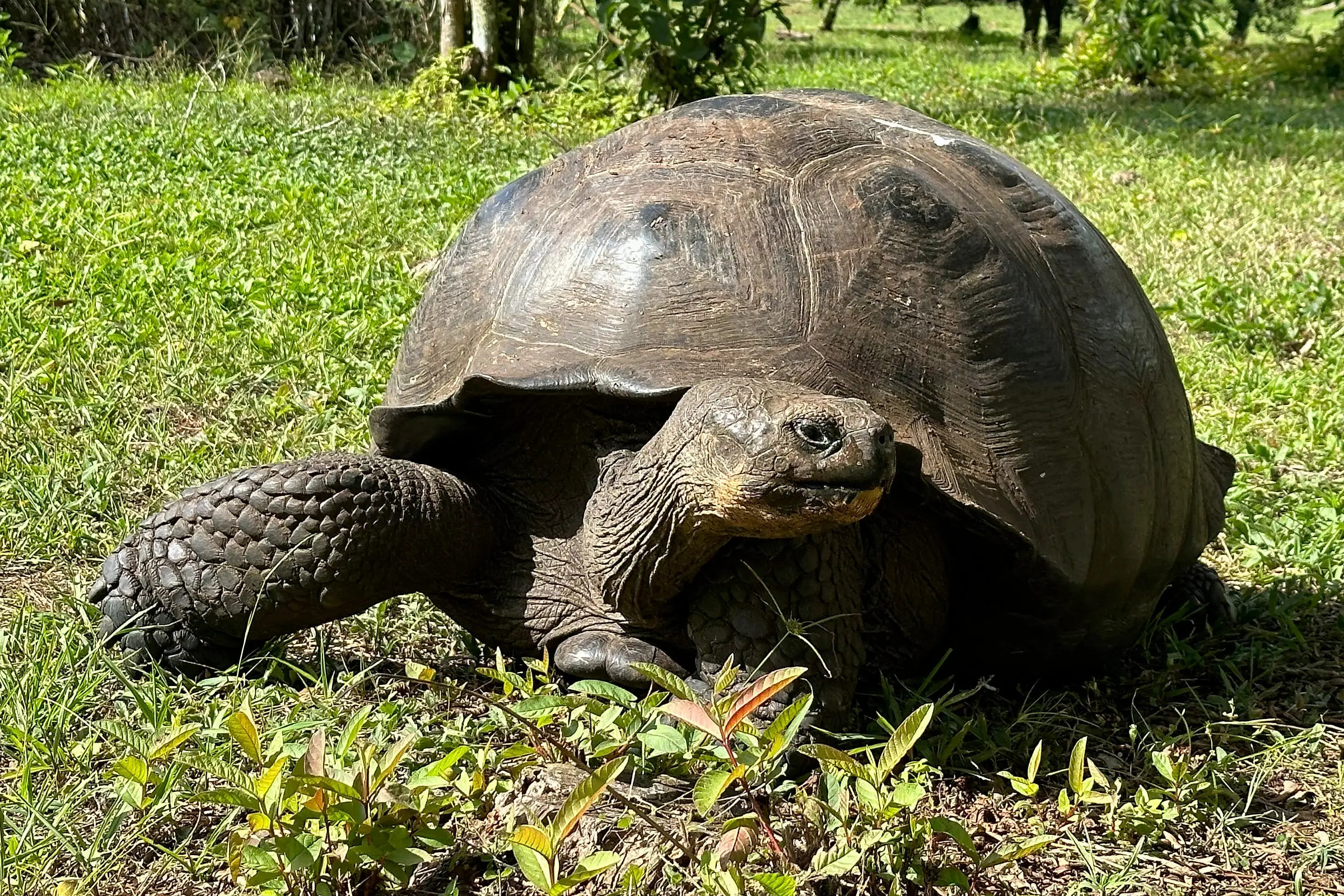
A giant tortoise in the Galápagos highlands, the first stop on the road down from Baltra.
Isabela fits into five days only by spending two of the three full days partly on boats. We keep it for the longer versions.
Seven days, in at Baltra and out at San Cristóbal
This is the length where the islands start to feel different from each other. Santa Cruz is the busy one, Isabela the wild one, and San Cristóbal the capital, with sea lions on the town beach. Our Galapagos island hopping trip runs the same three islands in six or eight days, starting on San Cristóbal.
- Fly to Baltra, the highlands on the way, two nights in Puerto Ayora.
- A boat day to North Seymour, Santa Fe, Bartolomé or Plazas.
- The morning boat to Isabela, about two hours. In the afternoon, Las Tintoreras, a lava islet in the bay where white-tipped reef sharks rest in a narrow channel.
- The rim of the Sierra Negra volcano in the morning, or a boat to Los Túneles, the lava arches off Cabo Rosa where you snorkel among turtles.
- The small plane from Isabela to San Cristóbal. By sea this day becomes two crossings and a long wait in Puerto Ayora, which is what the plane fare buys you out of.
- A boat to Kicker Rock, the split rock off the coast of San Cristóbal, to snorkel along its walls.
- Fly home from San Cristóbal. LATAM’s 10:30 departure on our sample date reached Quito at 14:46, with a stop in Guayaquil.
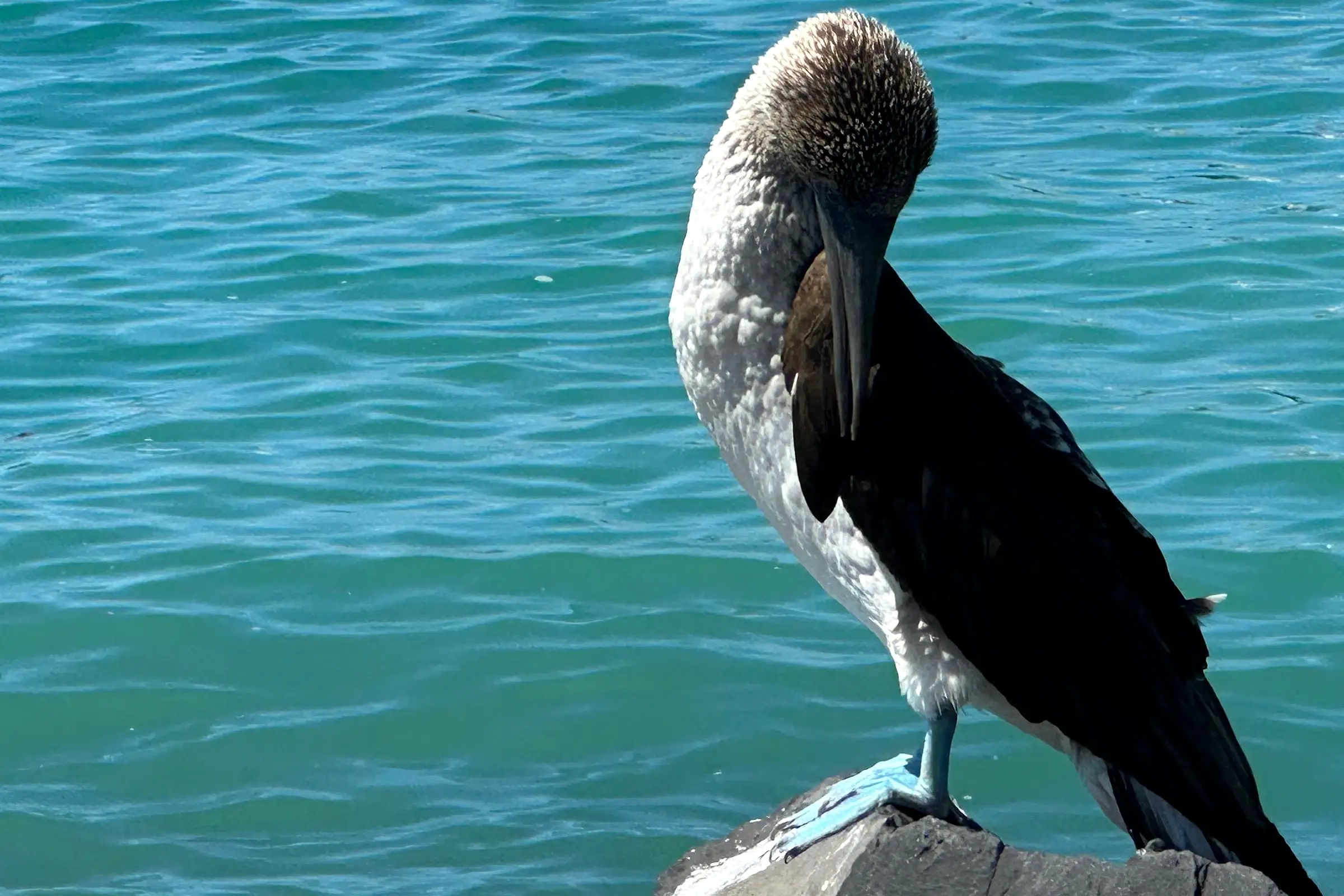
A blue-footed booby on a lava rock at the water’s edge in the Galápagos.
Ten days on three islands
The same route as the seven days, with the extra nights where they do the most good: a second boat day from Santa Cruz, a third night on Isabela, and time on San Cristóbal that is not spent waiting for a boat.
| Days | Island | What fills them |
|---|---|---|
| 1 to 4 | Santa Cruz, 4 nights | Highlands, two boat days, the Darwin Station and Tortuga Bay |
| 5 to 7 | Isabela, 3 nights | Boat from Puerto Ayora, Las Tintoreras, Sierra Negra, Los Túneles |
| 8 to 9 | San Cristóbal, 2 nights | Plane from Isabela, the town and its beaches, Kicker Rock |
| 10 | Flight home from San Cristóbal |
Day 5 is the boat to Isabela and day 8 the plane to San Cristóbal, so nothing sends you back through Puerto Ayora. The 06:00 boat from Isabela never comes into it.
Adding Machu Picchu to the trip
Peru and the Galápagos connect through Guayaquil. LATAM flies Cusco to Guayaquil through Lima in 5 h 20, leaving at 09:30 and landing at 14:50. That is too late for the island flights, so the night goes in Guayaquil and the islands start the next morning.
We put Peru first and the islands last. You climb to Cusco and the Sacred Valley while you are fresh, and you finish the trip at sea level, on a beach, with a flight back to Guayaquil that lands early in the afternoon. That is how our Machu Picchu and Galapagos trip runs, in ten, twelve or sixteen days: the five-day Santa Cruz plan above sits inside the ten-day version, and the twelve and sixteen add Isabela.
For the Peru half, our Peru itinerary sets out the order of Cusco, the Sacred Valley and Machu Picchu, and our guide to the best time to visit Peru has the dry months for the Andes.
Starting in Quito instead
If the mainland part of the trip is Ecuador, start in Quito and give it three or four days before the islands: the old town, the Otavalo market and the road south past Cotopaxi. Avianca’s 11:05 from Quito flew nonstop to Baltra on our sample date, and the other Quito flights stopped in Guayaquil on the way. At the end, fly home from San Cristóbal through Guayaquil to Quito or to your international connection.
The two halves of Ecuador do not share a season. The Andes are driest from June to September, when the islands are in their cool months; our guide to the best time to visit Ecuador compares the months region by region. For trips that put the islands next to the volcanoes, see our Ecuador tours.
Hotels or a cruise
Everything above is land-based: hotels in the three towns and boats by day. A cruise works the other way round. The ship sails at night and wakes up at a new visitor site, and cruises run from four days and three nights to twelve days and eleven nights, on boats of 12 to 110 passengers, according to the Galápagos Conservancy.
A cruise reaches islands too far for a day boat. A land trip gives you more control over the pace, a different bed only every two or three nights, and evenings in town. For a first visit, and for anyone who gets seasick, we find the land version easier to enjoy. For couples, our guide to a Galápagos honeymoon compares the hotels and lodges on each island, with the prices they publish.
The questions we get on this
- How many days is enough in Galápagos?
- Five days and four nights is the least we would plan for a first visit. Flights reach the islands around midday and leave before noon, so five days give three full days on Santa Cruz, two of them on boats to nearby islands. Seven days add Isabela and San Cristóbal, and ten cover the same three islands with a second boat day and a third night on Isabela.
- What is the best Galápagos itinerary?
- For a first trip by land, seven to ten days on three islands: fly into Baltra, stay on Santa Cruz, take the boat to Isabela, fly the small plane from Isabela to San Cristóbal and fly home from there. The route never repeats a crossing and avoids the day of two boats that the sea route between Isabela and San Cristóbal needs.
- How many days should you spend on each island?
- Three or four nights on Santa Cruz, two or three on Isabela and two on San Cristóbal. Santa Cruz gets the most because the day boats to North Seymour, Santa Fe, Bartolomé and Plazas leave from Puerto Ayora. Isabela needs at least two nights, since the boat there takes about two hours each way.