Best Time to Visit Ecuador, Region by Region (2026)
The best time to visit Ecuador is June to September for Quito and the Andes, on INAMHI rain data. The coast, Amazon and islands differ.

The best time to visit Ecuador is June to September if your trip centres on Quito and the Andes. In those four months Quito gets 158 mm of rain; in the four months from February to May it gets 534 mm. The figures are the 1981-2010 normals of INAMHI, Ecuador’s national weather service, as published by the World Meteorological Organization.
That answer covers one region. Ecuador fits four climates into a few hours of road and one short flight, and they do not share a calendar: the coast is driest when the Andes are, the Amazon is never dry, and the Galápagos run warm and wet in the first half of the year. We are based in Quito, and this is how we plan around them.
Four regions, four calendars
| Region | Station | Driest months | Wettest months | Rain in the wettest month |
|---|---|---|---|---|
| Andes | Quito, 2,850 m | Jul–Aug, 21–28 mm | Mar–Apr | 171 mm (April) |
| Coast | Guayaquil | Aug–Oct, 1–6 mm | Feb–Mar | 332 mm (February) |
| Amazon | Puyo, 960 m | Sep, 258 mm | Apr | 511 mm (April) |
| Galápagos | San Cristóbal | Aug–Nov, 8–13 mm | Feb–Mar | 107 mm (February) |
Quito, Guayaquil and San Cristóbal are INAMHI’s 1981-2010 normals. Puyo comes from the station’s monthly normals in the Japan Meteorological Agency’s world climate tables, which do not state the period, so read its figures as a guide to scale.
What the table hides is that temperature hardly enters into it. Quito’s average high moves between 20.8 °C and 22.3 °C across the whole year. Ecuador sits on the equator, and its seasons are made of rain.
Best time to visit Quito and the Andes
The best time to visit Quito is July and August. July averages 21.5 mm of rain over seven days, August 27.7 mm over seven. April, the wettest month, averages 171.2 mm over twenty: eight times July’s rain, and nearly three times as many wet days.
The Andes have two rainy seasons, which surprises most people who plan from a single wet season. Quito’s rain climbs from February to a peak in April, eases from June to September, and climbs again to a second peak in October and November. September is the hinge month: 68.9 mm, still drier than any month from October to May.
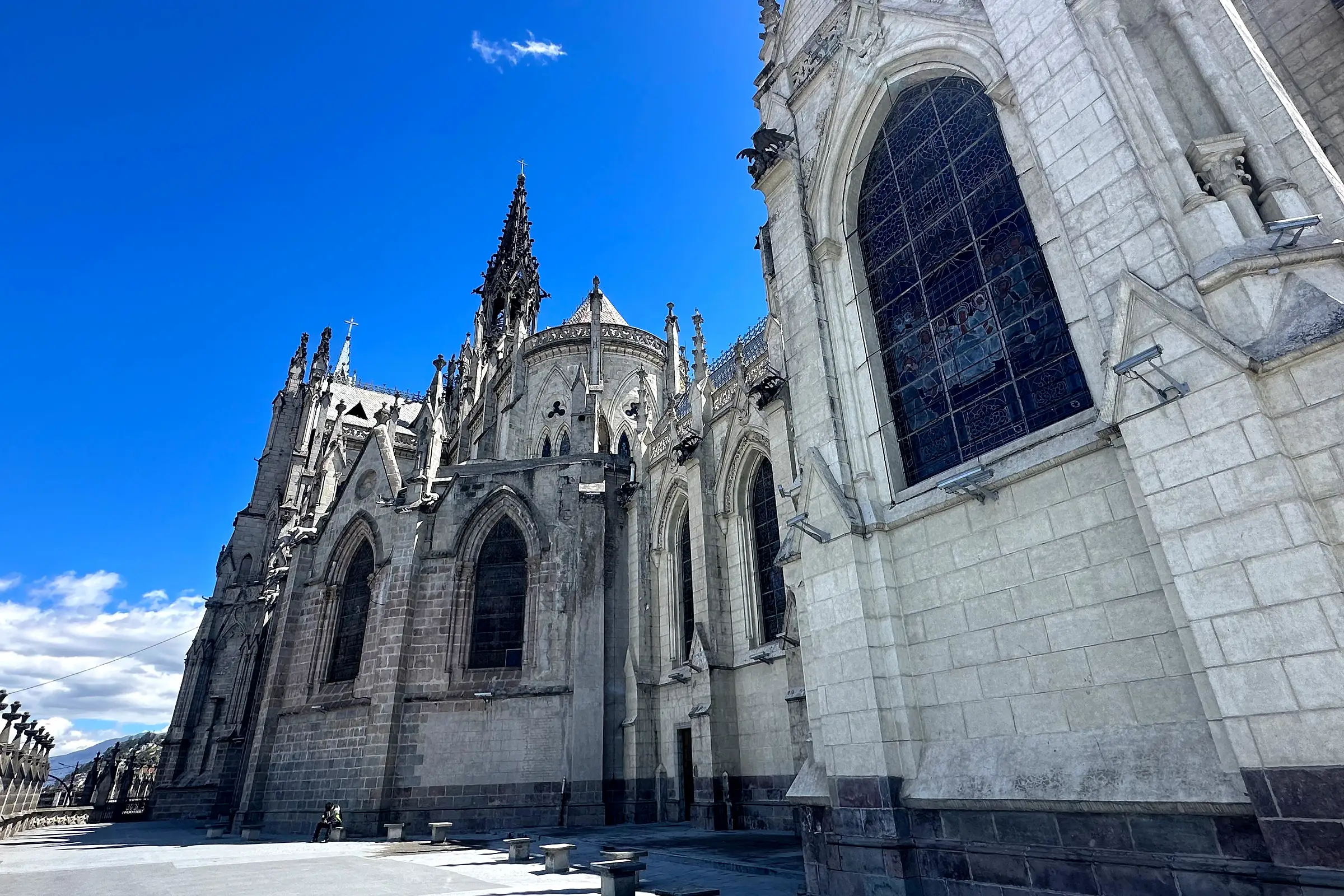
The Basílica del Voto Nacional in Quito’s old town, July 2026.
In practice the wet months are workable. In our experience Quito’s rain falls mostly in the afternoon, so we schedule the old town and the viewpoints early in the day from October to May. Nights are the same all year, 9 to 10 °C on average, which matters more for what you pack than for when you go.
The same pattern holds for the Avenue of the Volcanoes south of Quito. Cotopaxi, at 5,897 m, is rated active by Ecuador’s Geophysical Institute, with fumarolic activity on its last update. The summit reopened in February 2024 to organised groups with licensed operators, and access can change with the volcano’s status, so we confirm it before every departure. Day visits walk the lower slopes, on the trail toward the refuge in the photo below.
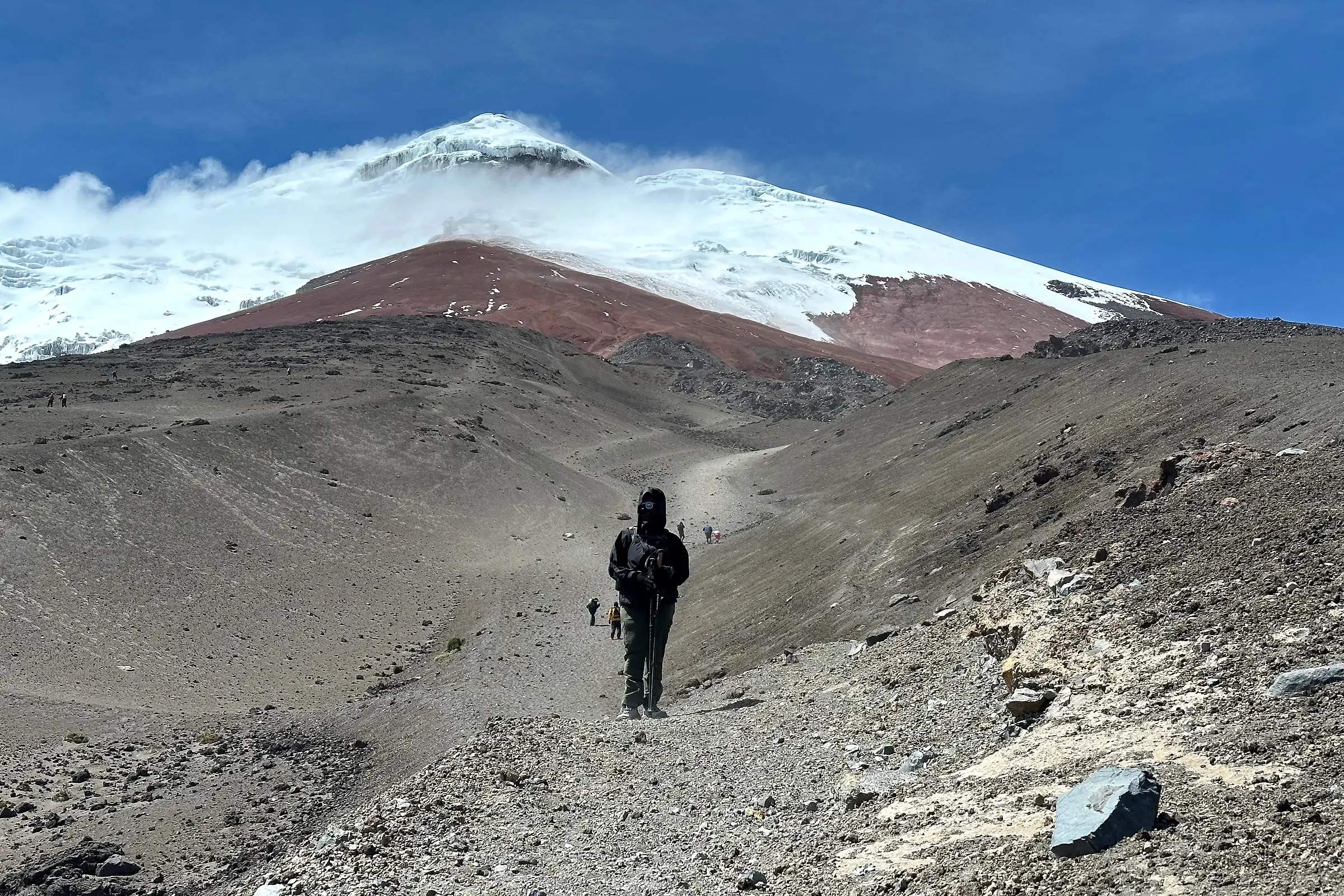
The trail to the José Rivas refuge on Cotopaxi, October 2025.
Quilotoa, the crater lake in the hero photo, shows why the rainy months matter on the ground. On 12 March 2026 a rockslide of about 20,000 m³ fell into the lake and sent unusual waves across it. The Geophysical Institute and the national risk agency found no volcanic cause: the slope gave way after heavy rain. The path down to the water is steep and loose, and we treat it as a dry-season walk.
Otavalo, about two hours north of Quito, follows Quito’s calendar, and its market is at its biggest on Saturdays in any month.
Galápagos: warm and wet, or cool and dry
The islands run on their own calendar. The Charles Darwin Foundation counts December to May as the warm season, with calm seas and warmer water, and June to November as the cool one, so the dry months in Quito are the cool months at sea. Our guide to the best time to visit Galápagos has the sea temperature, the wildlife calendar and the 2027 El Niño outlook, month by month.
Flights to the islands leave Quito and Guayaquil in the morning: our guide on how to get to Galápagos has the times and the fees, and the Galápagos itinerary sets out five, seven or ten days by land. Our Ecuador and Galapagos tours add the volcano road south of Quito; our Machu Picchu and Galapagos trip adds Peru, whose dry season the best time to visit Peru covers.
The Amazon has no dry season
Puyo, at the foot of the Andes on the road down from Baños, averages about 4,800 mm of rain a year. Its driest month, September, still receives about 258 mm: twelve times what Quito gets in July. The wettest is April, at 511 mm.
The rain does not close the forest; it changes the river levels and the mud on the trails. What the numbers support is a mild preference for August and September, the least wet months at Puyo, which also fall in the Andes’ dry season.
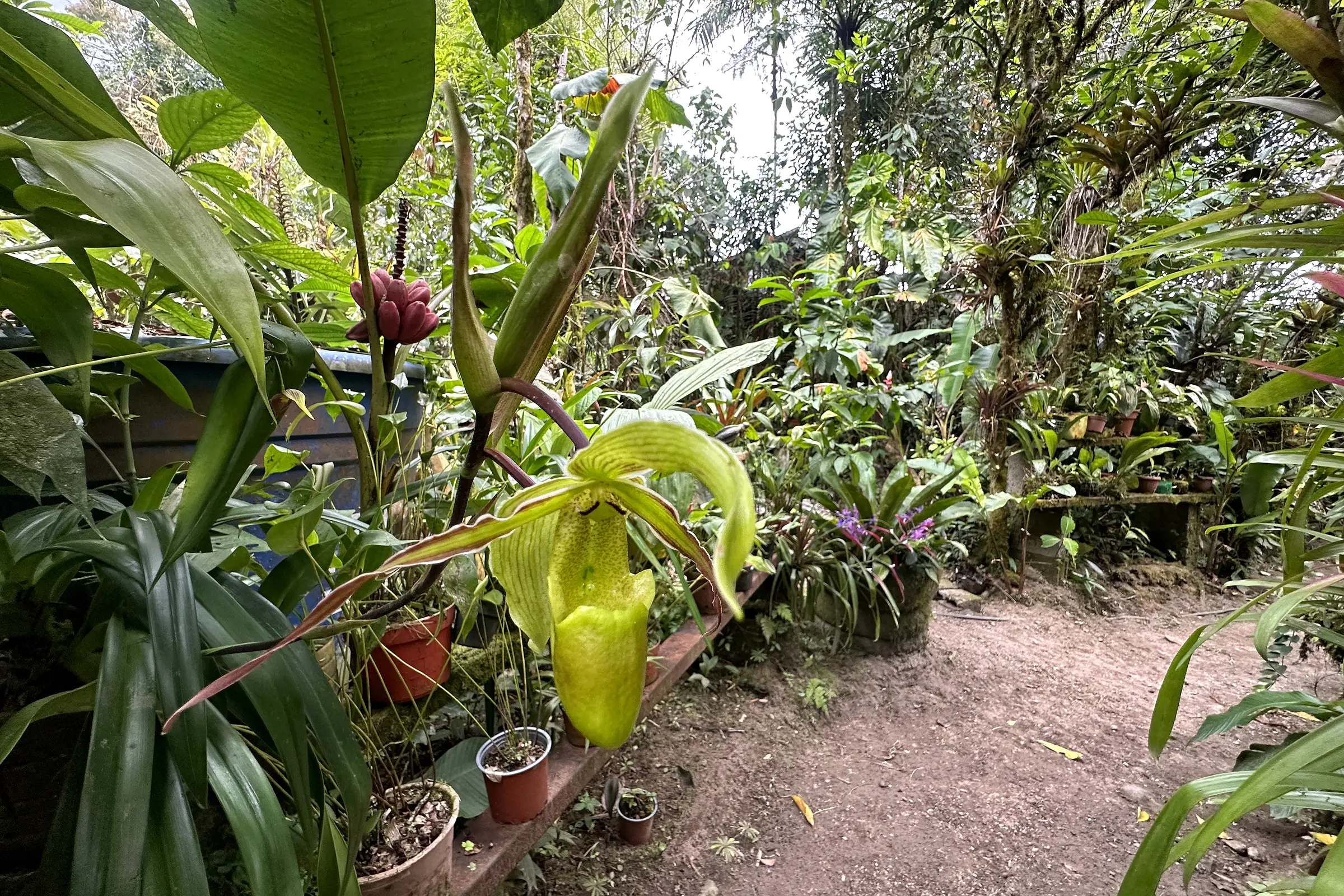
An orchid garden in the cloud forest at Mindo, on the western slope of the Andes, August 2024.
The cloud forest around Mindo, on the western slope, is wet in every month too. Go for the birds and orchids and accept the drizzle.
The Pacific coast, and the advice to read first
On the coast the dry season is unmistakable. Guayaquil receives 83% of its year’s rain from January to April, when February alone brings 332 mm. From August to October it averages under 6 mm a month, with highs around 30 °C.
Before you plan coastal days, read the current government advice. The UK’s travel advice, updated on 2 October 2026, advises against all but essential travel to seven coastal provinces, Guayas among them, with an exception for airside transit at Guayaquil airport. Canada lists specific areas of Guayaquil, Esmeraldas, El Oro and Los Ríos. Our guide to the safest country in South America sets out what each government says about Ecuador and its neighbours.
Festivals and holidays, 2026 and 2027
| Date | What | Where |
|---|---|---|
| 16–17 Feb 2026 · 8–9 Feb 2027 | Carnival, a national holiday | Everywhere; water fights in the Andes |
| 21 June | Inti Raymi, the festival of the June solstice | Imbabura province (Otavalo, Cotacachi) |
| 2 November | Día de los Difuntos, a national holiday | Everywhere |
| Late Nov to 6 December | Fiestas de Quito, the city’s founding day (1534) | Quito |
The 2026 holidays are from the official calendar published by Ecuador’s Vice Ministry of Tourism. Carnival 2027 falls on 8 and 9 February because Easter Sunday is 28 March; the government has not yet published the 2027 calendar. In 2026 Imbabura held Inti Raymi events from 12 to 20 June, around the central date of 21 June. The Fiestas de Quito programme is announced by the city each November; in 2025 it ran from 16 November.
National holidays move Ecuadorians too. On the long weekends of Carnival and November, roads out of Quito are slow and hotels in Baños and Otavalo fill early, so we book those dates first.
So when is the best time to go to Ecuador?
For a first trip that combines Quito, the Andes and the Galápagos, the best time to go to Ecuador is late June to early September. It is the driest window in the highlands, and the islands are in their cool season.
For warm water in the Galápagos and fewer constraints on the mainland, go in December or January, before the Andean rain builds; Quito’s December and January average 100 and 83 mm.
Avoid March and April only if the Andes are the heart of the trip. They are Quito’s two wettest months and the time of year when slopes like Quilotoa’s give way.
At Quito’s 2,850 m the altitude counts in every season; our guide to South America altitude has the order that helps. For how we put Ecuador into a longer journey, see our Ecuador tours.
The questions we get on this
- When is the best time to visit Ecuador?
- June to September for Quito and the Andes. INAMHI’s 1981-2010 normals give Quito 21.5 mm of rain in July against 171.2 mm in April, and the temperature barely moves all year. The same months are dry on the coast and cool in the Galápagos. If the islands are the priority and you want warm water and calm seas, December to May suits them better.
- What is the rainy season in Ecuador?
- It depends on the region. In Quito it rains most from February to May, with a peak in April, and again in October and November. On the coast at Guayaquil, January to April brings 83% of the year’s rain. The Amazon has no dry season: at Puyo even the driest month, September, averages about 258 mm.
- When is the best time to visit Quito?
- June to September, and July and August above all. Quito averages 21.5 mm of rain in July and 27.7 mm in August, with seven rainy days in each, against 20 rainy days in April. Days run at 21 to 22 °C all year and nights at 9 to 10 °C, so pack the same layers in any month.
- When is the best time to go to Ecuador and the Galápagos?
- June to September works for both, with a trade-off in the islands. The Andes are at their driest, and the Galápagos are in their cool season, which the Charles Darwin Foundation dates from June to November. Expect cooler water and rougher seas then. December to May brings warmer water and calm seas in the islands, but it is the Andes' wetter half of the year.
- Is it cold in Quito?
- The days are mild and the nights are cool. At 2,850 m, Quito’s average high stays between 20.8 °C and 22.3 °C in every month, and the average low between 9.4 °C and 10.2 °C, according to INAMHI’s 1981-2010 normals. There is no winter: the seasons change the rain, not the temperature.