How to Get to Galápagos From the US, Quito or Lima
How to get to Galapagos: fly from Quito or Guayaquil to Baltra or San Cristóbal, buy a $20 transit card and pay the $200 park fee. Lima adds a night.

How to get to Galápagos has one answer for every visitor: you fly. Planes leave from Quito or Guayaquil on the Ecuadorian mainland and land at one of two island airports, Baltra or San Cristóbal. The archipelago lies about 1,000 km off the coast, according to UNESCO, and the Galápagos authorities will not issue a tourist the transit card without a return air ticket between the mainland and the islands.
The rest is timing and paperwork. Island flights leave the mainland only in the morning, so most trips spend a night in Quito or Guayaquil first. At the mainland airport you pay $20 for a transit card and put your bags through a biosecurity check. When you land you pay the national park fee, $200 for a foreign adult. We are based in Quito, and this is the order we plan it in.
Which island airport to fly into
There are two, and the choice depends on where you sleep.
The Seymour Ecological Airport (code GPS) sits on Baltra, a flat, dry island off the north coast of Santa Cruz. It is the airport for Puerto Ayora, the town on Santa Cruz, and for Isabela, which you reach by boat from Puerto Ayora. Its airline directory lists two carriers from the mainland, LATAM and Avianca, plus the air taxis Emetebe and EsavAirlines.
The airport of San Cristóbal (SCY) is on the edge of Puerto Baquerizo Moreno, the capital of the province, about ten minutes from the town by road. LATAM and Avianca fly here too, though less often: on our sample date there were two flights from Guayaquil, against three to Baltra.
Isabela has a small airstrip, but only inter-island planes use it. If your hotels are on Santa Cruz or Isabela, book Baltra. If they are on San Cristóbal, book San Cristóbal. If the trip covers both ends of the archipelago, fly into one and out of the other, which saves a crossing. On a cruise the ship decides: ask which airport it meets before you buy the flight.
Flights from Quito or Guayaquil
These are the flights Google Flights listed for Wednesday 10 February 2027, checked on 17 November 2026. Schedules change from season to season. The shape of the day is what matters: everything leaves in the morning.
| Route | Airlines | Stops | Flying time |
|---|---|---|---|
| Guayaquil to Baltra | LATAM, Avianca | Nonstop | 1 h 58–2 h |
| Guayaquil to San Cristóbal | LATAM, Avianca | Nonstop | 1 h 50 |
| Quito to Baltra | Avianca | Nonstop, one flight | 2 h 15 |
| Quito to Baltra | LATAM, Avianca | Guayaquil | 3 h 30–3 h 40 |
| Quito to San Cristóbal | LATAM, Avianca | Guayaquil | 3 h 23–3 h 55 |
On that date every flight to the islands left the mainland between 07:27 and 11:25. The departures from Guayaquil to Baltra were at 09:18, 09:50 and 10:19. From Quito to Baltra there was one nonstop, Avianca at 11:05, and three flights that stop in Guayaquil. To San Cristóbal from Guayaquil there were two, at 09:00 and 11:25.
One detail confuses the arrival times. The islands keep their clocks one hour behind the mainland, so Avianca’s two-hour flight that leaves Guayaquil at 09:50 lands at 10:50. Set your watch back when you land.
Coming home works the same way in reverse. Flights from Baltra to Guayaquil on Wednesday 17 February left between 10:56 and 12:00 and landed between 13:49 and 14:53, mainland time. That leaves the evening for an international flight, if it leaves late enough to absorb a delay.
Guayaquil or Quito? From Guayaquil every island flight is nonstop and shorter. Quito makes sense when the trip also covers the Andes, or when you would rather not spend a night in Guayaquil (see the advice for British travellers below). Our Ecuador itinerary shows how the volcano road south of Quito ends back in the city the night before the island flight.
Getting to Ecuador first
The island flights all start on the Ecuadorian mainland, so the trip begins with a flight to Guayaquil or Quito. For Tuesday 9 February 2027, Google Flights listed:
- From Miami, American Airlines nonstop to Guayaquil in 4 h 34, and American and LATAM nonstop to Quito in about 4 h 20.
- From New York (JFK), nonstops to Guayaquil with LATAM, Avianca and JetBlue, between 6 h 39 and 6 h 51.
- From London, no nonstop. The shortest option took 15 h 20 with a change in Madrid.
Most of these land in the afternoon or at night, after the last island departure. So the normal plan is one night in Guayaquil or Quito and the island flight the next morning. The overnight flights from New York land around 08:00, which on paper leaves time for a 09:50 departure to Baltra. With the transit card and the bag check still to do, we would not build a trip on that connection.
How to get to the Galápagos Islands from Lima
There is no flight from Peru to the islands, so from Lima you connect through Ecuador. LATAM flies Lima to Guayaquil nonstop in about 2 h 15, at 12:35 and at 23:30 on our sample date, and Lima to Quito in 2 h 25. Avianca through Bogotá and Copa through Panama City take six to seven hours.
The midday flight lands in Guayaquil at 14:50, more than three hours after the last plane to the islands has gone. When we asked Google Flights for a single ticket from Lima to Baltra, the only options used the 23:30 departure and a wait of 7 h 38 to 8 h 39 in Guayaquil airport overnight. A hotel night is the better trade.
From Cusco the day is longer but still works: a LATAM connection through Lima leaves at 09:30 and reaches Guayaquil at 14:50. That is the transfer day of our Machu Picchu and Galapagos trip: Cusco in the morning, a quiet evening in Guayaquil, and the morning flight to Baltra the next day. The trip runs ten, twelve or sixteen days, and even the ten-day version keeps four nights on Santa Cruz. Our guide on how to get to Machu Picchu covers the Peru half of that route.
If you travel on a Peruvian passport, the park fee is lower: Peru belongs to the Andean Community, whose citizens pay $100 instead of $200.
For British travellers there is one more thing to weigh. The UK Foreign Office advises against all but essential travel to seven coastal provinces, Guayas among them, and its exception covers only airside transit at Guayaquil airport. A night in the city falls outside it, which is a good reason for British travellers to spend the mainland night in Quito.
Paperwork at the mainland airport
Everything here happens at the Quito or Guayaquil airport, before you check in with the airline. The Galápagos Government Council (CGREG) runs a counter in both airports.
- Pre-register online. The council asks visitors to fill in the pre-registration form before the day of travel, which shortens the queue at the counter.
- At the counter, show your passport and your return ticket to the islands, and pay $20 for the Transit Control Card (TCT). Keep it: you show it again when you leave the islands.
- Take your bags to the inspection room of the Galápagos biosecurity agency (ABG), where they are checked for organic products that could carry invasive species to the islands.
- Check in with the airline as usual.
As a tourist you can stay up to 60 days a year in the islands, counted from your first entry. Before landing, the cabin is sprayed with a product approved by the World Health Organization; the crew announces it first. The same bag inspection happens again at the docks whenever you take a boat from one inhabited island to another.
The park entrance fee on arrival
Park rangers collect the entrance fee at the Baltra and San Cristóbal airports as you come through. These are the amounts set by Provincial Ordinance 001-CGREG-30-06-2025, unchanged since the increase of 1 August 2024:
| Visitor | Fee |
|---|---|
| Foreign adult, 12 or older | $200 |
| Foreign child, under 12 | $100 |
| Citizen of an Andean Community or Mercosur country, 12 or older | $100 |
| Andean Community or Mercosur citizen, under 12 | $50 |
| Ecuadorian or resident of Ecuador, 12 or older | $30 |
| Child under 2 | Free |
In the park’s table the Andean Community countries are Bolivia, Colombia, Ecuador and Peru, and the Mercosur ones Argentina, Brazil, Paraguay and Uruguay; both groups pay half. The Government Council approved the increase on 24 February 2024, the first change in 26 years; before it, a foreign adult paid $100.
So a foreign adult needs $220 in fees to arrive: $20 on the mainland and $200 on the islands. If the price of a Galápagos trip you are comparing does not include them, add them.
From the airport to your hotel
From Baltra to Puerto Ayora takes three steps, which the Galápagos National Park sets out:
- A bus from the terminal to the Itabaca Channel, about ten minutes, $5 for an adult.
- A barge across the channel to Santa Cruz, about ten minutes, $1.
- A bus to Puerto Ayora, about $5 and 30 to 45 minutes across the island, or one of the white pickup taxis, which carry up to four people for $30 in total and are a little faster.
The road crosses the highlands of Santa Cruz, where the giant tortoises live, so many trips stop there on the first afternoon on the way down to town. From the airport of San Cristóbal, a taxi or bus into Puerto Baquerizo Moreno costs $2 to $3.
Check the news in the week you fly. On 31 October 2026 the Galápagos government declared an emergency after heavy rain flooded parts of Santa Cruz, and the UK Foreign Office reported road closures and disruption on the way to Baltra airport in its update of 1 November.
Moving between the islands
Once you are on the islands, small public speedboats run from Puerto Ayora to Isabela and to San Cristóbal, and Emetebe flies small planes between Baltra, San Cristóbal and Isabela. There is no boat between Isabela and San Cristóbal: by sea you change in Puerto Ayora. Our Galápagos itinerary has the crossing times and the order that wastes the fewest hours on boats, for five, seven or ten days.
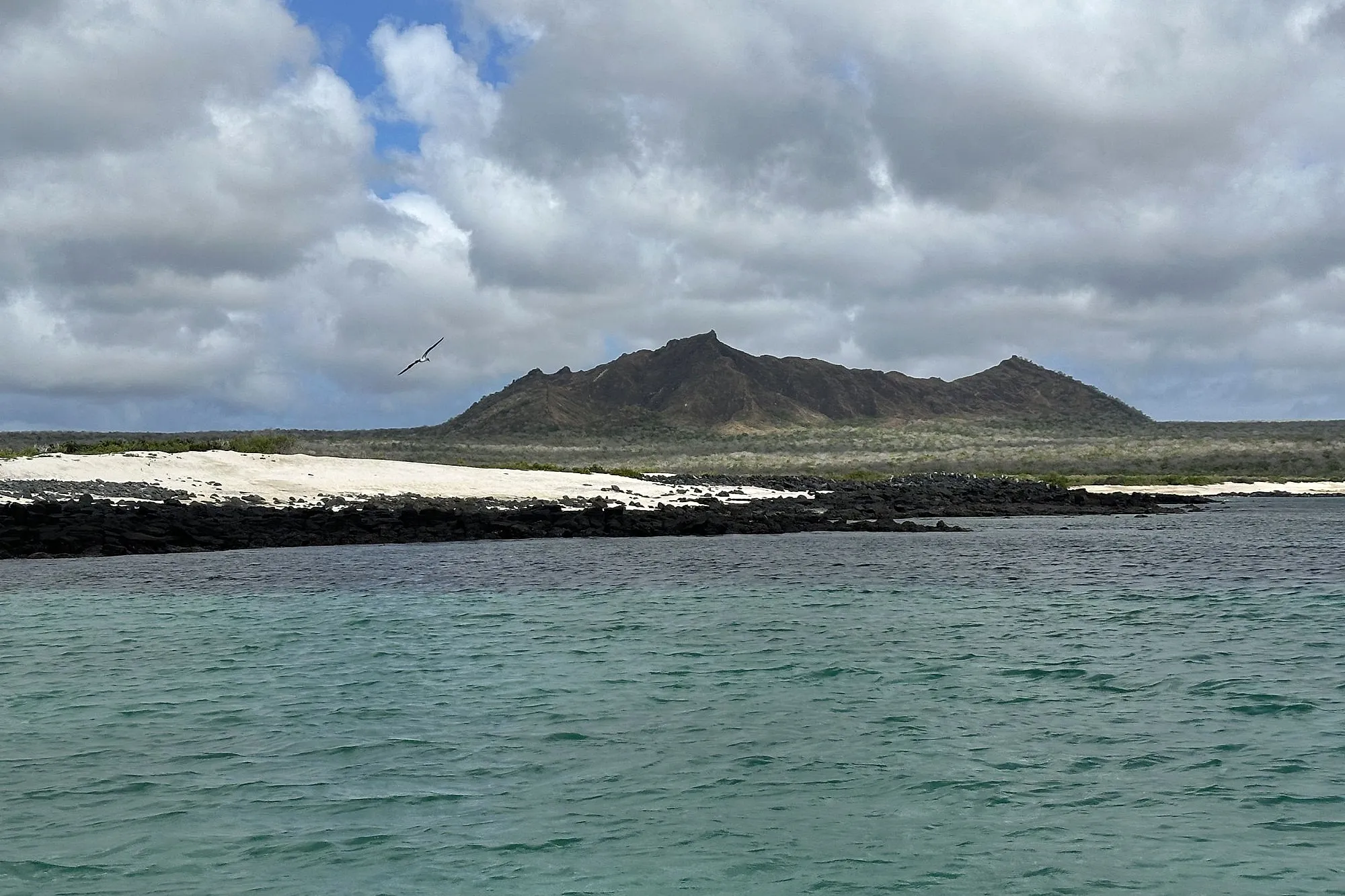
A white beach and black lava in the Galápagos.
The order we plan it in
For a first trip with the islands as one part of a longer journey, the sequence that works is this: fly to Guayaquil or Quito, sleep, take the morning flight to Baltra, and leave the islands from San Cristóbal if you have time for three islands. Book the island flights before anything else on the Ecuador side, because they set the dates for everything around them.
If the islands sit next to the Andes, our guide to the best time to visit Ecuador compares the seasons on the mainland and in the Galápagos, which run on different calendars. For how we combine the islands with Quito and the volcanoes, see our Ecuador tours.
The questions we get on this
- Which airport do you fly into for Galápagos?
- Seymour Ecological Airport on Baltra (GPS) or the airport of San Cristóbal (SCY). Baltra serves Santa Cruz, its town of Puerto Ayora and, by boat from there, Isabela. San Cristóbal serves its own island. If your trip covers both, fly into one and out of the other. Isabela has an airstrip, but only small inter-island planes use it.
- How long is the flight from Quito to Galápagos?
- About 2 h 15 nonstop, or 3 h 23 to 3 h 55 with a stop in Guayaquil, which is how most Quito flights run. On our sample date in February 2027, Avianca had the only nonstop from Quito to Baltra. From Guayaquil the nonstop flights take 1 h 50 to 2 h.
- Are there direct flights from Quito to Galápagos?
- Some. For 10 February 2027, Google Flights listed one nonstop from Quito to Baltra, an Avianca departure at 11:05, and none to San Cristóbal. The other Quito flights stop in Guayaquil. Every flight from Guayaquil to either island airport was nonstop.
- How long is a flight from the US to the Galápagos Islands?
- There is no flight from the US to the islands themselves. Nonstops from Miami reach Guayaquil or Quito in about 4 h 20 to 4 h 35, and from New York about 6 h 40 to 6 h 50. The island flight adds about two hours the next morning, because island departures leave the mainland before noon.
- How do you get to the Galápagos from Lima?
- Fly Lima to Guayaquil or Quito, sleep there, and take a morning flight to the islands. LATAM flies both routes nonstop in a little over two hours. The daytime flights land after the last island departure, so the only through connection we found was a 23:30 flight with a wait of seven to eight hours in Guayaquil airport.
- Can you do Galápagos and Machu Picchu in one trip?
- Yes. A LATAM connection leaves Cusco at 09:30 and reaches Guayaquil at 14:50 via Lima, and the island flights leave Guayaquil the next morning. Our trip that combines them runs ten, twelve or sixteen days, and even the ten-day version keeps four nights on Santa Cruz.