Best Time to Visit Machu Picchu and Galapagos (2027)
Best time to visit Machu Picchu and Galapagos in one trip: May, then early June. Rain, sea temperature and 2027 visitor caps by month.

The best time to visit Machu Picchu and Galapagos on one trip is May. Peru has just left its rainy season, the islands are still in their warm one, and Machu Picchu keeps its regular cap of 4,500 visitors a day for the whole of May 2027. The first half of June comes next. Every other month asks you to give something up on one side, and the table below shows what.
The best time to visit Galapagos and Machu Picchu, month by month
Three figures decide this trip: the rain in Cusco, the rain at Machu Picchu itself, and how warm the sea is around the islands.
| Month | Cusco rain, mm | Machu Picchu rain, % | Island sea, °C |
|---|---|---|---|
| Jan | 145.3 | 15.5 | 24.5 |
| Feb | 133.7 | 16.0 | 25.4 |
| Mar | 107.0 | 16.0 | 25.7 |
| Apr | 43.2 | 9.2 | 25.5 |
| May | 8.7 | 3.0 | 24.7 |
| Jun | 1.5 | 2.1 | 23.5 |
| Jul | 4.0 | 2.1 | 22.3 |
| Aug | 8.6 | 3.2 | 21.5 |
| Sep | 21.8 | 4.5 | 21.5 |
| Oct | 39.4 | 7.8 | 21.7 |
| Nov | 71.9 | 8.3 | 22.3 |
| Dec | 122.7 | 12.3 | 23.2 |
The Cusco column is the monthly normal that SENAMHI, Peru’s weather service, supplies to the World Meteorological Organization. The Machu Picchu column is each month’s share of the year’s rain at SENAMHI’s station there, from table 49 of its agroclimatic study of the Cusco region. The sea column is our own average, for 1991 to 2020, of the daily sea temperature the Charles Darwin Foundation records at Puerto Ayora, on Santa Cruz island.
Read across and one month stands out. May is the only one with less than 4% of Machu Picchu’s rain and a sea above 24 °C. June misses the second mark by half a degree.
May: the one month both halves agree on
In May the Machu Picchu station gets 3% of its yearly rain, and Cusco averages 8.7 mm for the whole month. Around Santa Cruz the sea still averages 24.7 °C, one degree below its March peak. The Charles Darwin Foundation counts May in the warm season, which it describes as the time of calm seas and warmer water.
Machu Picchu is not quiet in May, though. Ministerial Resolution 000408-2026-MC, published in El Peruano on 1 November 2026, holds the citadel to 4,500 visitors a day for all of May 2027. Our guide to the best time to visit Machu Picchu shows how close to that limit May ran in 2025, so the entry ticket is the first thing to book.
June: the driest Andes, a cooling sea
June is the driest month in Cusco, with 1.5 mm on average, and the first month of the Galapagos cool season. The sea at Puerto Ayora drops to an average of 23.5 °C, still warmer than any month from July to November.
The date that matters is 19 June. From that day until 2 November 2027 the same resolution raises the cap to 5,600 visitors a day, the high-season figure. Before it, fewer people can enter each day, which makes the first half of June the better half for this trip.
July to October: dry ruins, cool water
These are dry months at Machu Picchu, between 2.1% and 7.8% of the year’s rain each, and the coolest months in the islands. The sea at Puerto Ayora averages 21.5 °C in August and September, about four degrees below March. Snorkelling means a wetsuit; ours come included from June to November. Our guide to the best time to visit Galapagos takes the islands alone, month by month, with the wildlife calendar.
The Charles Darwin Foundation’s climate database explains why. From June the southeast winds strengthen, and the cold water of the Humboldt Current and the equatorial upwelling has more hold on the islands. The same pattern keeps a layer of low cloud and drizzle over the higher slopes that face the wind, while the rest of the archipelago gets almost no rain. At San Cristóbal, INAMHI’s 1981-2010 normals give less than 20 mm a month from July to November.
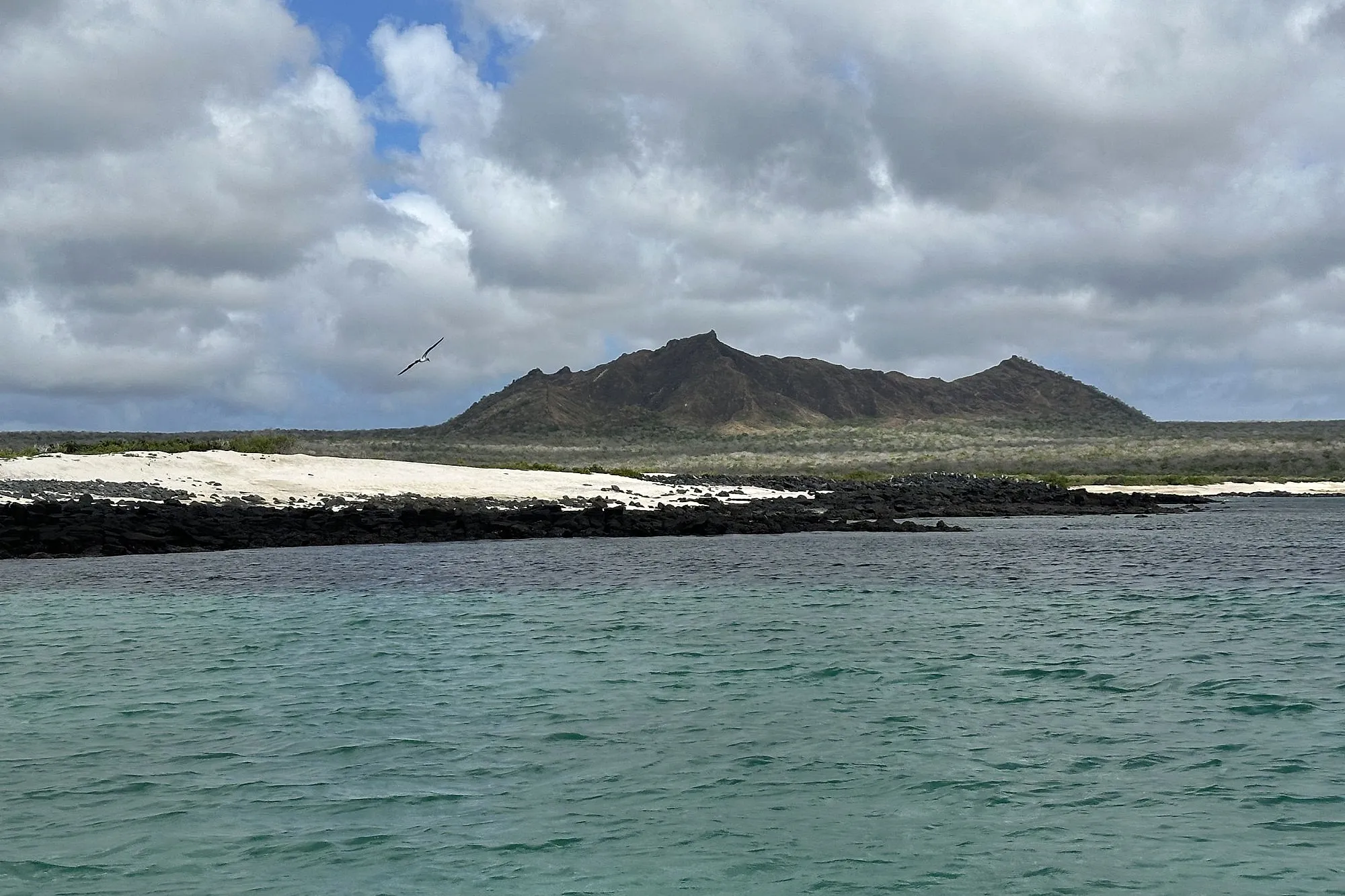
Lava, white sand and a low ceiling of cloud in the Galapagos, the kind of sky the Charles Darwin Foundation describes for the cool season.
For Machu Picchu this is high season, with the 5,600 cap every day from July to October 2027. If the ruins matter more to you than the sea, this is your window. The price is cooler water and, in our experience, a choppier ride on the launches between islands, above all from August on.
Whichever window you choose, our Machu Picchu and Galapagos trip runs ten, twelve or sixteen days and is dated from the citadel outwards: the Machu Picchu entry ticket first, then the train and the flights around it.
November and December: both seasons turn
November is the hinge month. At the Machu Picchu station it brings 8.3% of the year’s rain, the exact share at which SENAMHI starts counting a rainy season, and Cusco’s rain nearly doubles from October to 71.9 mm. In the islands the sea warms again, to 22.3 °C in November and 23.2 °C in December.
December is the month the islands’ calendar is least sure about. The Charles Darwin Foundation’s visitor page starts the warm season in December; its climate database starts it in January and notes that both seasons change length from year to year. Take December as a month that can go either way.
Machu Picchu’s year-end high season covers 29 to 31 December 2027, at 5,600 visitors a day, and 2027 opens the same way, from 1 to 3 January.
January to April: warm water, wet Peru
The sea is at its warmest from February to April, 25.4 to 25.7 °C at Puerto Ayora. This is also when the islands get their rain, which the Charles Darwin Foundation calls convective: San Cristóbal averages 107.4 mm in February.
In Peru it is the core of the rainy season. January to March bring 47.5% of the year’s rain at the Machu Picchu station, and Cusco gets between 107 and 145 mm in each of those months. Apart from 1 to 3 January, Easter is the one break in the regular cap: from 25 to 28 March 2027 Machu Picchu runs at 5,600 a day.
April is the best of these four months for this trip. Cusco has mostly dried out, at 43.2 mm, and the sea is still at 25.5 °C. Machu Picchu is the catch. Its station still records 9.2% of the year’s rain in April, above the 8.3% line, so the citadel stays wet for a month after the city.
February: the Inca Trail closes
Every February the Inca Trail network shuts for the whole month. Article 10 of the park authority’s regulation for the trail closes it each year for the recovery of its ecosystems and for maintenance. The closure covers the trail network; Machu Picchu itself stays open.
For this trip, February pairs some of the warmest water of the year with one of the two wettest months at Machu Picchu. We would plan it only for travellers who come mainly for the islands and do not mind rain at the ruins.
Which half should choose the month
If one half of the trip matters more to you, let it decide.
| If you care most about | Go in | What you accept |
|---|---|---|
| Both halves at once | May, or 1 to 18 June | A busy Machu Picchu |
| The warmest sea | February to April | Rain in Peru, and no Inca Trail in February |
| The driest Andes | June to September | Water at 21.5 to 23.5 °C, and a wetsuit |
The best time to visit Galapagos and Machu Picchu does not depend on which one you see first. On a trip of ten to sixteen days both halves fall in the same month or the next, so the season you pick applies to both.
Planning the rest of the trip
This guide covers only the overlap between the two places. For the Machu Picchu side in full, with the hourly entry slots and the routes sold in each season, see the best time to visit Machu Picchu. If Lima or the Amazon are on your route too, the best time to visit Peru covers the coast and the forest, which keep calendars of their own. On the Ecuador side, the best time to visit Ecuador has Quito and the coast, where this trip spends a night before the island flight. Our Peru tours page lists the other routes we run there.
The questions we get on this
- What is the best month to visit Galapagos and Machu Picchu?
- May. At Machu Picchu it is the first dry month, with 3% of the year’s rain at the SENAMHI station there, and in the Galapagos it is the last month of the warm season, when the sea at Puerto Ayora still averages 24.7 °C. In 2027 Machu Picchu keeps its regular cap of 4,500 visitors a day all through May. The first half of June is the next best choice.
- Can you do Galapagos and Machu Picchu together?
- Yes. We plan it in ten days at the least, with a night on the Ecuadorian mainland between the two, because flights to the islands leave only in the morning from Quito or Guayaquil. The harder part is the month: Machu Picchu is driest from May to August, while the Galapagos have their warm season of calm seas from December to May. May falls inside both.
- When not to go to the Galapagos Islands?
- For a trip that also includes Machu Picchu, two stretches are hardest. From August to October the sea at Puerto Ayora averages 21.5 to 21.7 °C, the coolest of the year, and the stronger winds of the cool season make the sea choppier. From January to March the water is warm but Peru is at the heart of its rainy season, and the Inca Trail is closed all of February.
- Is June a good time to visit Galapagos?
- Yes, and for a trip with Machu Picchu it is one of the best. June opens the Galapagos cool season, but the sea at Puerto Ayora still averages 23.5 °C, warmer than any month from July to November. In Cusco it is the driest month of the year, with 1.5 mm of rain. From 19 June 2027 Machu Picchu moves to its high-season cap of 5,600 visitors a day.