Is Colombia Safe? What 4 Governments Say, Stop by Stop
Is Colombia safe? The US, UK, Canadian and Australian advice side by side, with dates, and what it means on the route from Bogotá to Cartagena.

Is Colombia safe? The United States rates the whole country Level 3, reconsider travel, but on the route most visitors take, from Bogotá to the coffee region, Medellín and Cartagena, none of the four governments we read on 17 November 2026 puts a stop in its strictest category. That is a narrower claim than saying the country is safe, because the US rating covers the classic route as much as the borders.
What changes along the route is the kind of risk. In the cities the advice is mostly about crime aimed at visitors: phone theft, drugging, fake police and unlicensed taxis. The armed groups behind the strictest warnings are concentrated, the UK says, where coca is grown and trafficked, above all in rural areas near the borders and in Pacific ports such as Buenaventura and Tumaco. Both the US and the UK add that police and military targets are attacked in large cities too. This guide puts the four governments side by side, with the date on each page, and then goes through the route one stop at a time.
What four governments say, side by side
| Government, page updated | Overall advice | Strictest warning |
|---|---|---|
| United States, 31 Mar 2026 | Level 3, reconsider travel | Do not travel: Arauca, Cauca except Popayán, Valle del Cauca except Cali, Norte de Santander, 10 km from Venezuela |
| United Kingdom, 30 Oct 2026 | No overall level | All but essential travel: the Venezuelan border, most of the Pacific coast, parts of Antioquia, Bolívar, Córdoba, Meta, Caquetá, Guaviare and Putumayo |
| Canada, 2 Nov 2026 | High degree of caution | Avoid all travel: Arauca, Caquetá except Florencia, Cauca except Popayán, most of Chocó, Norte de Santander except Cúcuta, the border strips, Tumaco and Buenaventura |
| Australia, 6 Oct 2026 | High degree of caution | Do not travel: 20 km from the Venezuelan and Ecuadorian borders, Catatumbo, Cauca except Popayán, Buenaventura, Tumaco, the Darién Gap |
All four agree on two things: the land along the Venezuelan border, and Cauca outside its capital, Popayán. The US reasons for its Level 3 are crime, terrorism, civil unrest, kidnapping and natural disasters. Canada gives one reason for its overall advice, “high levels of crime”, and Australia gives two, violent crime and terrorism. The UK publishes no overall level at all; it lists areas, and its latest change, on 30 October, concerns Cúcuta, a border city that was already on its list.
Is Colombia safe to visit on the classic route?
Here is the same advice read the other way round, from the places a first trip usually goes. In the table, general advice means the US Level 3 for the whole country, the high degree of caution of Canada and Australia, and no mention on the UK’s list of areas.
| Stop | What the four advisories say |
|---|---|
| Bogotá | General advice only |
| Coffee region (Quindío) | General advice only |
| Medellín | General advice only |
| Guatapé | General advice only, inside Australia’s exception for the Oriente subregion |
| Rest of Antioquia | Australia: reconsider your need to travel. UK: Urabá and Bajo Cauca only. Canada: the north-west, by Chocó |
| Cartagena | General advice only |
| Santa Marta and Tayrona | General advice only; the UK and Australia say to visit Ciudad Perdida only on an organised tour, and Australia to keep to the paths in Tayrona |
Two rows need reading twice. The first is Antioquia, the department around Medellín. Australia asks travellers to reconsider going anywhere in it except Medellín and its Aburrá Valley, the Oriente subregion, and the towns of Jericó, Jardín and Santa Fé de Antioquia. The roads that leave the Aburrá Valley to the south cross parts of Antioquia that are not on that list, which is why our Colombia travel packages offer the daily flight from Armenia to Medellín as well as the road. The second is Tayrona, which sits on a road that was disrupted this autumn; that is covered below.
Is Bogotá safe?
Bogotá is on no government’s list of areas. The UK says British nationals have been robbed at gunpoint in the Candelaria, Bogotá’s old quarter, and warns that criminals posing as police operate in Bogotá and ask to inspect money for counterfeits. If that happens, the FCDO safety page says to ask them to walk you to the nearest police post, called a CAI. Australia adds that petty crime happens near hotels and at the airport in Bogotá, and that hikers have been robbed at gunpoint on trails in and around the city. Monserrate, the mountain above the centre, has a footpath; the funicular and the cable car go to the same summit.
At El Dorado airport only authorised taxis can pick up at the terminals. The UK describes them as yellow, with white plates and the number painted on the doors and roof. Then there is the altitude. Bogotá sits at about 2,600 m, Canada says, and Australia lists altitude sickness as a risk for anyone above 2,500 m. Our South America altitude guide explains what helps.
The coffee region: Salento, Cocora and Armenia
None of the four governments singles out Quindío, the department around Salento and the Cocora Valley. The question here in 2026 has been the earthquake of 10 August, which Canada and Australia still mention on their pages. Quindío’s tourism secretary, Juanita Gómez Zamorano, told El Olfato on 31 October 2026 that more than 95% of the department’s tourism businesses were operating normally, that all access roads were open and that Armenia’s airport had been working normally since 11 August.
Getting from here to Medellín is where the advice affects the plan. If you travel on Australian advice, the roads south of Medellín take you through the part of Antioquia it asks you to reconsider. The alternative is the flight: on the date we checked, 22 January 2027, there was a single nonstop from Armenia to Medellín, in the afternoon. The order of the route and the road times are in our Colombia itinerary, and the rain months for each region are in the guide to the best time to visit Colombia.
Is Medellín safe?
Medellín and its metropolitan area are on no government’s list of areas, and neither is Guatapé: Medellín’s tourism office places the town in the east of Antioquia, the subregion Australia leaves out of its warning. What the four pages say about the city itself is about crime. The UK names Medellín among the cities where pickpocketing, mugging and armed robbery are a problem, and Australia says organised criminals operate there.
Two warnings are specific to Medellín and the other big cities. Canada reports “an increase in deaths” linked to dating apps, with incidents most frequent in Bogotá, Cartagena and Medellín: criminals build trust over several dates, then drug the victim with scopolamine and rob or kidnap them. Australia says the victims are often single adult men. The second is Canada’s line on the comunas. It advises against renting accommodation in, or travelling to, vulnerable neighbourhoods “commonly known as comunas”, even on a guided tour. If a street-art walk in Comuna 13 is on your list, read Canada’s line before you book it. The UK asks for care in deprived areas of cities, after dark and when you are alone, and does not name neighbourhoods.
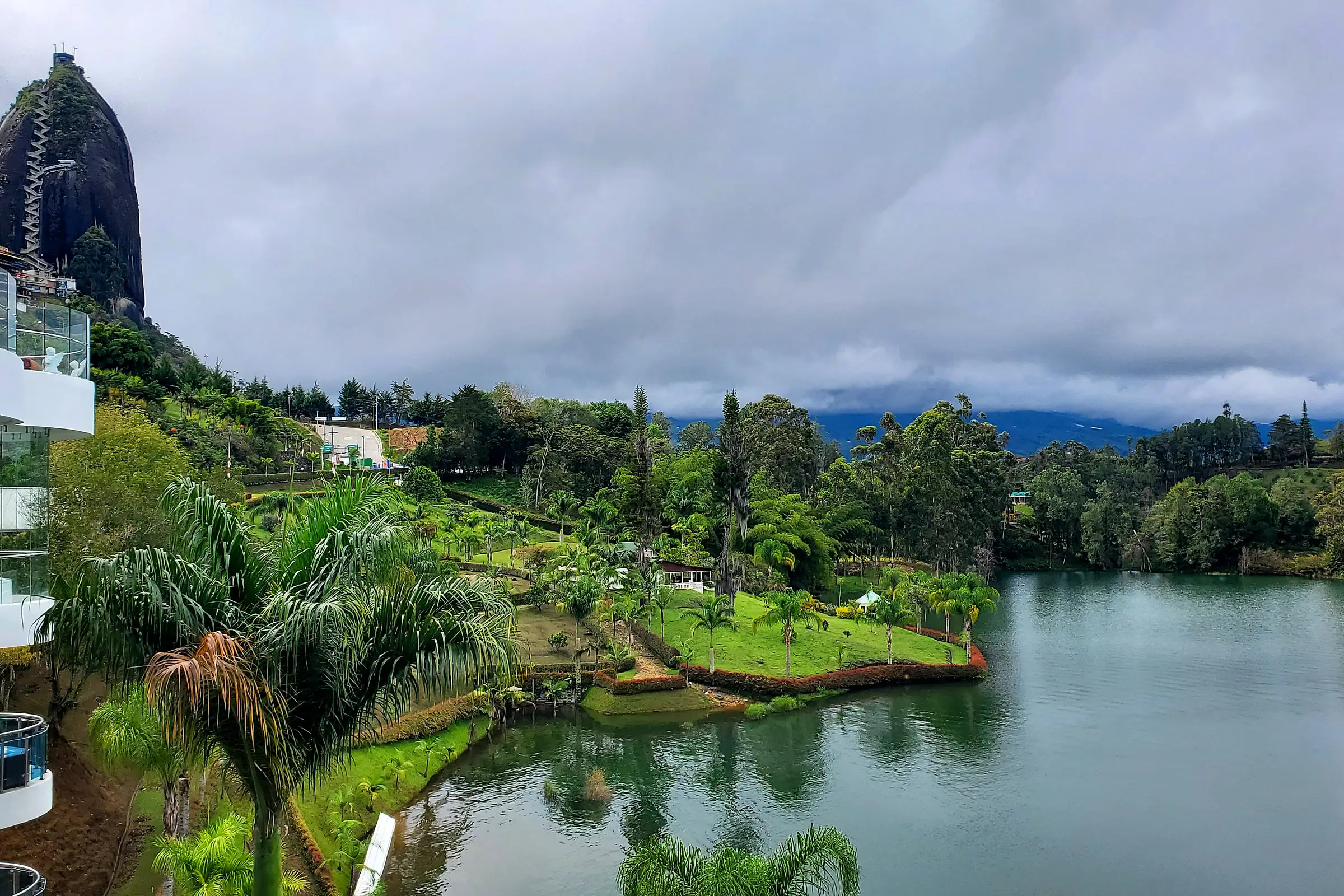
El Peñol and the reservoir at Guatapé, east of Medellín. Photo by Latin Lands.
Is Cartagena safe?
Cartagena is on no list of areas either, and what the four pages describe there is street crime, overcharging and the tour boats to the islands. Australia names Cartagena among the cities where pickpocketing and bag snatching are common. Canada and Australia both describe card overcharging in tourist areas, with scammers charging visitors inflated prices for food, drink and services, and both give the same advice: ask for a printed price list before you order.
The US Embassy issues alerts for big events. Before the Independence Day festivities of 11 to 16 November 2026 it warned of a significant increase in petty theft, advised avoiding the areas east of the Caribe Plaza shopping centre, and said residents there often set up illegal roadblocks to ask for money.
Then the boats. Canada says accidents have happened with unlicensed tour boats that do not meet safety standards, naming Cartagena, San Andrés and Santa Marta, and advises choosing a reputable company and not boarding a vessel that looks overloaded. Australia says to travel only in licensed boats and to check for life jackets, and it extends the warning to the islands and beaches near Cartagena, which is where the Rosario Islands boats go. On the beach, Canada warns that some beaches have no lifeguards, many have no warning flags, and riptides are common.
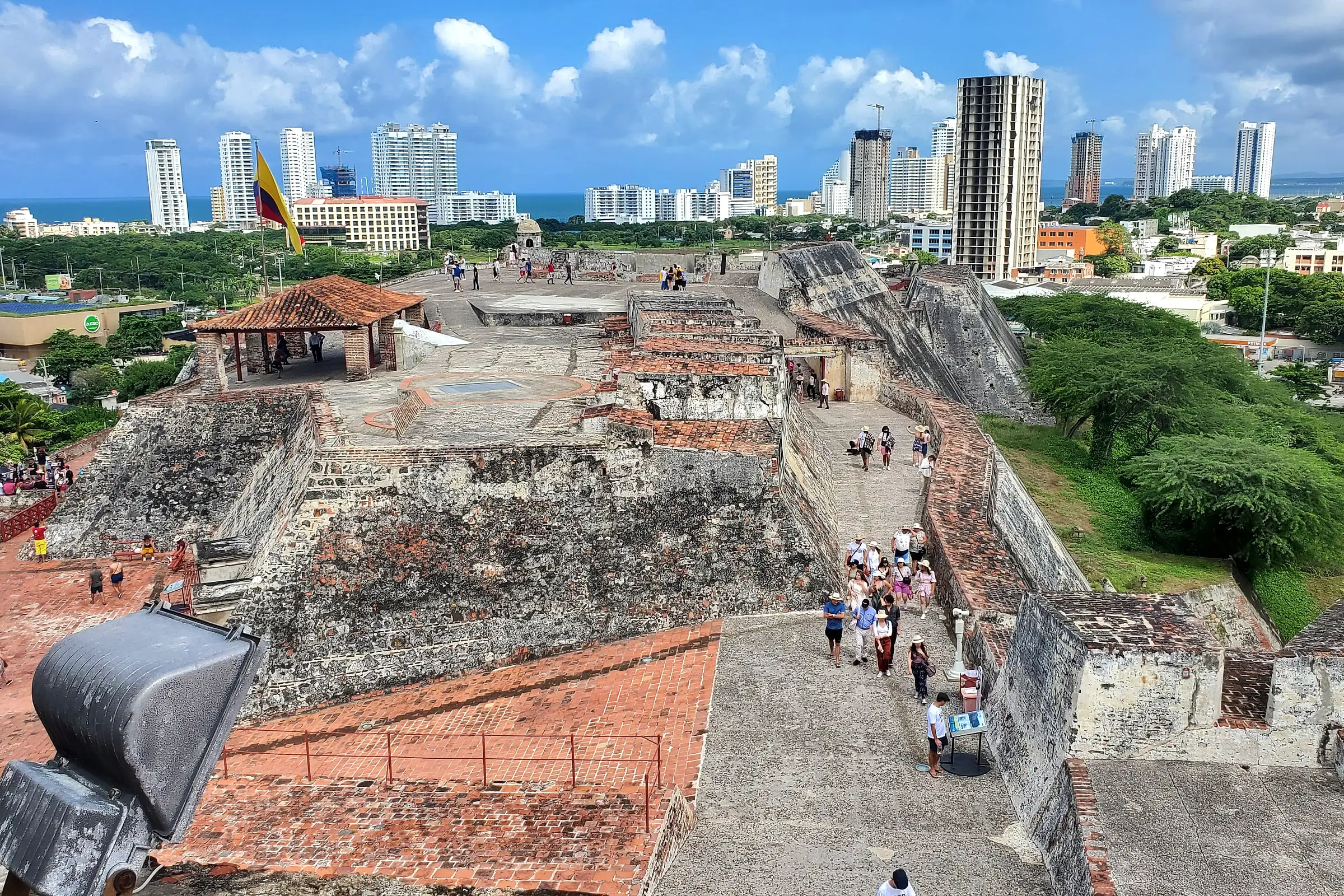
The ramparts of the Castillo San Felipe, Cartagena. Photo by Latin Lands.
Santa Marta and the road east to Tayrona
Santa Marta is outside every list, but the road east of it has had a difficult autumn. On 23 September 2026 the US Embassy reported that an illegal armed group had announced a 72-hour armed transport blockade in Santa Marta and the surrounding area, including Route 90 through Palomino and the approaches to Tayrona National Park. Two days later Colombia’s national parks authority said Tayrona remained open and was operating normally. Canada notes that Route 90 has been closed by roadblocks before and that more closures can come with little warning; it gives 767, the highway police line, for road status in Spanish.
Inside the park, Australia’s advice is short: do not venture inland, and keep to the marked paths, the beaches and the resorts. The UK and Australia both say to visit Ciudad Perdida, the Lost City in the Sierra Nevada, only on an organised tour. Tayrona also closes three times a year, in February, June and October to November; the latest closure ran from 19 October to 2 November 2026 and it reopened on 3 November.
Is Colombia safe for tourists? Taxis, apps and scams
The advice that applies at every stop of the route is about taxis, bars and cash machines, and on this the four governments agree.
- Do not hail taxis in the street. The UK recommends licensed taxis booked by phone or app, or through your hotel or restaurant, and names Uber and Cabify. The US goes further for its own staff in Colombia, who are not allowed to hail taxis from the street or use any form of public transport.
- Use cash machines inside a bank, supermarket or shopping centre during business hours. The UK calls express kidnappings, where the victim is driven between ATMs or forced to make transfers, common, and says they often start around ATMs at night.
- Never leave a drink unattended or accept food, drinks, cigarettes or gum from strangers. The UK says scopolamine can be given in food, drinks, cigarettes, aerosols and even paper flyers.
- If someone says they are police and asks for your money or passport, ask to go to the nearest CAI, the advice of the UK and Australia.
- If you are robbed, hand things over. The US says “do not resist”, and Canada says the same.
Roads, buses and boats
Canada’s advice on public transport is a single sentence: “You should avoid public transportation.” It describes city and rural buses as frequent targets for theft, with passengers drugged and robbed. The UK reports armed robberies on buses and asks travellers to avoid night journeys, adding that main roads are generally safe in daylight. Both advise against driving at night, and Canada warns that roads are most hazardous in the rainy months of April to May and October to November.
Off the main roads the risks change in kind. The UK says there are landmines in rural and remote areas, often unmarked. The classic route avoids long overland legs by flying between regions, and our Colombia travel guide covers those flights along with entry rules, money and the vaccines to get before you go.
Is Colombia safe to travel to right now?
Three things were current when we read the pages on 17 November 2026. The UK reported that on 29 October the president ordered security forces into Cúcuta, on the Venezuelan border, an area all four governments already warn against. The UK also says the Colombian government has declared an El Niño event, likely strong to very strong until at least March 2027, with heavy rain, landslides, drought and wildfires that may disrupt travel. And the US advisory points to landslides in the informal settlements on the hillsides of mountain cities such as Bogotá and Medellín.
None of that moves a stop of the classic route into a no-go area. It does mean the dates matter, and that a plan should be checked against the advisories in the week you travel, not the week you book.
Colombia or Peru?
If you are choosing between the two for a first trip, the US advisories differ by one level: the State Department rates Peru at Level 2, exercise increased caution, in an advisory issued on 4 September 2026. Our guide to whether Peru is safe reads the same four governments for Peru, and our Machu Picchu tour packages follow the classic Peruvian route from Lima to Cusco. For the whole continent on the same measures, see our guide to the safest country in South America.
If Colombia is the trip you want, the next question is money: our guide to the Colombia travel cost prices the same route item by item, and our Colombia tours page explains how we plan trips there.
The questions we get on this
- Is it safe to travel to Colombia right now?
- It depends where. On 17 November 2026 the US rated Colombia Level 3, reconsider travel, and Canada and Australia advised a high degree of caution. None of the four governments we read puts Bogotá, Medellín, Cartagena, Santa Marta or the coffee region in its strictest category; those warnings cover the Venezuelan border, Cauca and much of the Pacific coast. On the usual route the risks are robbery, drugging and unlicensed taxis.
- Is Colombia safe for Americans?
- The State Department rates Colombia Level 3, reconsider travel, in an advisory issued on 31 March 2026. It says not to travel to Arauca, Cauca outside Popayán, Valle del Cauca outside Cali, Norte de Santander or within 10 km of Venezuela. Its own staff in Colombia may not hail taxis in the street or use public transport, which is a fair guide for visitors as well.
- Is Medellín safe?
- Medellín is outside every no-go list, but Canada and Australia name it among the cities where criminals use dating apps to drug and rob foreigners. Australia advises reconsidering travel to most of Antioquia, with exceptions for Medellín and its metropolitan area, the Oriente subregion and three towns. Canada advises against vulnerable neighbourhoods, which it says are commonly called comunas, even on a guided tour.
- Is Cartagena safe?
- Cartagena is outside every regional warning; the risks there are petty theft, overcharging and tour boats. Australia says pickpocketing and bag snatching are common in Cartagena, Canada reports accidents with unlicensed tour boats there, and both advise asking for a printed price list before ordering. The US Embassy expected a significant increase in petty theft during the Independence Day festivities of 11 to 16 November 2026.
- Is Bogotá safe?
- Bogotá is outside every no-go area, but the UK says British nationals have been robbed at gunpoint in the Candelaria quarter, and Australia says hikers have been robbed on trails in and around the city. Use app or hotel-booked taxis; at El Dorado airport only authorised taxis can pick up at the terminals. Australia also lists altitude sickness as a risk above 2,500 m, which includes Bogotá.
- Is Santa Marta safe?
- Santa Marta is outside the regional warnings of all four governments, but the road east to Tayrona has been disrupted. On 23 September 2026 the US Embassy reported a 72-hour armed blockade announced by an illegal group around Santa Marta and Route 90, while the national parks authority said Tayrona stayed open. Australia advises keeping to designated paths and beaches inside the park.