Colombia Travel Guide: Entry, Money and Safety (2026)
A Colombia travel guide for planning: entry rules, pesos and tipping, safety region by region, domestic flights, the altitude of Bogotá and vaccines.

This Colombia travel guide covers the practical side of a first trip: you can visit for up to 90 days without a visa on most Western passports, you pay in pesos and need cash outside the cities, the classic route of Bogotá, Medellín, the coffee region and Cartagena sits outside every no-go area in the US and UK advice, you fly between regions rather than drive, and Bogotá is high enough to feel. The one vaccine to sort before you go is yellow fever.
We plan multi-day trips across South America and write this from the planning side: what we check before every Colombian booking, with the official source linked the first time it appears. For where to go once the practical side is settled, see our guide to the best places to visit in Colombia.
Colombia at a glance
| What to know | |
|---|---|
| Entry | Up to 90 days without a visa for UK visitors, onward ticket required |
| Currency | Colombian peso (COP); cards in cities, cash everywhere else |
| Emergency number | 123 for police and ambulance |
| Main airport | El Dorado, Bogotá |
| Altitude | Bogotá about 2,600 m; Cartagena at sea level |
| Vaccines | Yellow fever recommended for most routes and asked for at national parks |
| Tap water | Safe only in Bogotá |
Entry requirements
The rules below are the UK government’s reading of Colombia’s rules, which is the clearest official summary in English. According to the FCDO entry requirements for Colombia, updated on 15 October 2026, British visitors can stay up to 90 days without a visa for tourism, at the discretion of the immigration officer, and must be able to show an onward or return ticket inside those 90 days. You can extend once you are there, but no visitor can stay more than 180 days in any 12-month period.
Three details catch people out:
- Passport validity. Colombia only asks for a passport valid on entry, but its immigration service recommends six months beyond the date you leave. Airlines sometimes apply the stricter version at check-in.
- The Check-Mig form. Migración Colombia runs an online pre-registration you can fill in between 72 hours and one hour before your flight. The FCDO describes it as not mandatory but faster at the desk. We ask our travellers to do it anyway.
- San Andrés and Providencia. The islands charge a tourist card that you buy at the boarding gate on the day of the flight, unless you stay under 24 hours.
US, Canadian, Australian and EU passport holders get a similar visa-free stay. The authority on your own nationality is the Colombian foreign ministry, and it is worth a look before you book anything non-refundable.
Money, cards and tipping
Colombia uses the peso. Prices run into thousands and tens of thousands, so a lunch can read 35.000 on the menu: Colombians use the point as the thousands separator. The central bank publishes the official daily rate, the TRM on the Banco de la República site, which is a good reference before you change money.
Cards work in most hotels and the better restaurants of the big cities. Outside them you need cash: the boatmen on the coast want it, and so do the jeep drivers in the coffee region. Take it from ATMs inside shopping centres or banks in daylight. That is not superstition: the FCDO warns that so-called express kidnappings, where a victim is driven between cash machines, often start around ATMs at night and in unlicensed taxis.
Restaurants usually add a service charge, and this is where visitors pay twice. Colombia’s consumer regulator, the Superintendencia de Industria y Comercio, says the tip is voluntary, can never be more than 10% of the bill, and the waiter has to ask whether you want it included. If the bill already has a line for propina or servicio voluntario, that is the tip.
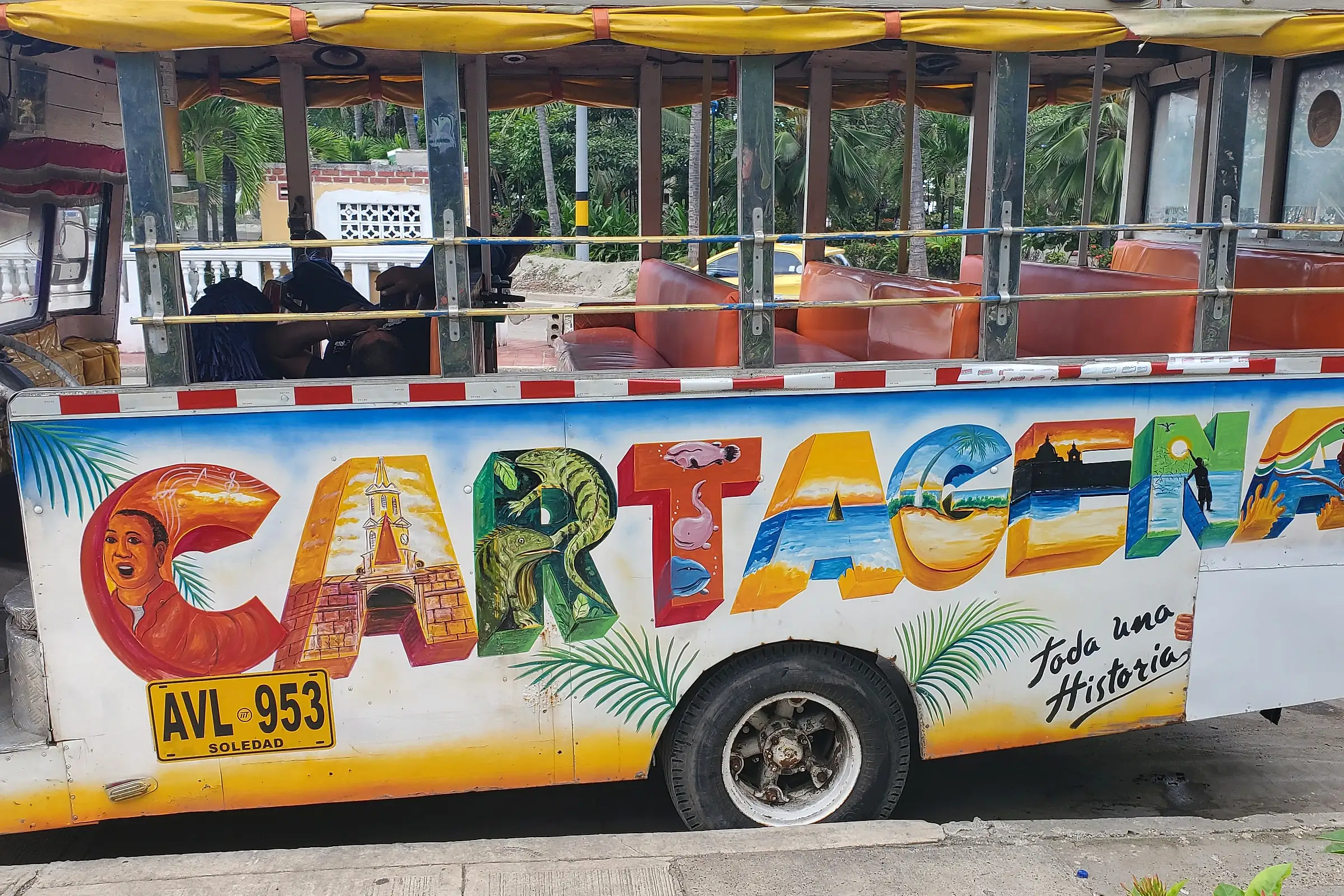
A chiva, the painted open-sided bus of the Caribbean coast, in Cartagena. Rides like this are paid in cash. Photo by Latin Lands.
Is Colombia safe? What the US and UK governments say
Both governments publish advice by region, and the two lists overlap more than they differ. Our guide to whether Colombia is safe adds Canada and Australia and reads the four stop by stop. We read both before every booking and route around anything either of them marks.
| Region | United States | United Kingdom |
|---|---|---|
| Country as a whole | Level 3, reconsider travel | No overall level |
| Arauca and Norte de Santander (Venezuela border) | Do not travel | Against all but essential travel |
| Land near the Venezuelan border | Do not travel within 10 km | Against all but essential travel within 5 km |
| Cauca, except Popayán | Do not travel | Against all but essential travel |
| Valle del Cauca, except Cali | Do not travel | Western part and Buenaventura only |
| Chocó (Pacific), except Quibdó, Nuquí, Bahía Solano and Capurganá | Not singled out | Against all but essential travel |
| Southern Meta, except Caño Cristales | Not singled out | Against all but essential travel |
| Bogotá, Medellín, Cartagena, Santa Marta, coffee region | Level 3 as the rest | No regional warning |
The US figures come from the State Department advisory for Colombia, issued on 31 March 2026 (checked on 26 October 2026), which keeps the country at Level 3 for crime, terrorism, civil unrest, kidnapping and natural disasters. The UK list comes from the FCDO warnings page, which is longer and more specific; the table shows the parts that touch a traveller’s route.
What that means in practice: the places most people come for are outside both no-go lists, and the risks there are the urban ones. The FCDO safety page is blunt about them, and they are the ones we brief every traveller on:
- Phone theft and armed robbery in the cities, including the Candelaria quarter of Bogotá. Keep the phone in your pocket on the street, not in your hand.
- Unlicensed taxis. Use an app or a taxi the hotel or restaurant books for you. At El Dorado airport only the authorised yellow taxis can pick up at the terminals.
- Drugging with scopolamine, often set up through dating apps, and drinks left unattended in bars.
- Fake police who ask to check your cash for counterfeit notes. Real police do not do that.
Two current notes. The Colombian government declared an El Niño event that the FCDO expects to last until at least March 2027, with heavy rain, landslides and drought in different parts of the country. And on 10 August 2026 a magnitude 7.4 earthquake centred on San José del Palmar, in Chocó, struck western Colombia, according to the PAHO situation report; the coffee region took much of the damage. Its status today is in our best places guide.
The coffee region is open again: on 31 October Quindío’s tourism secretary said more than 95% of the department’s tourism businesses were working normally, as El Olfato reported. Our Colombia travel packages stay inside the places that neither list marks, and the farm and the hotel there are confirmed by name when you book. If you already know your month, you can tell us your dates and the places you have in mind and we will say plainly what we can confirm on the ground.
Getting around: fly between regions
Colombia is three mountain ranges and two coasts, and the roads between regions are slow, winding and, after heavy rain, prone to landslides. Between regions we fly. Bogotá’s El Dorado is the hub, with direct flights to Medellín, Pereira, Armenia, Cartagena, Santa Marta, San Andrés and Leticia, so most routes go through it at least once.
Some places only work by air. The FCDO notes that the departmental capitals of Amazonas, Vaupés and Guainía, Leticia among them, have no road connection at all, and Caño Cristales is reached by small plane to La Macarena. Book those flights early: they are small aircraft and sell out in season.
Inside a region we use private drivers. Bogotá to Villa de Leyva is about three hours by road, which is the right size for a day on the road with stops. Long overland legs between regions are what we avoid, partly for time and partly because both governments advise against several rural roads.
In Medellín you can leave the taxi behind: its metro and the Metrocable lines that climb the hillside neighbourhoods are clean, cheap and part of the visit in their own right.
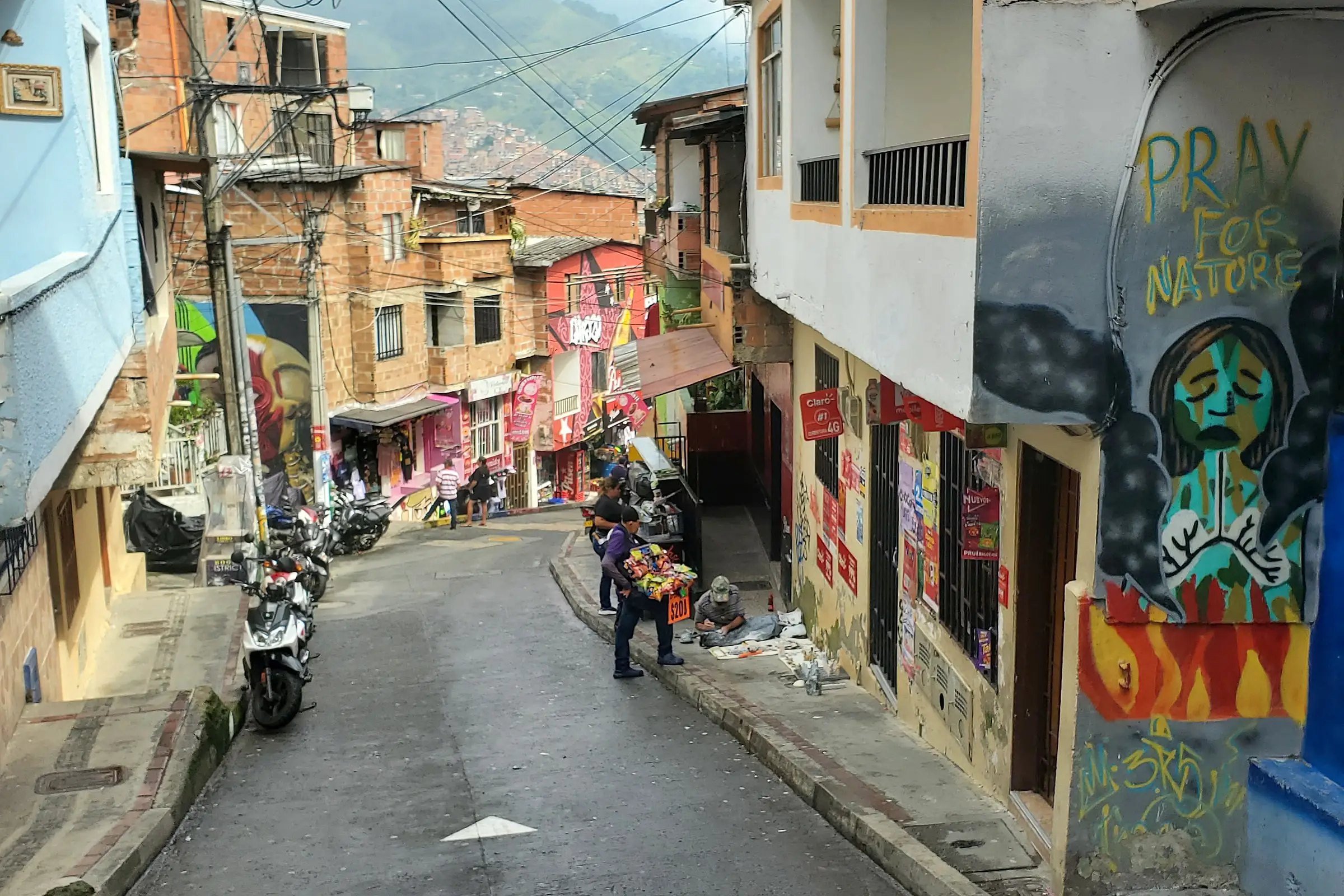
A street in Comuna 13, Medellín, reached by the metro and its outdoor escalators. Photo by Latin Lands.
Altitude in Bogotá
Bogotá sits at about 2,600 m, according to the city’s own health advice for visitors, and the FCDO lists altitude sickness as a risk there and in the high parts of four Andean departments around it. Most people feel it as a headache and short breath on the stairs for the first day or two, not more.
The fix is in the order of the trip. If you start in Bogotá and move down to the coffee region, Medellín and then the Caribbean, every night after Bogotá is lower than the one before. That is how we route it. For how altitude works on the higher Andean trips, and what helps, see our guide to altitude in South America.
Health: vaccines, water and mosquitoes
Yellow fever is the one to plan. The CDC’s Colombia page for travellers, reviewed on 3 September 2026, recommends the vaccine for everyone over nine months old except travellers who stay only in Bogotá, in San Andrés and Providencia, or above 2,300 m; for a trip limited to Barranquilla, Cali, Cartagena or Medellín it is “generally not recommended”. The CDC also has a level 2 notice for yellow fever in Colombia, updated on 18 September 2026, because cases have risen.
What decides it for most of our travellers is the parks. The home page of Parques Nacionales Naturales, Colombia’s national parks authority, says that vaccination is now required to enter its parks. That covers Tayrona, the Rosario islands and the Amazon parks. Get the jab well before you fly and carry the certificate.
The rest is ordinary tropical sense:
- Malaria is present below 1,700 m, the CDC says, but not in Bogotá, Cartagena or Medellín. For the Amazon or the Pacific coast, ask your travel clinic about tablets.
- Dengue and Zika are on the FCDO’s list of health risks. Repellent and long sleeves at dusk on the coast and in the Amazon.
- Tap water is safe only in Bogotá, again per the FCDO. Bottled water everywhere else.
What shapes the cost of a Colombia trip
We publish our own Colombia prices land only and by group size, with the flights quoted apart. On any trip there, this is where the money goes.
Domestic flights are the line that grows fastest: every region you add is at least one more flight, and the small planes to Caño Cristales, Leticia or the Pacific cost more per hour than anything else on the trip. Cartagena’s old-town hotels are the most expensive nights in the country. Colombian school holidays and the end-of-year season fill the coast early, and that pushes prices up more than any other factor. Our prices are land-only: international flights are an add-on, as on all our routes.
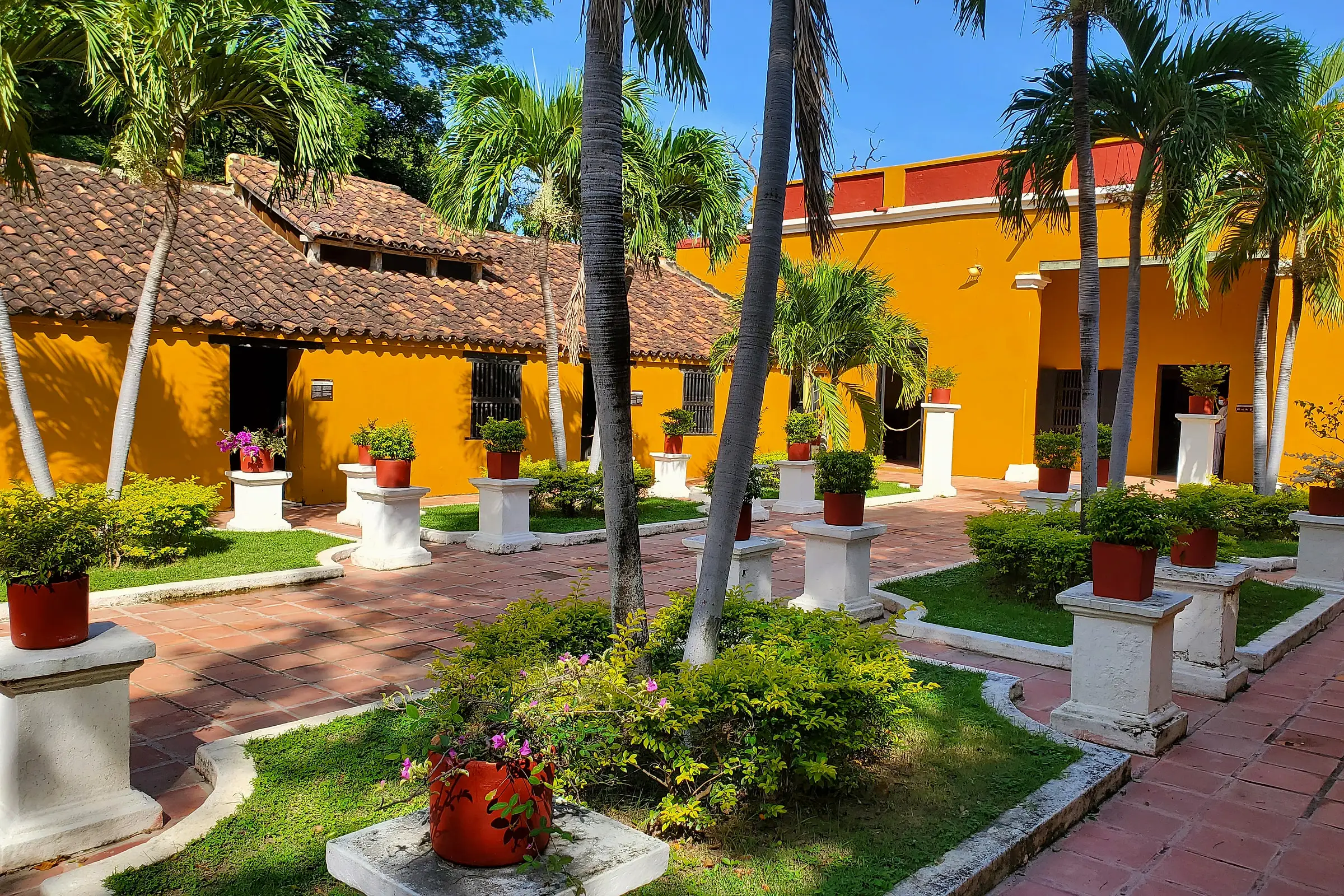
The garden of the Quinta de San Pedro Alejandrino, the hacienda in Santa Marta where Simón Bolívar died. Photo by Latin Lands.
How we plan a trip to Colombia
The route most first trips want is Bogotá, the coffee region, Medellín and Cartagena, in that order, so that the trip starts high and ends at the sea. We add the Tayrona coast, Villa de Leyva or the Amazon when the dates allow. Every plan is checked against the US and UK advice in the week we send it, not the week we wrote it. If you want to talk it through, start with our Colombia tours page.
The questions we get on this
- Do I need a visa to visit Colombia?
- Not for a holiday on a British passport, and the rule is similar for most North American, European and Australian passports. The UK government says British visitors can stay up to 90 days without a visa, at the discretion of the officer at the airport, and must show an onward or return ticket. Check the Colombian foreign ministry with your own nationality before booking.
- Is Colombia safe for tourists right now?
- The main tourist route is, with city precautions. The US rates Colombia Level 3, reconsider travel, and the UK advises against travel to several border and Pacific regions, but Bogotá, Medellín, Cartagena and Santa Marta are outside the no-go areas of both. In the cities the risks are robbery, unlicensed taxis and drugging through dating apps, not the armed conflict.
- Can you drink tap water in Colombia?
- Only in Bogotá, according to the UK government's health advice for Colombia. Everywhere else, including Cartagena and Medellín, drink bottled or filtered water and skip the ice. Most hotels we use leave bottled water in the room.
- Do I need a yellow fever vaccine for Colombia?
- For most trips, yes. The CDC recommends it for travellers over nine months old except those who stay only in Bogotá, San Andrés or above 2,300 m, and Colombia's national parks authority says vaccination is now required to enter its parks, Tayrona included. Get it well before you fly and carry the certificate.