13 Best Places to Visit in Colombia, by Region (2026)
The best places to visit in Colombia, from Cartagena and Bogotá to Caño Cristales and the Amazon, with the days we give each one on a trip.

The best places to visit in Colombia are spread over four very different regions: the Caribbean coast with Cartagena and Tayrona, the Andes with Bogotá, Medellín and the coffee region, the south with the stone statues of San Agustín, and the far east and south with Caño Cristales and the Amazon. A first trip usually takes three or four of them, and the choice is about which regions, because the country is big and most of these places are a flight apart.
These are the thirteen places we send travellers to, grouped by region, with how you get there from Bogotá and how many days each needs. For the practical side, visas, money, safety and vaccines, see our Colombia travel guide.
The 13 places at a glance
| Place | Region | From Bogotá | Days we give it |
|---|---|---|---|
| Cartagena | Caribbean | Direct flight | 3 |
| Tayrona and Santa Marta | Caribbean | Flight to Santa Marta, then road | 3 |
| Mompox | Caribbean lowlands | Flight to the coast, then a long road | 2 |
| San Andrés and Providencia | Caribbean islands | Direct flight to San Andrés | 4 |
| Bogotá | Andes | You land here | 2 |
| Villa de Leyva | Andes | About 3 h by road | 2 |
| Barichara | Andes | Road, or flight to Bucaramanga | 2 |
| Medellín and Guatapé | Andes | Direct flight | 3 |
| The coffee region | Andes | Flight to Pereira, Armenia or Manizales | 3 |
| San Agustín | South | Flight to Neiva, then road | 2 to 3 |
| Caño Cristales | East | Small plane to La Macarena | 3 |
| Leticia and the Amazon | South | Flight only | 3 to 4 |
| The Pacific coast | West | Small plane to Nuquí or Bahía Solano | 4 |
1. Cartagena
The walled port on the Caribbean is the place nearly every trip ends, and it earns it. UNESCO inscribed its port, fortresses and group of monuments as World Heritage in 1984. The old town is small enough to cross on foot in a few minutes, which is why we put people inside the walls or in Getsemaní next door rather than in the beach towers of Bocagrande.
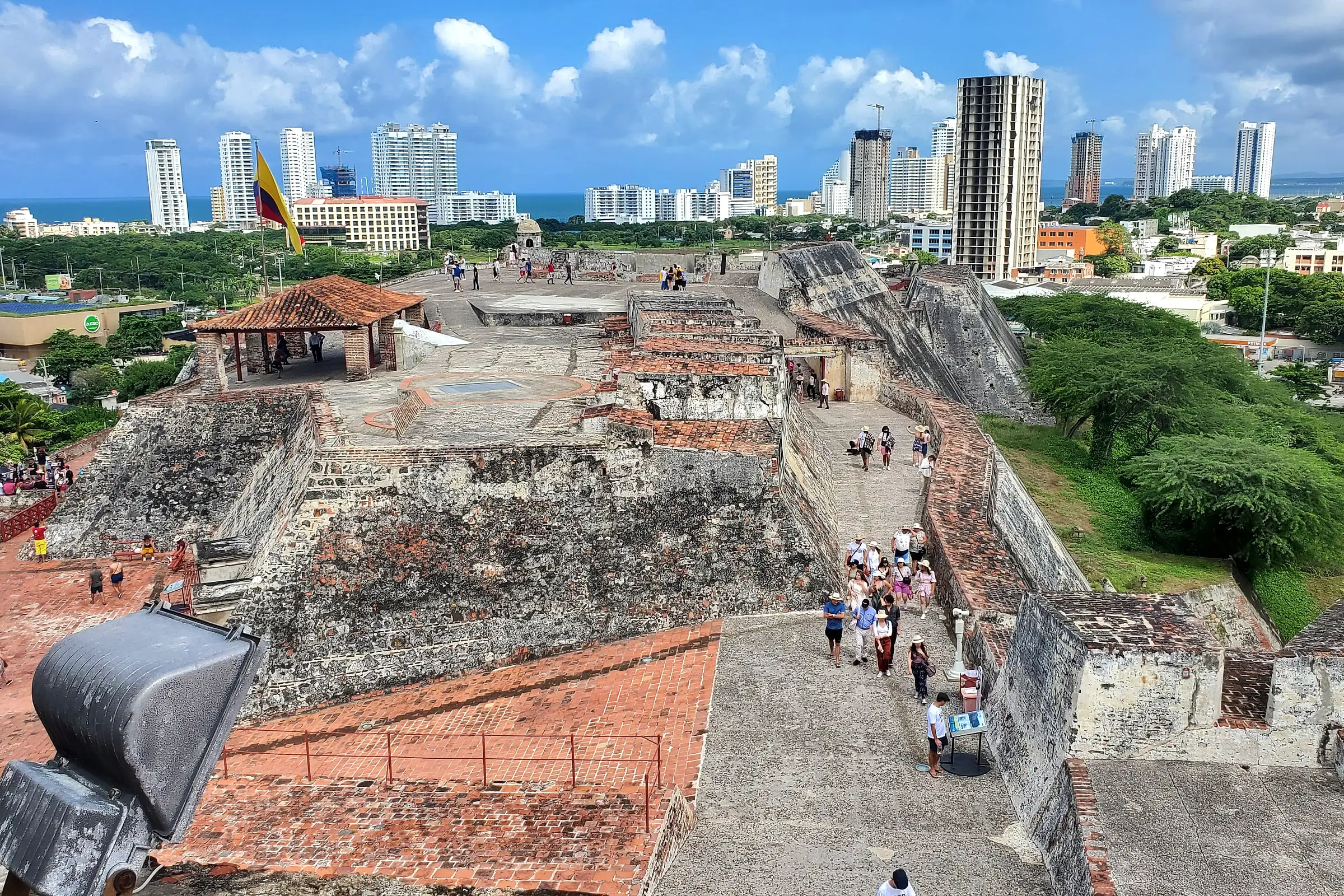
The ramparts of the Castillo San Felipe de Barajas, with Bocagrande on the horizon. Photo by Latin Lands.
Give it three days: one for the old town and the fortress of San Felipe, one for a boat to the Rosario islands or the beaches of Barú, and one spare for the heat, because Cartagena at midday is hot in every month. It is also where the cost of a trip jumps, since old-town hotels are the dearest in the country.
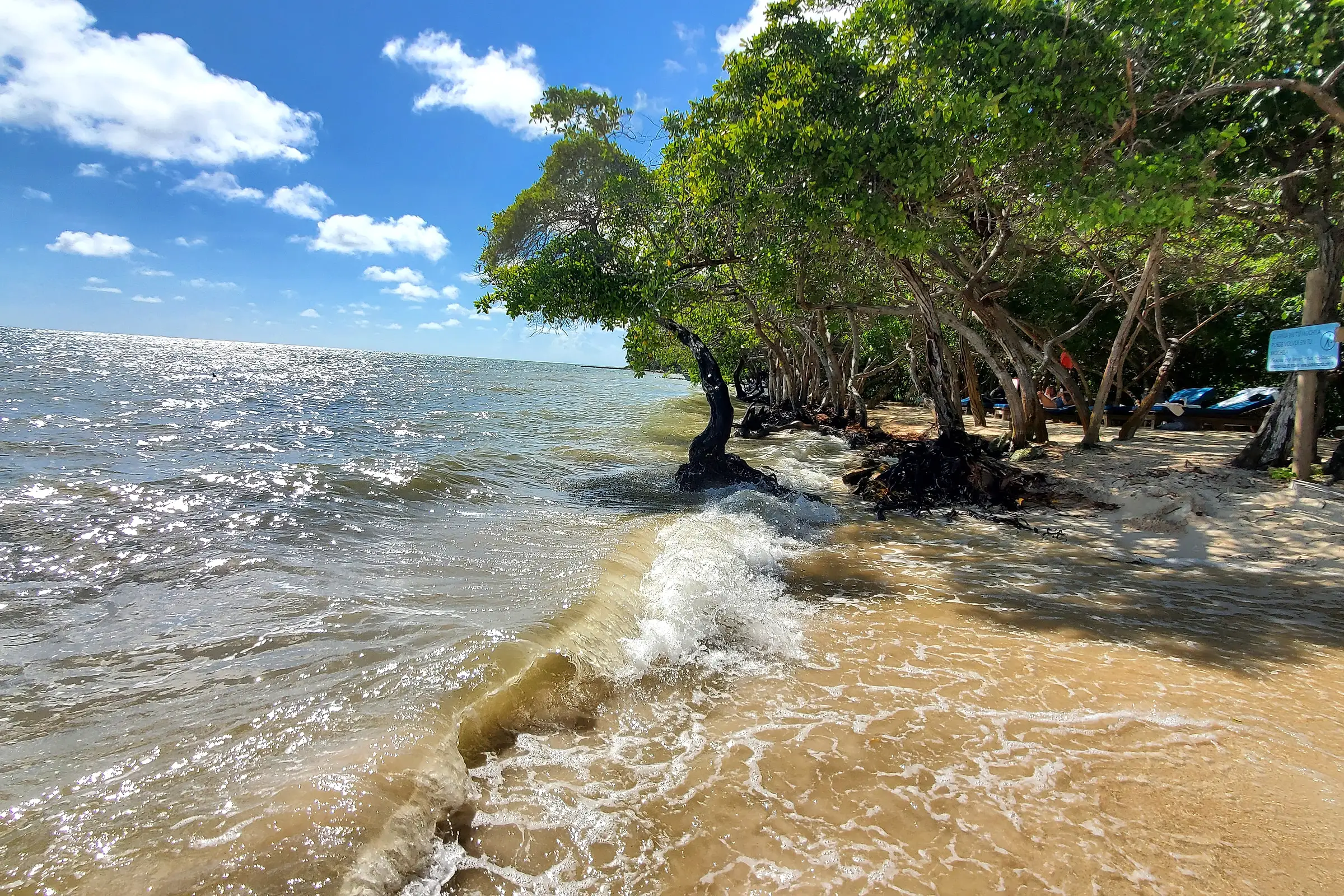
A beach on Barú, south of Cartagena. Photo by Latin Lands.
2. Tayrona and Santa Marta
Tayrona National Park is the stretch of coast where the Sierra Nevada de Santa Marta drops into the sea: jungle, boulders and beaches you walk between. Two rules shape any visit. The park closes three times a year, in February, June and October to November, by agreement with the four Indigenous peoples of the Sierra Nevada. In 2026 the closures ran from 1 to 15 February, 1 to 15 June and 19 October to 2 November, and the 2027 dates had not been published by mid-November. And Colombia’s parks authority now asks for proof of yellow fever vaccination at the gate. All four land sectors, Calabazo, Zaíno, Palangana and Bahía Concha, have been open since 3 July 2026, from 8:00 to 16:00 with the last entry at 14:00.
We base people in Santa Marta for the park and keep a spare day, in case the park or the coast road says no on the first try. Minca, a cooler village in the hills above the city, is the other half of a stay here, for birds and coffee. The trek to Ciudad Perdida also starts here, but it is a multi-day walk of its own and a separate decision.
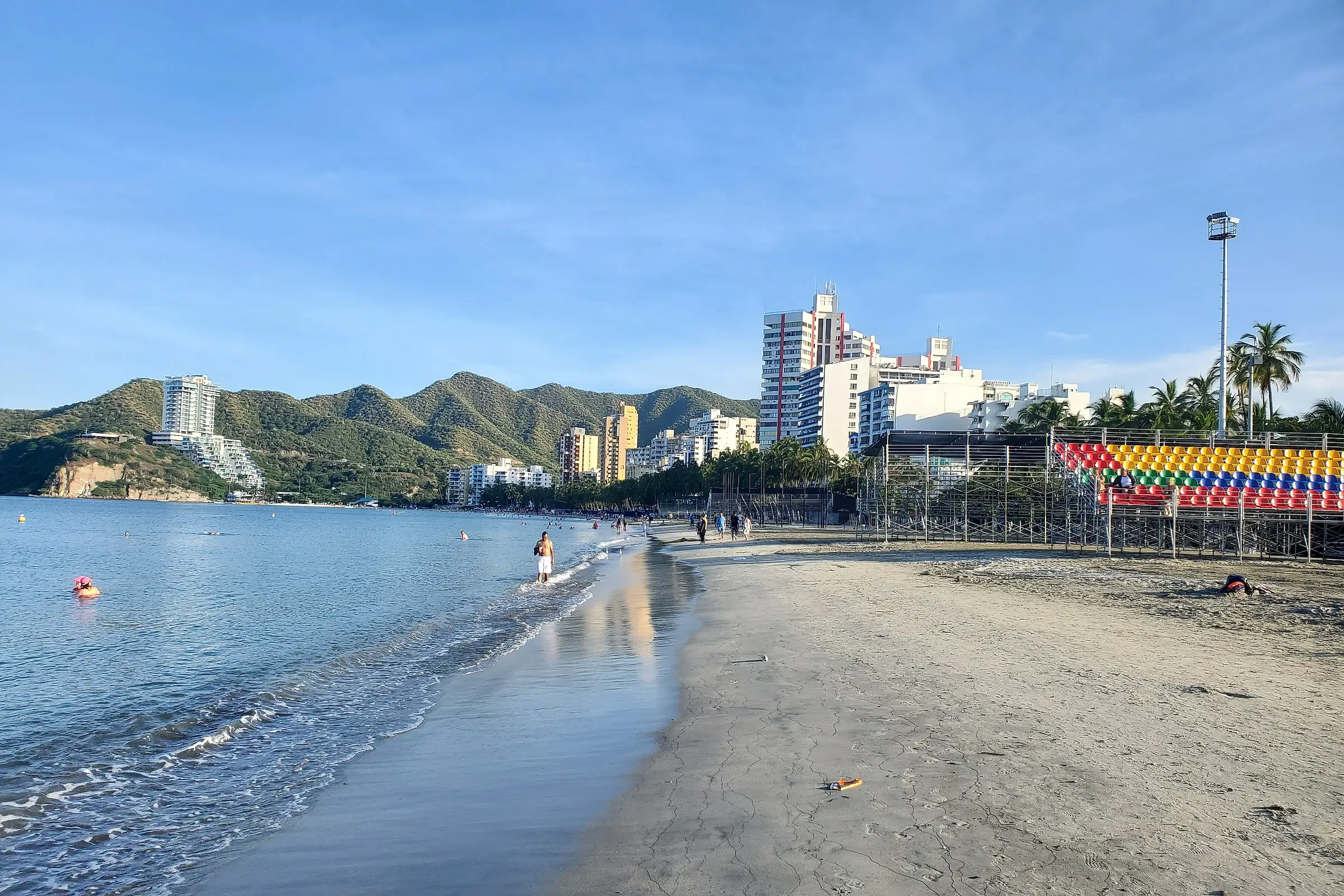
El Rodadero, the city beach of Santa Marta, early in the morning. Photo by Latin Lands.
3. Mompox
A colonial river town on the Magdalena, inscribed by UNESCO as the Historic Centre of Santa Cruz de Mompox in 1995. It sees far fewer visitors than Cartagena because it is a long road from anywhere. That is exactly its appeal: two quiet days of riverfront, churches and silver workshops. We only add it to trips of two weeks or more.
4. San Andrés and Providencia
The archipelago lies far out in the Caribbean, closer to Nicaragua than to the Colombian mainland. San Andrés is the busy island with the flights and the hotels; Providencia, reached from it, is the quiet one with the reef. You buy a tourist card at the boarding gate in Colombia, as the UK government’s entry advice explains. Four nights is the minimum we would plan, since the connections eat a day each way.
5. Bogotá
The capital sits at about 2,600 m, according to the city’s health advice for visitors, so the first afternoon is for walking slowly. The reasons to stay are the Gold Museum of the Banco de la República, the colonial Candelaria quarter, and the cable car or funicular up Monserrate for the view over a city of several million. We give it two days, at the start of the trip, because starting high and moving down to the coast is the easiest way to deal with the altitude.
6. Villa de Leyva
A white colonial town in Boyacá about three hours from Bogotá by road, built around a huge cobbled main square. Two nights is right: the town, the fossil museum and the Ráquira pottery village on one day, the drive back via the salt cathedral of Zipaquirá on the other. It is the easiest way to see the Colombian countryside without a flight.
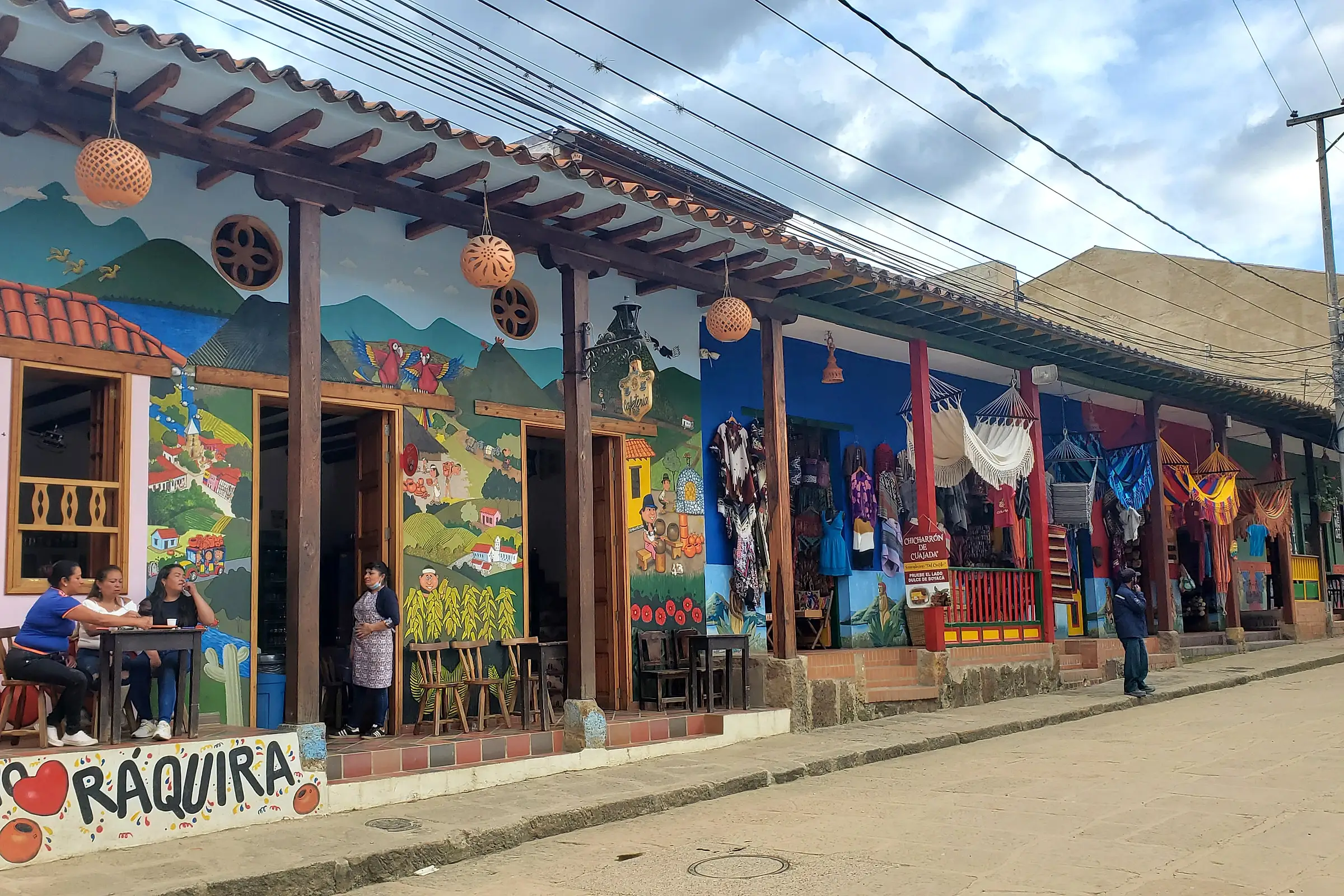
The painted main street of Ráquira, the pottery village near Villa de Leyva. Photo by Latin Lands.
On the way up from Bogotá the road passes the Puente de Boyacá, the small stone bridge where the battle that decided Colombia’s independence was fought. It is a twenty-minute stop we always make.
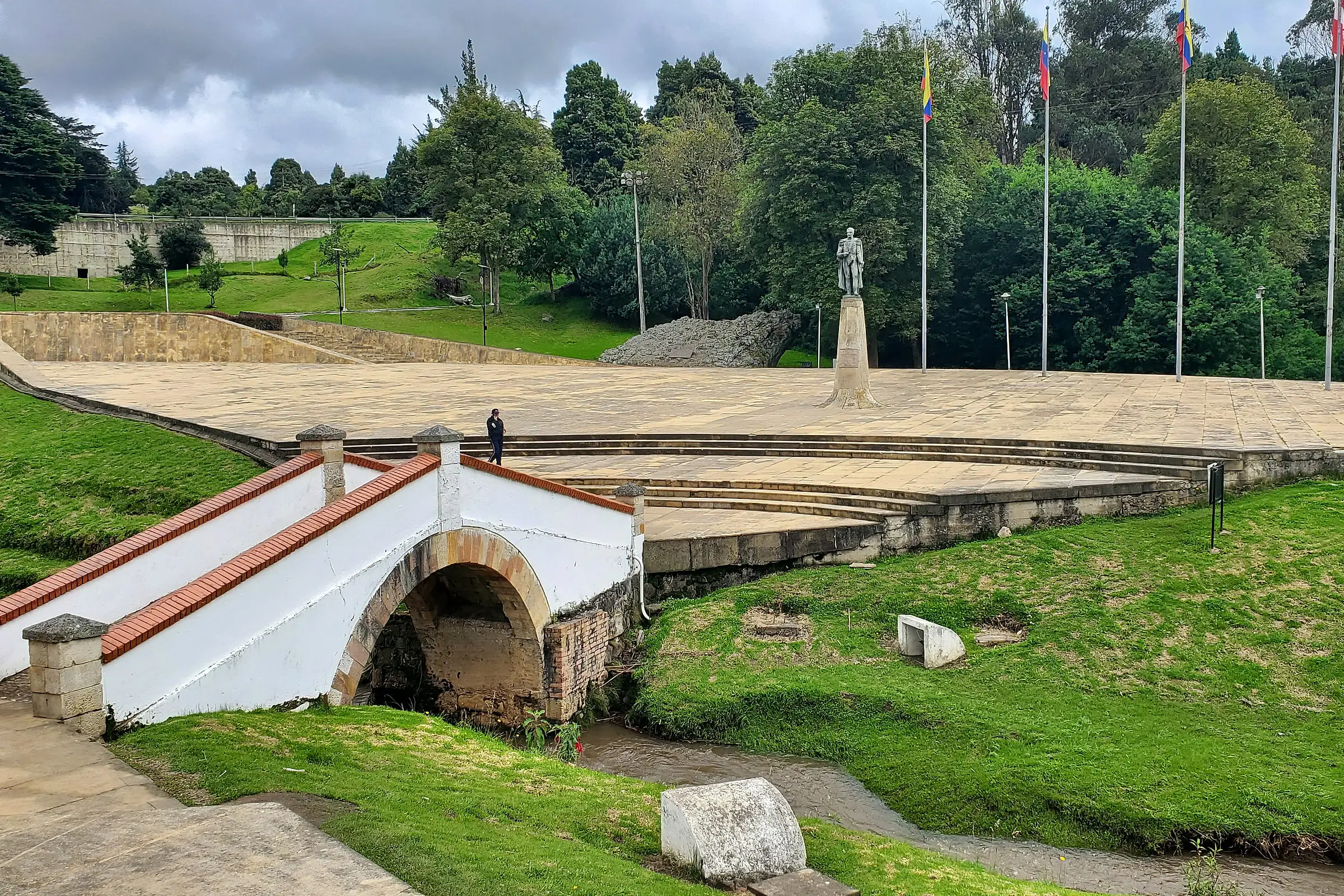
The Puente de Boyacá, on the road from Bogotá to Villa de Leyva. Photo by Latin Lands.
7. Barichara
Barichara, in Santander, is a village of stone streets and whitewashed houses above the Suárez canyon, and the one we pick when a traveller wants quiet. The old Camino Real path to Guane is a half-day walk on original paving, and the town of San Gil next door is the base for rafting and canyoning. Two days, and it pairs well with Villa de Leyva on a road trip north of Bogotá.
8. Medellín and Guatapé
Medellín has a spring climate all year, a clean metro and the Metrocable lines that climb its hillside neighbourhoods. The story of how the city changed is best told on a walk through Comuna 13 with a local guide.

A mural in Comuna 13, Medellín. Photo by Latin Lands.
The day trip everyone takes is Guatapé, east of the city, for the climb up the granite rock of El Peñol, the view over the reservoir, and lunch in the painted streets of the village itself, the one in the photo at the top of this page. Three days covers both.
9. The coffee region
The coffee region of Caldas, Risaralda and Quindío is the third pillar of the classic route, with the town of Salento, the Cocora valley and its wax palms, and the coffee farms that UNESCO inscribed as World Heritage in 2011.
It is also where the news of this year landed. On 10 August 2026 a magnitude 7.4 earthquake centred on San José del Palmar, in Chocó, struck western Colombia, according to the PAHO situation report, and Pereira and Armenia were among the cities hit. Here is where things stand on the dates we can source:
- Pereira’s Matecaña airport reopened in stages after 19 days closed, with part of the terminal in use.
- On 5 October 2026 the regional paper Crónica del Quindío reported hotels and farms in Salento and Filandia operating, with little physical damage but far fewer bookings.
- On 31 October Quindío’s tourism secretary said more than 95% of the department’s tourism businesses were working normally and Armenia’s airport had run normally since 11 August, as El Olfato reported. The worst damage, she said, was on rural properties, some coffee farms among them.
The region is back on our published route. Our Colombia travel packages give it three nights on the twelve- and fourteen-day versions and two on the ten-day one, going in through Armenia, with the farm and the hotel confirmed by name when you book. Our Colombia tours page has the rest of the country.
10. San Agustín
In the south of Huila, the San Agustín Archaeological Park, inscribed by UNESCO in 1995, holds hundreds of stone statues carved by a culture that left no writing. It is a long way from anywhere, and two full days on the sites is the minimum. Its sister site, the painted tombs of Tierradentro, is in Cauca, a department the US and UK both advise against outside Popayán, so we do not route there.
11. Caño Cristales
The river in the Serranía de la Macarena that turns red, pink and green when a water plant blooms in its bed. Colombia’s parks authority puts the season of colour from June to November; outside it the river is closed or plain. The surrounding south of Meta is on the UK’s list of places to avoid, with Caño Cristales itself excepted, and the FCDO’s advice is to fly to La Macarena and go with a reputable operator. That is the only way we do it, on a three-day trip.
12. Leticia and the Amazon
Leticia sits where Colombia, Brazil and Peru meet on the Amazon, and there is no road to it: the FCDO notes that the capital of Amazonas is reached only by air. From there you go upriver by boat to lodges and Indigenous communities. Plan three or four nights, and the yellow fever vaccine. If the Amazon is the main draw of your trip, our guide to the Amazon rainforest in Peru covers the side we run most often.
13. The Pacific coast
The Chocó coast is rainforest down to black-sand beaches, and between June and October humpback whales come to calve. Colombia’s parks authority ran its 2025 whale season from June to October across Gorgona, Utría and Uramba Bahía Málaga. The department of Chocó is on the UK’s list of places to avoid except for Quibdó, Nuquí, Bahía Solano and Capurganá, so we plan only Nuquí or Bahía Solano, by small plane, with four nights for the boats and the weather.
How the places fit together
Colombia rewards a trip that picks regions instead of collecting places. The combinations we plan most:
- The classic first trip runs Bogotá, the coffee region, Medellín and Cartagena, moving down from the Andes to the sea.
- A shorter Andes and coast version takes Bogotá and Villa de Leyva, then Cartagena and Tayrona.
- Either one can take something wilder on top: Caño Cristales, the Amazon or the Pacific. Each of those needs its own flights and three or four days.
How many days each version takes, and in what order, belongs to the route itself. For the rest of the continent around a Colombia trip, see our guide to the best places to visit in South America.
The questions we get on this
- What is the most beautiful place in Colombia?
- For most travellers it is either the Caribbean coast around Tayrona, where the mountains of the Sierra Nevada come down to the sea, or the Cocora valley in the coffee region with its wax palms. For colour, Caño Cristales, a river that turns red with water plants between June and November.
- What is the number one tourist attraction in Colombia?
- The walled old town of Cartagena. Its port, fortresses and monuments have been a UNESCO World Heritage Site since 1984, and almost every first trip to Colombia ends there. Bogotá's Gold Museum and the coffee region come next on most lists.
- Is Medellín or Cartagena better to visit?
- They are different trips, and most first visits include both. Medellín is a mountain city with a spring climate, a metro and cable cars, and day trips to Guatapé. Cartagena is the hot Caribbean port with the colonial walled town and the islands. If you can only pick one, pick the one that matches the rest of your route.
- Is it safe to visit the coffee region after the 2026 earthquake?
- Hotels and farms in Salento and Filandia were operating in October 2026, according to the regional press, and Quindío's tourism secretary said on 31 October that more than 95% of the department's tourism businesses were working normally. The worst damage was on rural properties, so check the farm and the hotel by name before you book.