Colombia Itinerary: 10 or 14 Days, and the Order That Works
A Colombia itinerary for 10 days or 2 weeks, day by day: Bogota, the coffee region, Medellin and Cartagena, in the order that saves a flight.

A first Colombia itinerary almost always runs from Bogota through the coffee region and Medellin down to Cartagena. Ten days fits three of those stops. Two weeks fits all four at a pace you will enjoy. The order matters more than in most countries, and so do the flights between regions, because Colombia is too big and too mountainous to cross by road on a short trip.
One thing has changed in 2026. An earthquake hit the coffee region in August, and we cover where it stands now further down.
The route every Colombia itinerary shares
| Stop | Nights | Altitude | Why it is there |
|---|---|---|---|
| Bogota | 2 to 3 | about 2,550 m | The main international airport, the Gold Museum |
| Coffee region (Salento) | 3 | about 1,900 m | Coffee farms and the Cocora Valley |
| Medellin | 3 | about 1,500 m | The city, and the day trip to Guatape |
| Cartagena | 3 | sea level | The walled city and the Caribbean |
The altitudes are those of the weather stations run by IDEAM, Colombia’s weather institute: 2,547 m at Bogota airport, 1,926 m at Salento and 1,490 m at Medellin’s city airport.
Read down that column and the order explains itself. You start high and every move takes you lower. Bogota is above the 2,450 m at which the CDC starts counting unacclimatised travellers as at risk, so take the first day slowly. It is below the 2,750 m the CDC sets as the limit for a first night’s sleep from low ground, which makes it a gentler start than Cusco or La Paz. Our guide to altitude in South America explains those thresholds.
Running the route backwards, from Cartagena to Bogota, means arriving at altitude after a week at sea level and finishing the trip in the coldest, greyest city on it. We have never seen a good reason to do it.
Flights: the structure of the trip
Colombia’s three mountain ranges make road travel slow, so the domestic flight is the backbone of the trip, not an extra. Bogota to Cartagena takes about 1 h 30 in the air, an average of 1 h 31 on one Avianca flight according to flight records. Bogota to Medellin and Medellin to Cartagena are shorter, about an hour each, as Rough Guides’ own itinerary also notes. Avianca’s midday Medellin to Cartagena flight, AV9282, is scheduled at exactly one hour on its current timetable. Bogota to Armenia, the flight into the coffee region, averages about an hour nonstop on Skyscanner’s route data.
Budget half a day for every flight anyway: the drive to the airport, check-in and the wait. Two details catch people out:
- Medellin has two airports. International and most national flights use José María Córdova, in Rionegro, outside the city; the airport in town, Olaya Herrera, handles regional routes. Check which one your ticket says.
- The coffee region has two airports, Armenia and Pereira, and after the earthquake they are not in the same state. More on that below.
Colombia itinerary: 10 days without the coffee region
Ten days covers three regions with one full day trip, and it leaves out the coffee region. It is the simplest version to plan, with one domestic flight fewer.
| Day | Where you go | Where you sleep |
|---|---|---|
| 1 | Arrive in Bogota | Bogota |
| 2 | La Candelaria, the Gold Museum, Monserrate | Bogota |
| 3 | Fly to Medellin | Medellin |
| 4 | Medellin: the Metrocable and Comuna 13 | Medellin |
| 5 | Day trip to Guatape and El Peñol | Medellin |
| 6 | Fly to Cartagena | Cartagena |
| 7 | The walled city and the San Felipe fortress | Cartagena |
| 8 | Boat to the Rosario Islands | Cartagena |
| 9 | A free day in Cartagena | Cartagena |
| 10 | Fly home from Cartagena | On the flight home |
Medellin is a city of steep hillsides, and the best way to understand it is from above: the Metrocable cable cars run up the slopes, and Comuna 13, once one of its most troubled districts, is now visited on foot for its street art and its view down the valley.
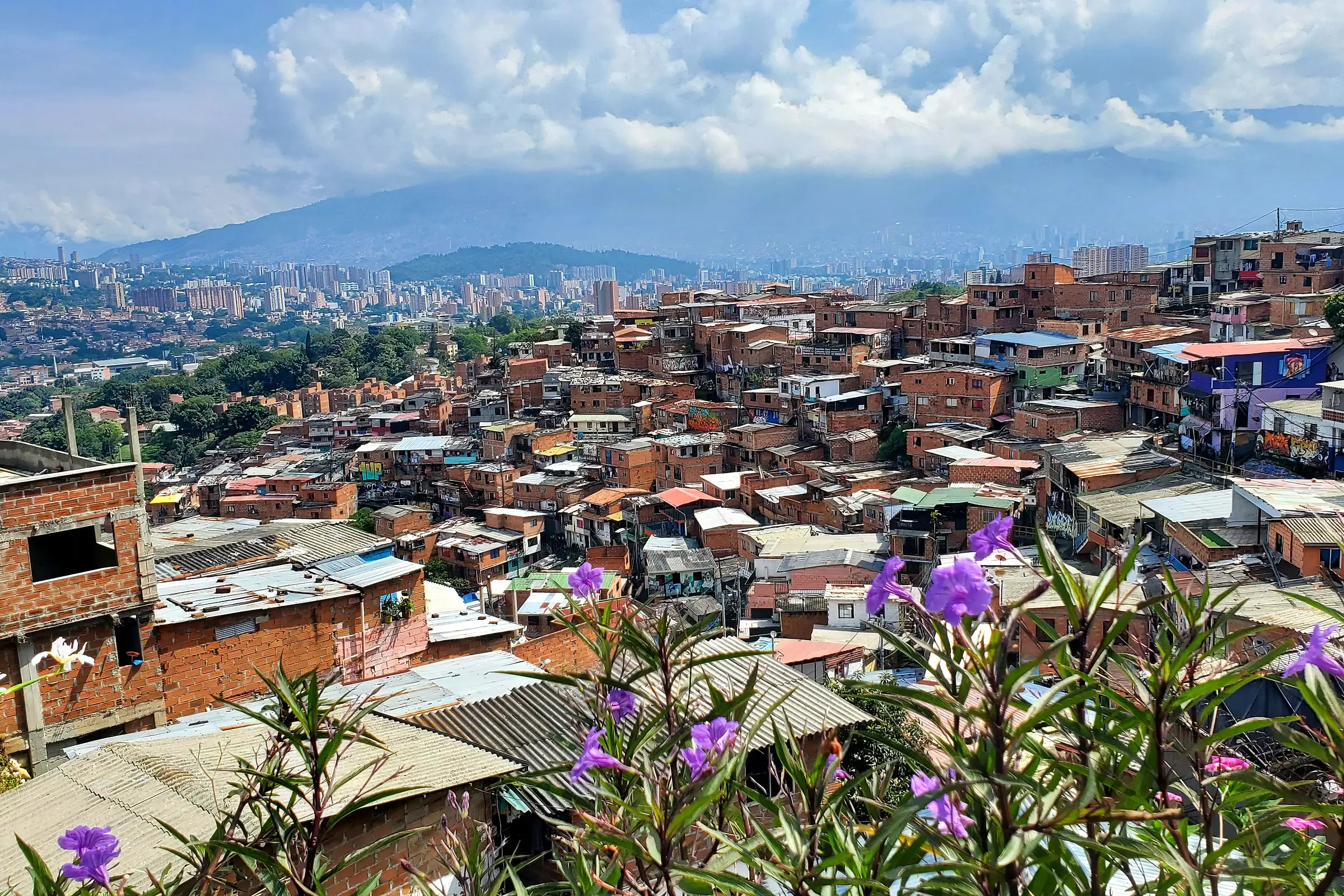
Medellin from Comuna 13. Photo by Latin Lands.
The Guatape day is the one to keep if you cut anything. The town is 81 km from Medellin, about 1 h 50 by road in normal traffic, and the climb to the top of El Peñol, the granite rock above the reservoir, is 702 steps, according to Medellin’s official tourism site.
If you want the coffee region inside ten days as well, it fits with two nights there and two in Medellin, at the cost of Comuna 13. That is the ten-day version of our Colombia travel packages, which keeps the Guatape day.
A 14-day Colombia itinerary: the classic route
Two weeks in Colombia is enough for the whole route, with three nights in each region and no day spent only on transit. The extra Bogota day goes north to Zipaquira, where the salt cathedral is carved into the tunnels of a salt mine.
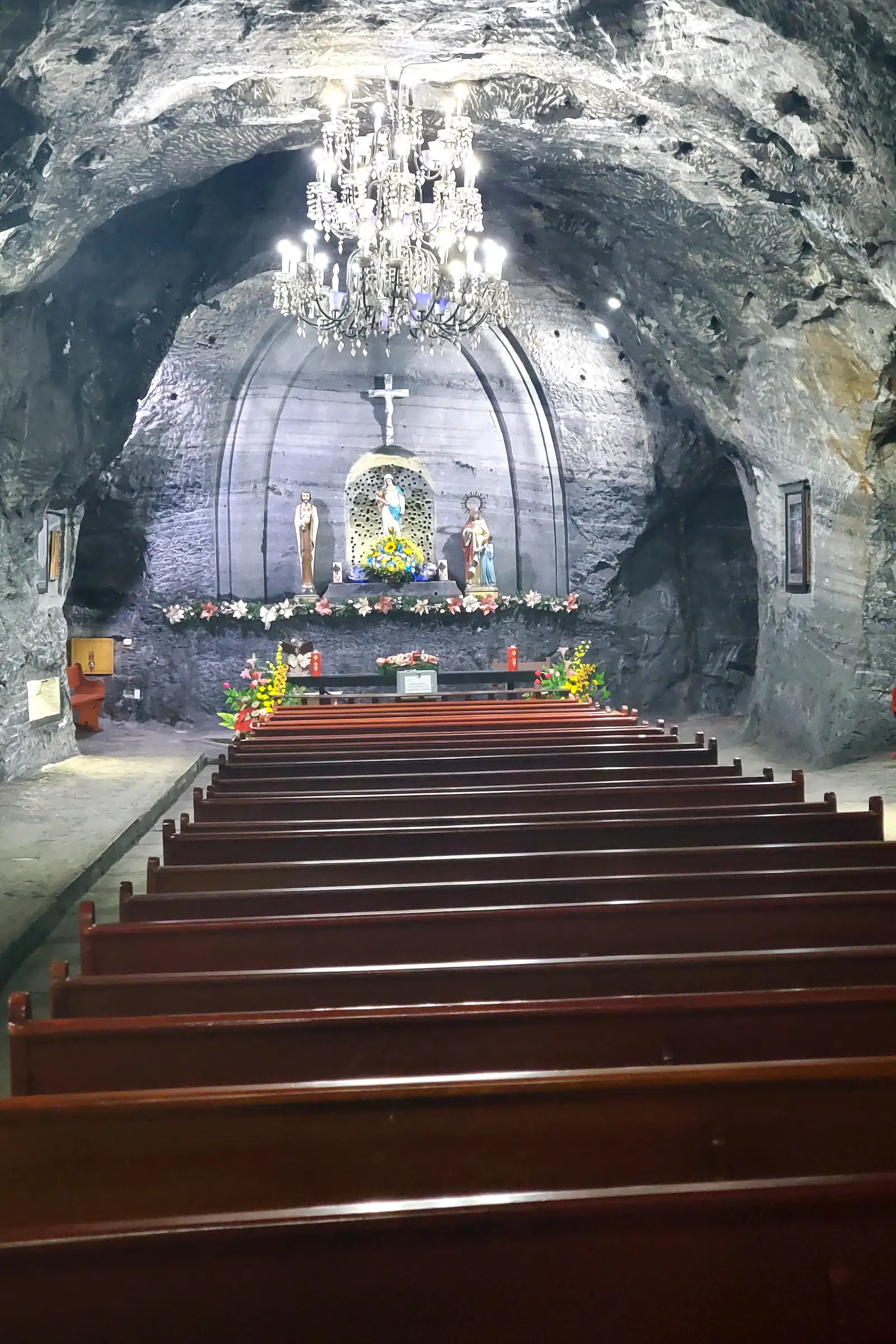
Inside the Salt Cathedral of Zipaquira. Photo by Latin Lands.
| Day | Where you go | Where you sleep |
|---|---|---|
| 1 | Arrive in Bogota | Bogota |
| 2 | La Candelaria, the Gold Museum, Monserrate | Bogota |
| 3 | The salt cathedral at Zipaquira | Bogota |
| 4 | Fly to Armenia, road to Salento | Salento |
| 5 | The Cocora Valley on foot | Salento |
| 6 | A coffee farm, from the plant to the cup | Salento |
| 7 | Road to Medellin | Medellin |
| 8 | Medellin: the Metrocable and Comuna 13 | Medellin |
| 9 | Day trip to Guatape and El Peñol | Medellin |
| 10 | Fly to Cartagena | Cartagena |
| 11 | The walled city and the San Felipe fortress | Cartagena |
| 12 | Boat to the Rosario Islands | Cartagena |
| 13 | A free day in Cartagena | Cartagena |
| 14 | Fly home from Cartagena | On the flight home |
The Cocora Valley is the reason most people go to Salento. Jeeps run up to the valley from Salento, about 11 km further up the road, as the Cocora Valley entry on Wikipedia describes. The loop walk takes most of a day, so Cocora needs the night before in Salento, not a day trip from Medellin.
The road from Salento to Medellin is a long day on mountain roads, about 280 km. The direct bus takes around 7 h 30, according to Gecko Routes, and a private car is not much quicker on those curves. It saves you a flight and a return to an airport. If you would rather fly, plan the whole day for it anyway.
The coffee region after the 2026 earthquake
On 10 August 2026 a magnitude 7.4 earthquake struck western Colombia, with its epicentre in Chocó. The coffee region, the departments of Caldas, Risaralda and Quindío, was among the hardest hit. Here is what we have been able to confirm, with dates:
- Armenia’s airport, El Edén, resumed commercial flights the day after the quake, though its terminal was damaged, according to the civil aviation authority’s report carried by Valora Analitik on 11 August.
- Pereira’s airport, Matecaña, was closed to commercial traffic. The civil aviation authority cleared it on 22 August and it reopened gradually, working from its ground floor while the rest of the terminal was repaired, as Valora Analitik reported on 29 August. Avianca resumed flights there from 26 August, as Portafolio reported.
- The roads. The day of the quake, the national roads agency reported the La Línea crossing between Calarcá and Cajamarca, the main road from Bogota, passable on one lane at three damaged points, LA FM reported. We have not found a later update for that road, which is one more reason to fly in. On 26 October the highway between Armenia and Pereira, which passes the turn for Salento, showed only roadworks on its operator’s road-status page.
- Salento was open. Its town hall told Semana on 24 August that there were no restrictions on visiting.
- Visitors had not come back. In October, Quindío’s governor said hotel occupancy had fallen from about 80% to around 20%, as Infobae reported.
- On 31 October, Quindío’s tourism secretary said more than 95% of the department’s tourism businesses were working normally, Armenia’s airport had run normally since 11 August and every road into the department was open, as El Olfato reported. She added that the worst damage was on rural properties, some coffee farms among them.
So the region is open, and the open question is the single farm or hotel on your plan. Our Colombia tours include it again, entering through Armenia, with the farm and the hotel confirmed by name when you book.
Cartagena: how many days, and where it fits
Cartagena goes at the end, for three reasons: it is at sea level, it has direct international flights home, and after the Andes three days of heat and the sea are the right way to finish. Three nights is the right length. One full day for the walled city and the San Felipe fortress, one on the water at the Rosario Islands, and one left free.
If you want the coast beyond Cartagena, Santa Marta and Tayrona National Park are the usual addition, two to three more days by road along the coast. The drive is about 230 km, four to five hours in normal traffic, according to Semana. Check the park’s closure dates first: in 2026 it closed three times, for two weeks each, to rest the land, and our best time to visit Colombia guide lists them with the rest of the calendar.
What each add-on costs in days
| Add-on | Days it costs | Why that many |
|---|---|---|
| The coffee region | 3 | A flight in, a full day at Cocora, the road out |
| Santa Marta and Tayrona | 2 to 3 | By road from Cartagena, and the park has closure periods |
| Villa de Leyva | 2 | By road from Bogota, before you fly on |
| The Amazon from Leticia | 3 to 4 | Flights via Bogota, then at least two days on the river |
| Whales on the Pacific coast | 3 to 4 | Only July to October, and remote |
| Each extra domestic flight | ½ | Airport transfers and waiting, before the flight itself |
Villa de Leyva is the add-on we suggest most often for a slower trip. It is a whitewashed colonial town in Boyacá, north of Bogota, with cobbled streets and the mountains close behind, and it fits at the start of the route without a flight.
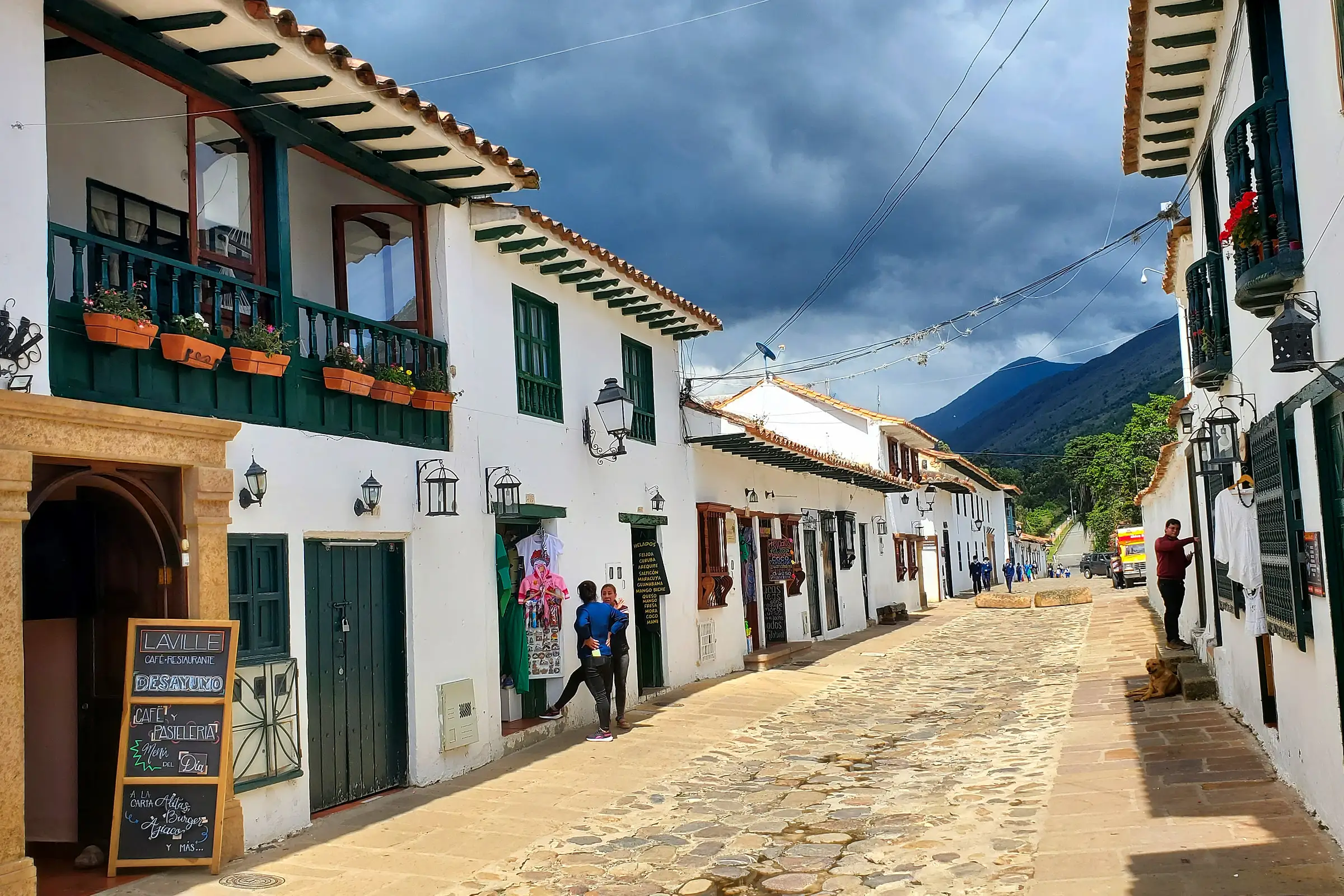
Villa de Leyva. Photo by Latin Lands.
If Colombia is part of a longer trip
Bogota has direct flights to Lima and Quito, so Colombia combines naturally with Peru or Ecuador. Our Machu Picchu tour packages start in Lima, and the Machu Picchu and Galápagos tour adds the islands. When we plan Colombia with Peru, July and August are the months that work for both: the second dry season in Bogota and the coffee region, and the dry season in the Peruvian Andes.
If you have dates in mind for Colombia, send them to us and we will tell you plainly what we can confirm on the ground for those weeks.
Flight details, road times and airport status were checked on 26 October 2026, and the situation in the coffee region on 17 November 2026.
The questions we get on this
- How many days do you need in Colombia?
- Ten days is the minimum for Bogota, Medellin and Cartagena without rushing. Two weeks adds the coffee region around Salento and the Cocora Valley, which is the version most first trips aim for. Every leg between the regions is a domestic flight or a long road day, so each extra stop costs at least half a day in transit.
- What is the best order for a Colombia itinerary?
- Bogota first, then the coffee region, Medellin, and Cartagena last. The route only goes down: from about 2,550 m at Bogota's airport to about 1,900 m around Salento, 1,500 m in Medellin and sea level on the coast. You sleep your highest nights first and finish on the Caribbean, where you can fly home from Cartagena.
- Is 2 weeks enough for Colombia?
- Two weeks is enough for the classic route of Bogota, the coffee region, Medellin and Cartagena at a comfortable pace, with a day trip to Guatape. It is not enough to add the Amazon, the Pacific coast or the Tayrona coast as well; each of those needs three days or more of its own.
- How many days should I spend in Cartagena?
- Three nights. Two full days cover the walled city and the San Felipe fortress, and the third day goes to the Rosario Islands by boat or simply to the beach. Cartagena is also the natural place to end the trip, because it has direct flights home and is at sea level.
- Is it safe to visit the coffee region after the 2026 earthquake?
- Yes, with one check. Quindío's tourism secretary said on 31 October 2026 that more than 95% of its tourism businesses were working normally and Armenia's airport had run normally since 11 August. The worst damage was on rural properties, some coffee farms among them, so confirm the farm and the hotel you will use by name before you book.