Best Time to Visit Colombia: Region by Region, Month by Month
The best time to visit Colombia by region: IDEAM rainfall for the coast, Bogota, Medellin, the coffee region and the Amazon, plus 2027 festival dates.

The best time to visit Colombia, for a first trip that covers Bogota, Medellin and Cartagena, is December to March, with January the one month that is dry almost everywhere you are likely to go. July and August are the second window, good for the Andes and the coffee region but wet on the Caribbean coast. The rest of this guide is the detail, region by region, from the Colombian weather service’s own records.
Why Colombia has no single season
Colombia sits on the equator, so the year is not summer and winter. Temperature barely moves from month to month; it changes with altitude. Bogota averages about 14 °C in every month of the year and Cartagena about 28 °C. What moves is the rain, and it moves differently in each region.
All the rainfall figures below are the 1991 to 2020 climate normals published by IDEAM, Colombia’s national weather and climate institute, read station by station. Thirty-year averages, measured at airports wherever the airport is the station that counts.
| Region (station) | Driest months | Wettest months | Mean temperature |
|---|---|---|---|
| Caribbean coast (Cartagena) | Jan to Mar, under 4 mm | Oct, 236.5 mm | 27 to 29 °C |
| Bogota (El Dorado, 2,547 m) | Jan, 32.9 mm | Apr, 116.7 mm | 14 °C |
| Medellin (city airport, 1,490 m) | Jan, 71.5 mm | May, 218.9 mm | 22 to 24 °C |
| Coffee region (Salento, 1,926 m) | Jul and Aug, 62 to 72 mm | Nov, 475.6 mm | not published |
| Amazon (Leticia) | Aug, 139.9 mm | Jan and Mar, about 386 mm | 25 to 27 °C |
| Pacific (Quibdo) | Feb, 487.3 mm | Aug, 867.4 mm | 26 to 27 °C |
| Llanos (Villavicencio) | Jan, 61.7 mm | May, 657.7 mm | 24 to 28 °C |
Two rows break the pattern most guides repeat. The coffee region is driest in July and August, not in January. And the Pacific coast has no dry season at all: Quibdo airport averages 8,157 mm a year, with rain on 287 days.
The Caribbean coast: December to April
Cartagena, Santa Marta and the beaches between them have one dry season and one wet one. From January to March, Cartagena airport averages 0.5, 0.3 and 3.2 mm of rain, with almost no rainy days. Santa Marta is even drier: 0.1 mm in January. Rain arrives in May, stays through November and peaks in October, when Cartagena gets 236.5 mm over about 12 days.
It is hot whichever month you pick. The monthly mean in Cartagena runs from 26.9 °C in January to 28.9 °C in June, and the wet months are the more humid ones. In practice the wet season here means heavy afternoon storms, not grey weeks, but October and November are the months to avoid if the beach is the point of the trip.
Two things to check before you book the coast:
- Tayrona National Park closes three times a year so the Sierra Nevada’s Indigenous peoples can rest the land. In 2026 the closures were 1 to 15 February, 1 to 15 June and 19 October to 2 November, as reported by Blu Radio. The park reopens on 3 November 2026, according to Infobae, citing the national parks service. The 2027 dates are not out yet. In 2026 it was also shut for security from 17 February under Resolution 091 of Colombia’s national parks service, and reopened in March under Resolution 112. After the June closure the land entrances at Calabazo and Zaíno stayed shut for a few weeks, El Espectador reported. Since 3 July all four land sectors, Calabazo, Zaíno, Palangana and Bahía Concha, have been open again, from 8:00 to 16:00 with the last entry at 14:00, according to the national parks service, and they came back with the rest of the park on 3 November.
- Minca and the Sierra Nevada are wetter than the coast below them. Minca, at 640 m above Santa Marta, averages 3 mm in January but 365 mm in October.
Bogota and the Andes: two dry seasons
Bogota has two dry seasons and two wet ones. At El Dorado airport the driest months are January (32.9 mm, about five rainy days) and, a long way behind, July and August (48.6 and 44.3 mm). The wet months are April and May, then October and November, all between 107 and 117 mm.
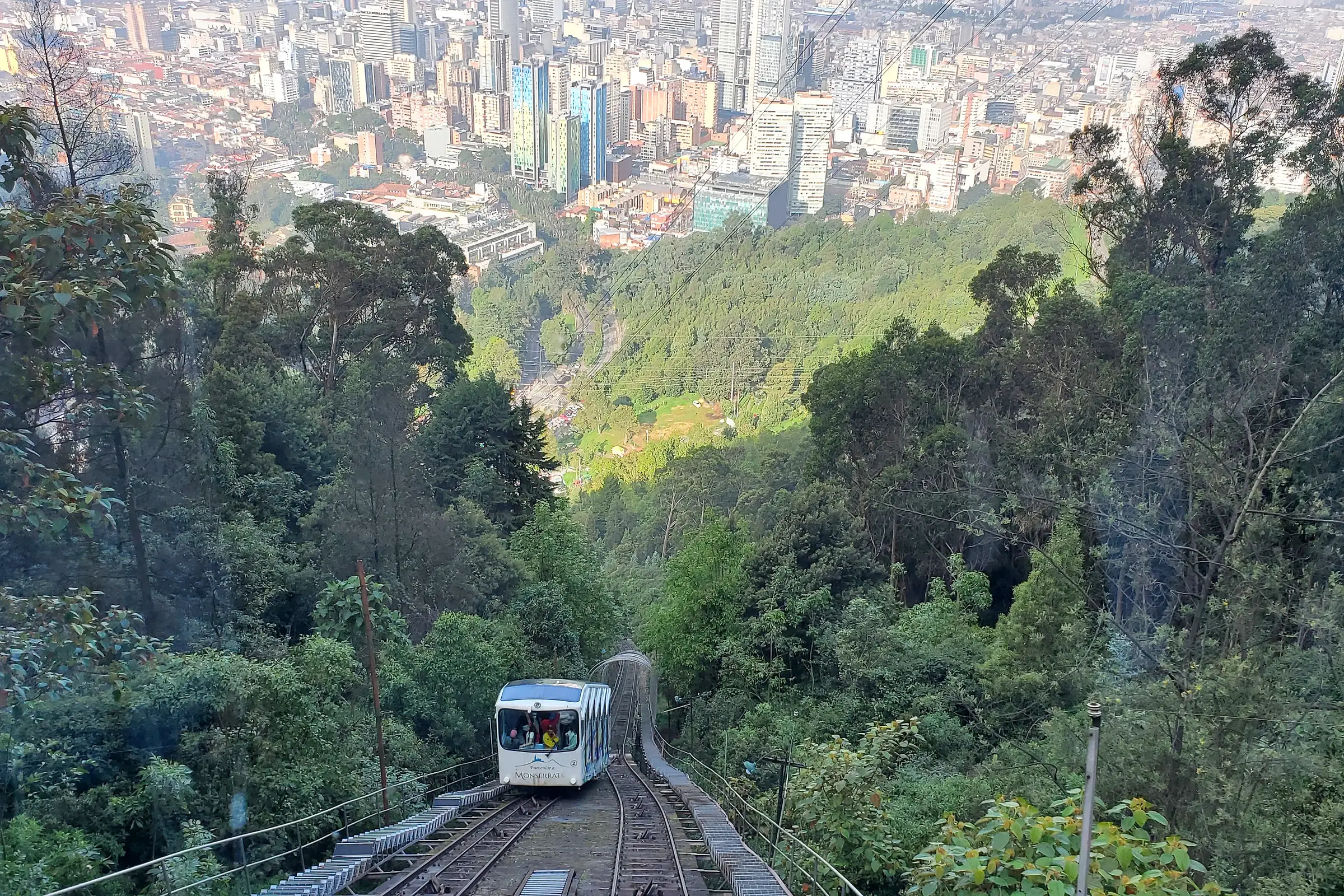
The funicular up Monserrate, with Bogota below. Photo by Latin Lands.
Even the wettest month in Bogota is not much rain by tropical standards. What it means on the ground is a cold, grey afternoon at 2,600 metres, with a mean of 14 °C. Pack a waterproof in any month.
Medellin, lower and warmer at about 1,500 m, follows the same two-season rhythm with more water: 71.5 mm in January, then 218.9 mm in May and 211.5 mm in October. Its mean temperature stays between 22 and 24 °C all year, which is why the city calls itself the city of eternal spring.
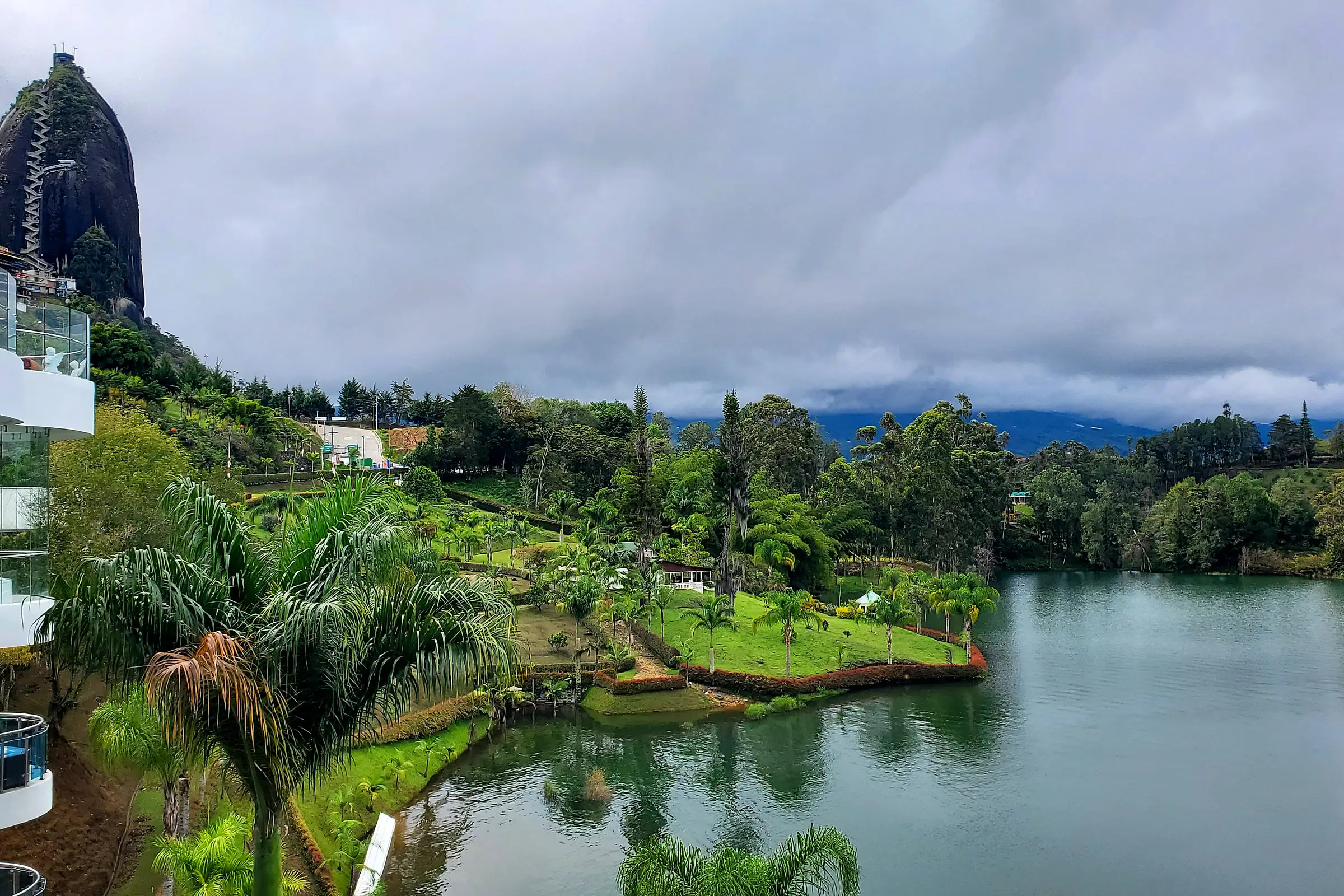
The Guatape reservoir and El Peñol, the usual day trip from Medellin, under November cloud. Photo by Latin Lands.
The coffee region: July and August
This is the region where the general advice goes wrong. At the Salento station, the town at the entrance to the Cocora Valley, the two driest months are July (62.3 mm, about five rainy days) and August (72.4 mm). January, the best month almost everywhere else, brings 249.7 mm. November is the wettest of the year at 475.6 mm.
The airports that serve the region tell a softer version of the same story. Armenia’s averages 87.4 mm in August and 134.6 mm in January; Pereira’s is almost level, 127.9 mm in January and 128.7 mm in August. If the coffee farms and the Cocora walk are the reason you are going, July and August are the months to aim for.
On 10 August 2026 a magnitude 7.4 earthquake struck western Colombia, and the coffee region took some of the worst damage. Salento’s town hall told Semana on 24 August that there were no restrictions on visiting, and Avianca resumed flights to Pereira on 26 August, according to Portafolio. Pereira’s airport reopened gradually after the civil aviation authority cleared it on 22 August, working from its ground floor while the rest of the terminal was repaired, Valora Analitik reported. On 26 October the road between Armenia and Pereira, which passes the turn for Salento, showed only roadworks and single-lane stretches on its operator’s road-status page. But Quindío’s governor said in October that hotel occupancy had fallen from about 80% to around 20%, as Infobae reported. On 31 October the department’s tourism secretary put the share of its tourism businesses working normally at more than 95%, according to El Olfato. The region is back on our Colombia tours, and the twelve-day version of our Colombia travel packages gives it three nights around Salento.
The Amazon: wet all year, less wet from June
Leticia, the gateway to the Colombian Amazon, never really dries out. It averages 3,359 mm a year. The wettest months are January and March, at about 386 mm, with rain on more than 20 days. The least wet are July and August, at 162.8 and 139.9 mm, with about 12 rainy days.
The temperature hardly changes, 25 to 27 °C all year. The difference between seasons is the river: in the wetter months the water rises into the flooded forest and you explore by canoe, and in the drier months more trails open on foot.
The Pacific coast: rain, and whales from July
The Pacific is one of the wettest places on the planet, and the numbers show it. Quibdo, the capital of Chocó, averages 8,157 mm a year, and even its driest month, February, gets 487.3 mm. There is no dry season to wait for.
People go anyway for the humpback whales, which travel up from the southern hemisphere to breed. The season runs from mid-July to mid-October, according to Colombia’s national public radio, citing the national parks service. Chocó was close to the epicentre of the August 2026 earthquake, so check local conditions first.
The eastern plains: December to March
The eastern plains, the Llanos, have the sharpest contrast in the country. Villavicencio averages 61.7 mm in January and 657.7 mm in May; Yopal, further north, 9.7 mm in January and 377.4 mm in May. The dry months, December to March, are the ones to aim for.
Caño Cristales, the river that turns red with aquatic plants, works the other way: it opens to visitors only when the water is high enough, and the dates are set each year by the national parks service, the town of La Macarena and Cormacarena, the regional environmental authority. The 2026 season opened on 29 May and runs until December, as Semana reported when it was announced. Entry needs a permit arranged through a registered local operator. Before you plan the Llanos, read the US State Department advisory for Colombia: Arauca, one of the plains departments, is on its do-not-travel list.
Colombia month by month
January
The best single month for the classic route: dry in Bogota, Medellin and on the coast. Also the busiest, because Colombian families travel until schools go back. The Carnaval de Negros y Blancos in Pasto runs from 28 December to 6 January, on UNESCO’s description.
February
Still dry almost everywhere. Barranquilla’s carnival, on UNESCO’s list since 2008, runs from 6 to 9 February 2027, according to the organisers’ own calendar. Tayrona closed for the first half of February in 2026.
March
The coast stays dry; the Andes start to turn. Holy Week 2027 runs from Palm Sunday, 21 March, to Easter Sunday, 28 March, and it is one of the busiest weeks of the year inside Colombia. Popayán’s night processions, inscribed by UNESCO in 2009, are the best known.
April to May
The first Andean wet season. Bogota’s wettest month is April and Medellin’s is May. The coast starts to get rain in May.
June
Drying out in the Andes, wet on the coast, and the start of the mid-year school holidays. Tayrona closed from 1 to 15 June in 2026.
July to August
The second dry window in the Andes and the best months in the coffee region, but wet on the Caribbean coast: Cartagena averages 121.1 mm in July and 127.5 mm in August, against 0.5 mm in January. Medellin’s Feria de las Flores fills the city in early August; the 2026 edition ran from 31 July to 9 August, according to Publimetro. The city had not announced the 2027 dates when we checked in late October 2026. Whale season opens on the Pacific in mid-July.
September
A quiet month between two wet spells in the Andes, and wet on the coast. Fewer visitors than any time since Easter.
October to November
The wettest stretch of the year almost everywhere we go: Cartagena’s wettest month is October and Salento’s is November. Tayrona closed from 19 October to 2 November in 2026 and reopens on 3 November. These are the months we would not choose for a first trip.
December
The dry season returns to the coast and the Andes from mid-month, and so do the crowds. Book the second half of December early.
If Colombia is one stop in a longer trip
The months that suit Colombia do not always suit its neighbours. If you are pairing it with Peru, July and August are the overlap: dry in Cusco and Machu Picchu, and the second dry season in Bogota and the coffee region. The coast will be wet, so the trade-off is Cartagena. Our Machu Picchu tour packages are built around those same dry months, and the best time to visit Peru sets out the Peruvian side month by month.
January works the other way: the best month in Colombia, and the wet season in the Peruvian Andes.
For the order of a Colombian route and how many days each part needs, see our Colombia itinerary. If you already have dates in mind, tell us what you have and we will say plainly what we can confirm for them.
Weather figures are IDEAM’s 1991 to 2020 normals. Festival dates and park seasons were checked on 26 October 2026, and Tayrona’s entrances and the situation in the coffee region on 17 November 2026.
The questions we get on this
- What is the best month to visit Colombia?
- January, if you want one month that suits the whole classic route. On IDEAM's 1991 to 2020 averages it is the driest month of the year at Bogota airport (32.9 mm) and Santa Marta (0.1 mm), and Cartagena gets 0.5 mm. The catch is that it is also the busiest month, with Colombian school holidays running into it.
- What is the rainy season in Colombia?
- In the Andes there are two: roughly April to May and October to November. Bogota gets 108 to 117 mm in each of those months against 33 mm in January. The Caribbean coast has one long wet season, May to November, peaking in October, when Cartagena averages 236.5 mm. The Pacific coast is wet all year.
- When is the best time to visit Cartagena?
- December to April. From January to March Cartagena averages under 4 mm of rain a month and almost no rainy days, on IDEAM's 1991 to 2020 normals. It is hot all year, with monthly means between 26.9 and 28.9 °C, so the season is about rain and humidity, not temperature.
- When is the best time to visit Medellin?
- December to February, the driest stretch: Medellin's city airport averages 71.5 mm in January against 218.9 mm in May and 211.5 mm in October. Its mean temperature stays between 22 and 24 °C all year. The Feria de las Flores fills the city in early August; the 2026 edition ran from 31 July to 9 August, and the 2027 dates had not been announced by late October 2026.
- When is the best time to visit the coffee region?
- July and August. At the Salento station, the town closest to the Cocora Valley, they are the driest months, with 62.3 and 72.4 mm and about five rainy days each, against 475.6 mm in November. January is wet in Salento (249.7 mm), even though it is dry in Bogota and on the coast.
- When is Carnival in Barranquilla in 2027?
- From Saturday 6 to Tuesday 9 February 2027, the four days before Ash Wednesday. The dates come from the carnival's own organisers. It is the largest carnival in Colombia and is on UNESCO's list of intangible heritage, so hotels in Barranquilla and Cartagena fill early that week.