11 Things to Do in Cusco, Peru, Low to High (2026)
Eleven things to do in Cusco, from low to high, with 2026 ticket prices, the four ruins above the city and what Rainbow Mountain is really like.

The things to do in Cusco that matter are the Plaza de Armas and the colonial centre, the Inca walls under it on Calle Hatunrumiyoc and at the Qorikancha, Sacsayhuamán and the three other ruins on the hill above, and two day trips that go far higher: Humantay lake at 4,200 m and Rainbow Mountain at 5,036 m. Cusco itself sits at 3,400 m, and that number decides everything else.
We list the eleven from low to high. Do the flat centre first, climb to the ruins on your second day, and leave the 5,000 m mountain for the end, when your body has had time to adjust. The fees and opening hours come from the official records, read in October 2026.
The eleven at a glance
| Foreign adult | Altitude | |
|---|---|---|
| Plaza de Armas, Cathedral | Plaza free | 3,400 m |
| Calle Hatunrumiyoc | Free | 3,400 m |
| San Blas | Free | 3,425 m |
| Qorikancha | S/ 20 | 3,400 m |
| San Pedro market | Free | 3,400 m |
| Sacsayhuamán | Boleto | 3,700 m |
| Q’enqo, Puka Pukara, Tambomachay | Boleto | 3,580-3,764 m |
| Tipón and Pikillaqta | Boleto | south valley |
| Humantay lake | S/ 10 | 4,200 m |
| Rainbow Mountain | S/ 30 | 5,036 m |
| Inti Raymi, Corpus Christi | Plaza free | 3,400 m |
In the table, Boleto means the Boleto Turístico del Cusco, explained below. Opening hours are in each section.
Cusco is high, so start low
The Plaza de Armas is at 3,400 m, according to Peru’s national tourism inventory. The CDC’s advice on high-altitude travel puts the risk of altitude sickness from 2,450 m, recommends taking it easy for the first 48 hours, and notes that one or two nights lower down before Cusco can be enough on their own. The Sacred Valley, about 500 m below the city, is the obvious place for those nights.
For the numbers behind this, including how Cusco compares with La Paz, see our guide to South America altitude.
The Boleto Turístico: what S/ 130 covers
Most of what is on this list beyond the centre is paid with one ticket, the Boleto Turístico del Cusco. COSITUC, the body that runs it, sells the full version to a foreign adult for S/ 130, valid for 10 days, and to a foreign student for S/ 70. Each partial circuit costs a foreigner S/ 70.
The full ticket covers sixteen sites in three circuits:
- Circuit I: Sacsayhuamán, Q’enqo, Puka Pukara and Tambomachay.
- Circuit II: the Qorikancha site museum, four city museums, the Pachacútec monument, the Centro Qosqo de Arte Nativo, Tipón and Pikillaqta.
- Circuit III: Pisac, Ollantaytambo, Chinchero and Moray, in the Sacred Valley.
It is sold in person only, at Av. El Sol 103 from 07:30 to 18:00 and at most of the sites, and it starts the day you buy it. Two things it does not cover: the Qorikancha temple itself and the Cathedral, which charge their own entry. A new tourist ticket law (Ley 32586) passed in May 2026, and its regulation was still out for comment in October, so check the prices before you travel.
Day one: the centre, on foot
Everything in this section is within about 500 m of the Plaza de Armas, which makes it the right first day: flat, short, and close to your hotel if you need to rest.
1. Plaza de Armas and the Cathedral
The square was the centre of the Inca city, and the Cathedral on its upper side was built between 1559 and 1654, according to the tourism inventory record. The Cathedral opens 10:00 to 18:00 and is not part of the Boleto Turístico. It is sold on its own or in a religious ticket with two other churches; ask the price at the door, because the published figures we found did not agree with each other.
2. Calle Hatunrumiyoc and the twelve-angled stone
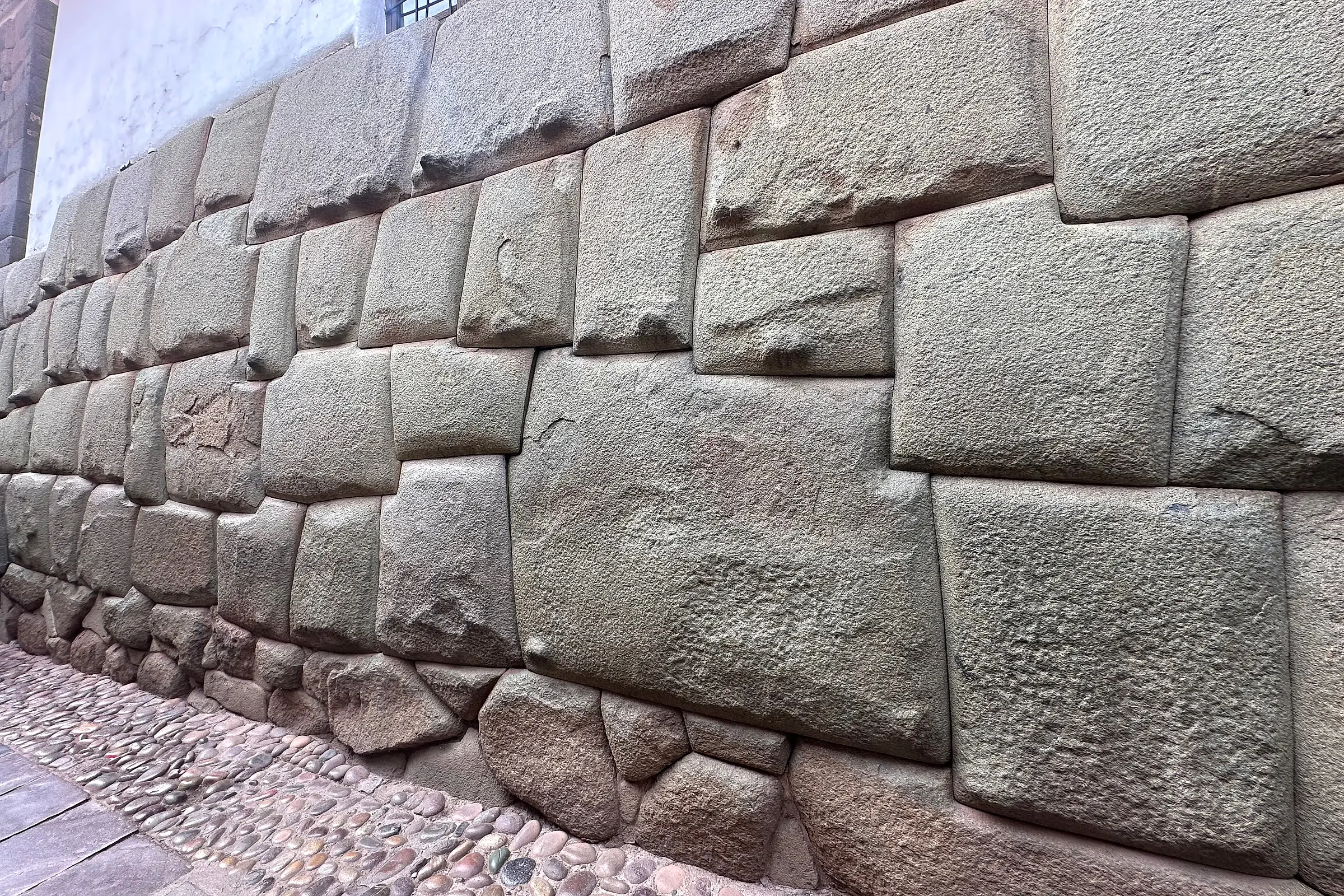
The Inca wall on Calle Hatunrumiyoc, Cusco, September 2025. Photo by Simon P. Toaquiza.
A short walk up from the square, 150 m by the inventory’s count, the street runs along a wall of the palace of Inca Roca. The famous stone has twelve angles and weighs about six tonnes. It is free, and the street is open to walk at any hour.
3. San Blas
Keep climbing and you reach San Blas, the artisans’ quarter, 450 to 500 m from the Plaza according to the inventory record. The streets are steep and narrow, with workshops, cafés and white walls with blue doors. The church on the square has a seventeenth-century pulpit carved from a single cedar trunk, but it has been closed for works since 2023.
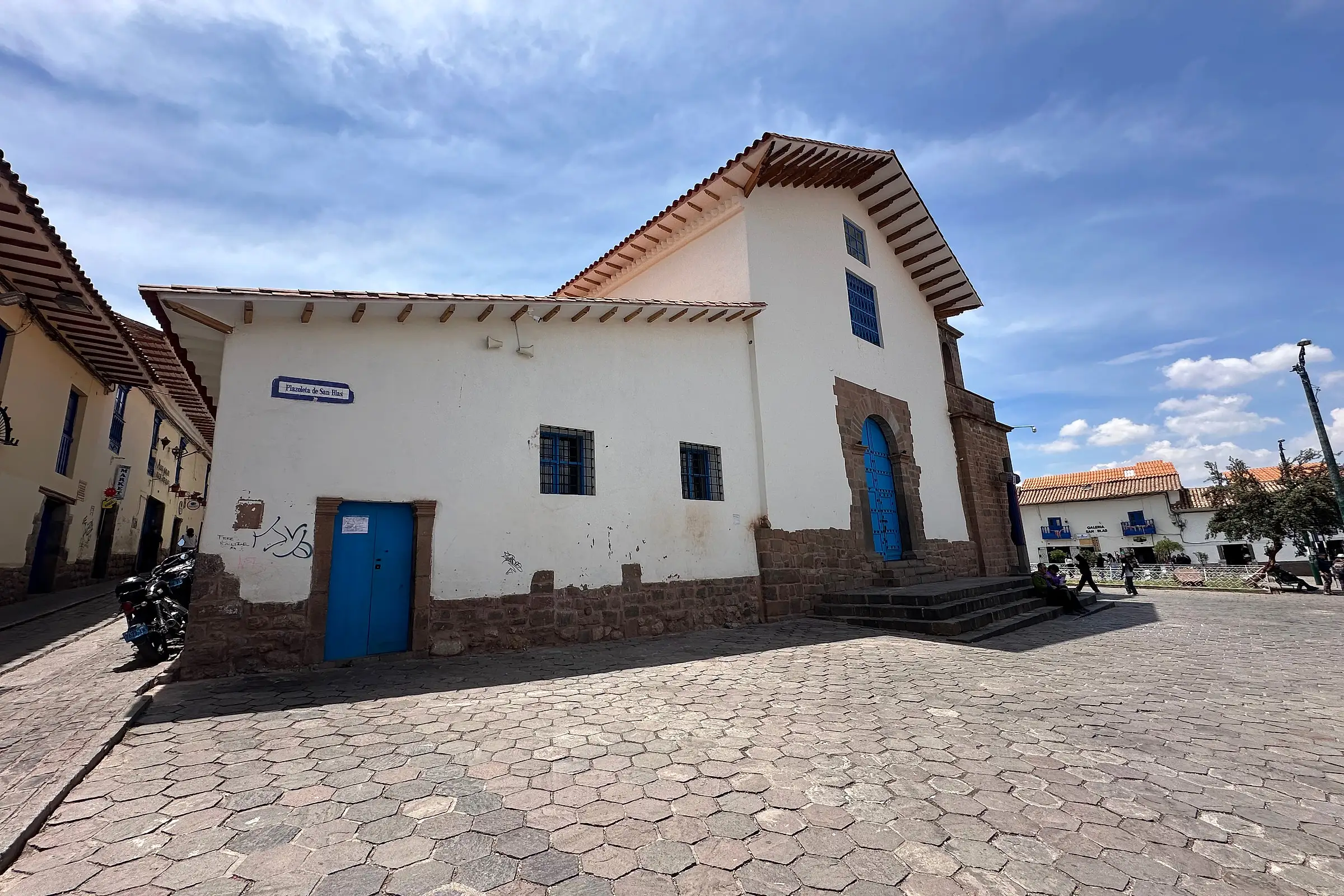
A corner of San Blas, Cusco, September 2025. Photo by Simon P. Toaquiza.
4. Qorikancha
The main temple of the Inca empire is now under the Dominican convent of Santo Domingo, which has run it since 1538. Inside, the Inca stonework and the colonial cloister share the same walls. The inventory record gives S/ 20 for adults, S/ 10 for students, and 08:00 to 17:30. This is a separate ticket: the Boleto Turístico only covers the municipal site museum under the gardens on Av. El Sol.
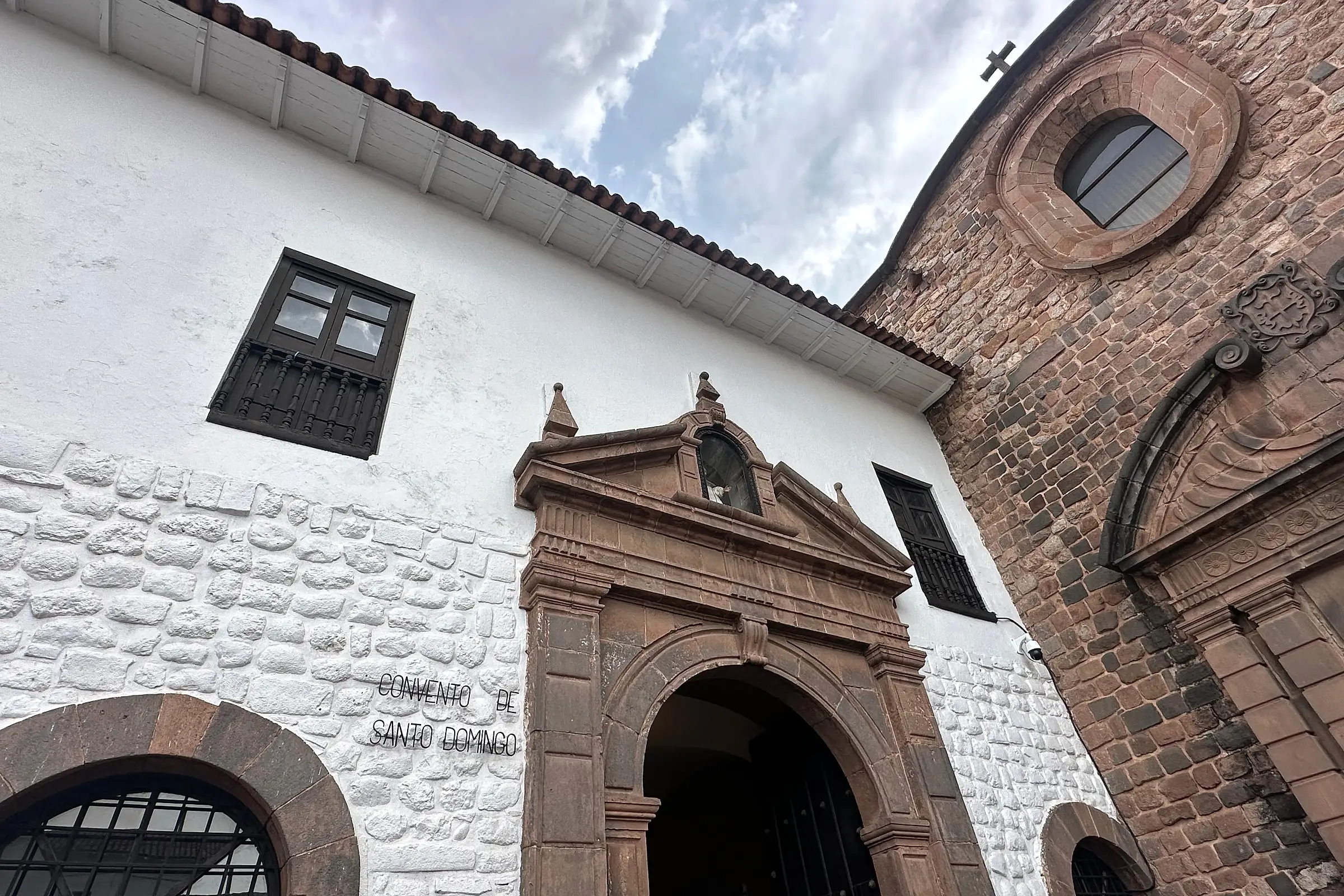
The entrance to Santo Domingo and the Qorikancha, Cusco, September 2025. Photo by Simon P. Toaquiza.
5. San Pedro market
The covered market opposite the old San Pedro station opened on 7 June 1925, and the inventory attributes its iron structure to Gustave Eiffel. It is free and open 06:30 to 16:00. Go in the morning, have a fresh juice at one of the stalls, and keep your phone in a front pocket, as you would in any busy market.
Day two: the four ruins above the city
6. Sacsayhuamán
This is the one ruin in Cusco we would not skip. The zigzag walls are built from blocks up to about 5 m high, and the site sits at 3,700 m, open 07:00 to 18:00, according to the tourism inventory. The record gives 2.5 km on foot from the Plaza de Armas, up Calle Suecia. It also says 20 minutes, which is optimistic: it is a steep 300 m climb, so take it slowly, or take a taxi up and walk down.
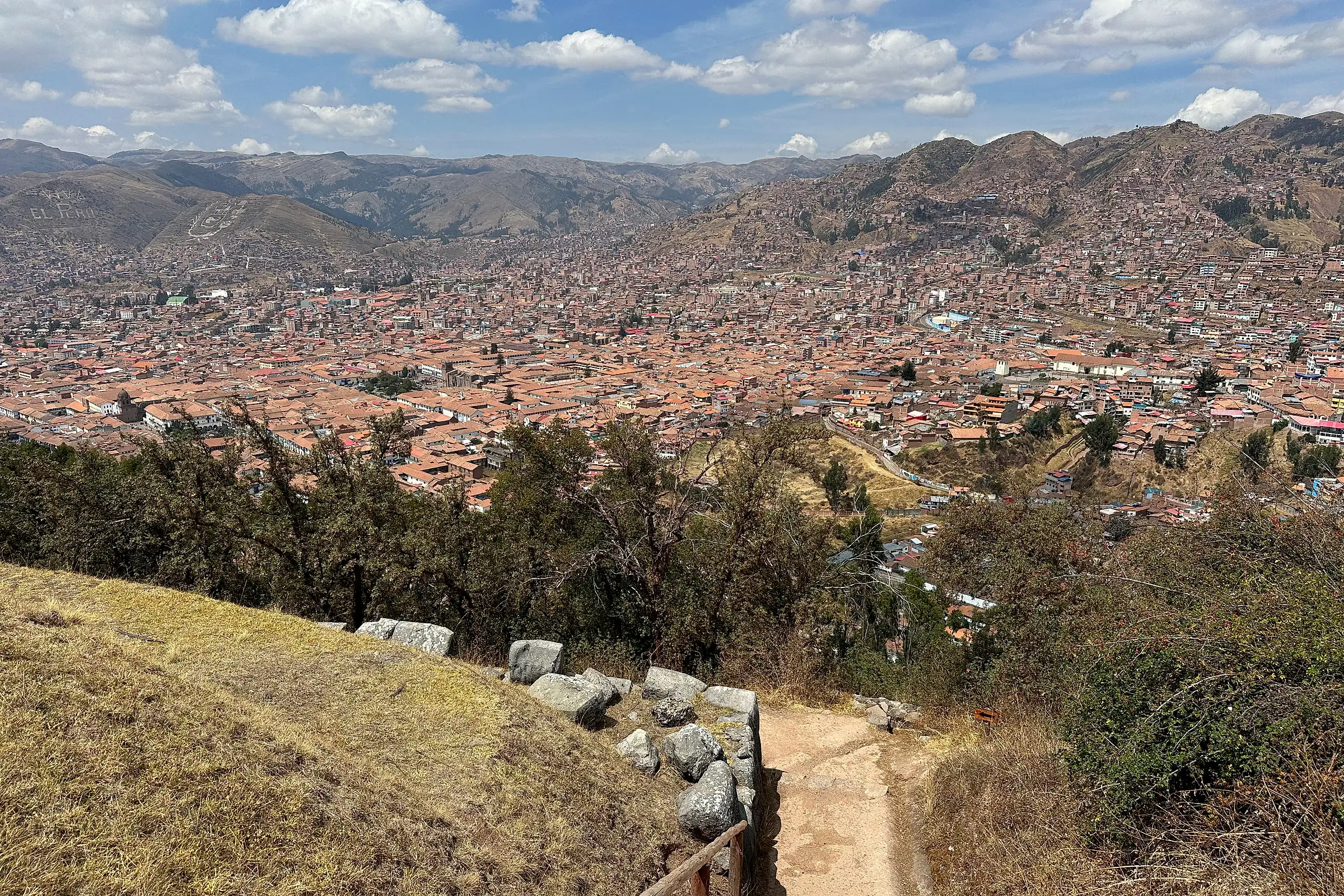
Cusco from the path below Sacsayhuamán, September 2025. Photo by Simon P. Toaquiza.
7. Q’enqo, Puka Pukara and Tambomachay
The other three ruins of Circuit I are further along the same road. Q’enqo, a carved rock shrine, is at 3,580 m; Puka Pukara, a small fort, at 3,764 m; and Tambomachay, the Inca water channels, at 3,700 m, according to the inventory records for Q’enqo, Puka Pukara and Tambomachay. They close earlier than Sacsayhuamán, between 16:00 and 16:30, so the usual way is to drive to Tambomachay first and walk back down towards the city, finishing at Sacsayhuamán in the afternoon.
8. Tipón and Pikillaqta
South of the city, on the road to Puno, are two sites of Circuit II: Tipón, with its Inca terraces and water channels, and Pikillaqta, a city built by the Wari before the Incas. Half a day covers both. On our Machu Picchu tour packages, the two nights in Cusco come at the end of the trip, after the Sacred Valley and Machu Picchu, which is when a morning like this feels easy.
Day trips from Cusco, higher up
9. Humantay lake
The turquoise lake under the Humantay glacier is at 4,200 m, and the Mollepata district charges foreigners S/ 10, according to the inventory record. The drive is 97 km to Mollepata and then 25 km more to Soraypampa, where the walk up begins. Two warnings for 2026. Access was suspended from February through March for the rains. And after an ice avalanche on 27 July, the regional risk office asked Mollepata to set up an early warning system, without closing the lake. Check the situation the week you go.
10. Rainbow Mountain (Vinicunca)
Rainbow Mountain is the highest thing on this list by a long way. Vinicunca stands at 5,036 m, and the upper viewpoint is above 5,200 m, according to the tourism inventory. Two communities run the two entrances. From Pitumarca, through Pampachiri, and from Cusipata, through Chillihuani, both charge foreigners S/ 30 and open 06:00 to 17:00. The Cusipata record gives 3 km and about 1 hour 45 minutes on foot from the car park to the top. By the official distances to the Pitumarca side, the drive from Cusco is about 127 km, three hours each way, so it is a very long day.
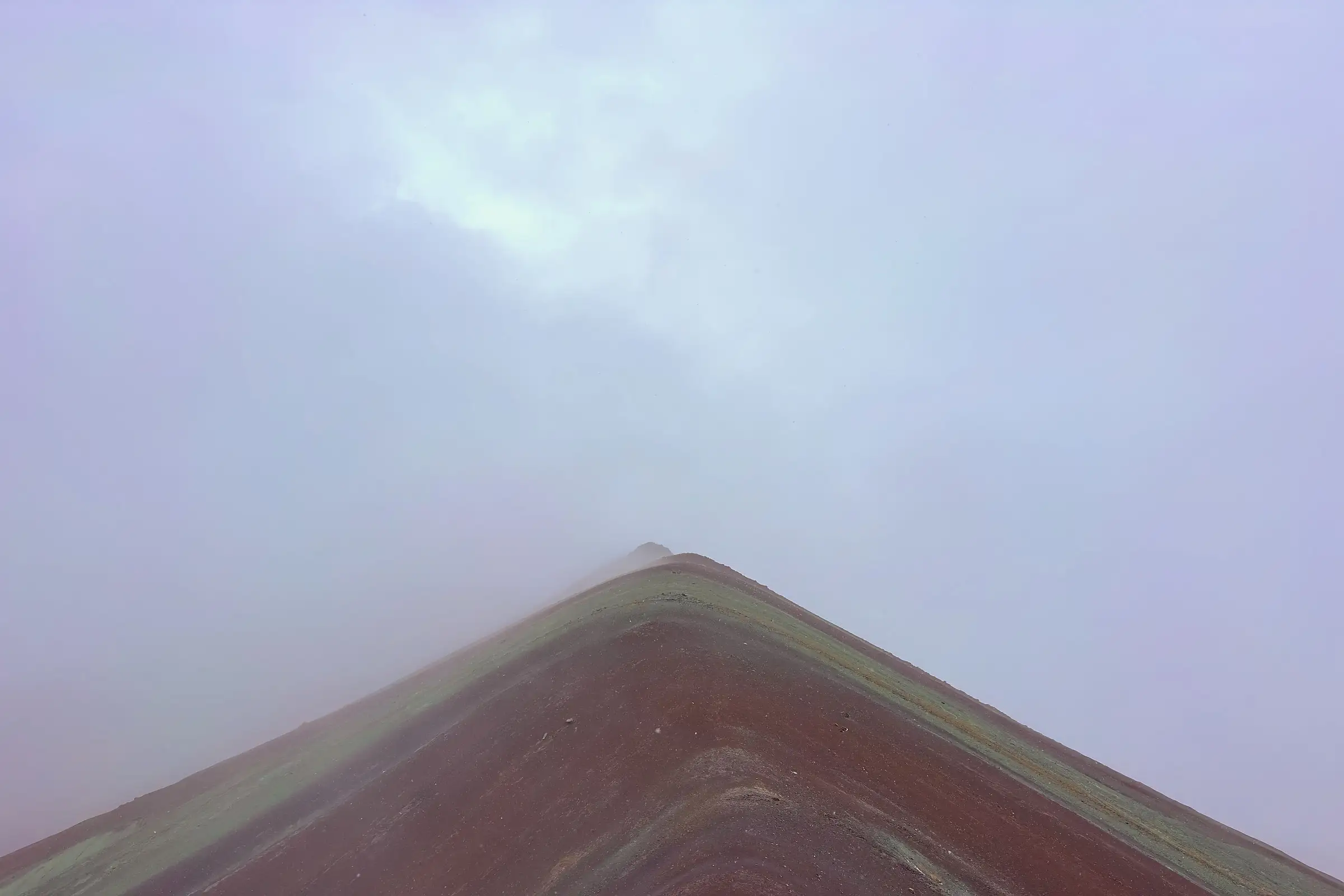
The top of Vinicunca on 26 September 2025, in snow and cloud. Photo by Simon P. Toaquiza.
We went on 26 September 2025, inside the April to October season the inventory recommends, and it snowed at the top. On the way up the ridges showed their reds and greens under a grey sky; at the summit we saw the stripes for a few minutes through the cloud. The colours need sun, and no month promises it.
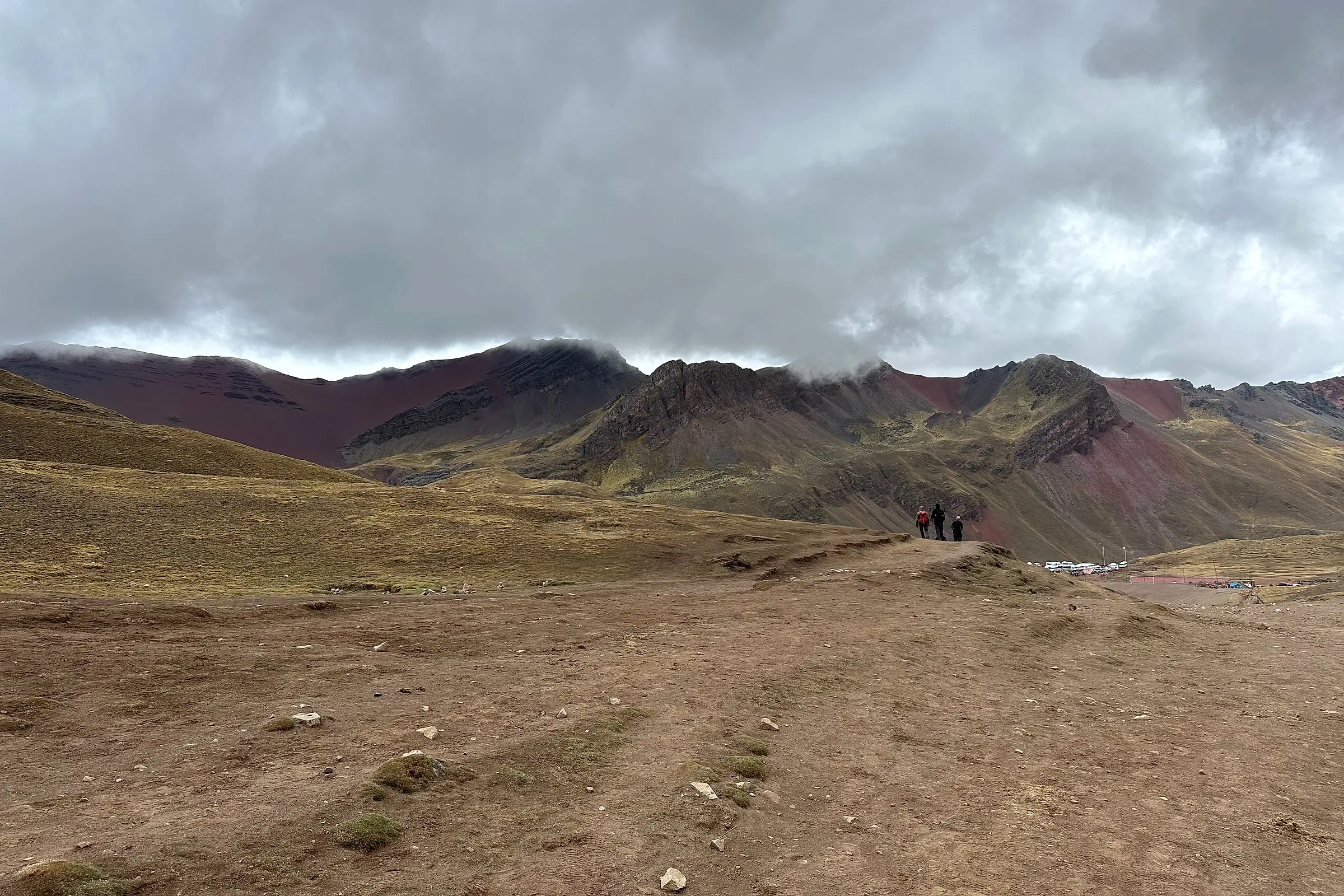
The coloured ridges from the trail to Vinicunca, September 2025. Photo by Simon P. Toaquiza.
Three more things worth knowing before you book:
- Palccoyo, another striped mountain run by its own community, is lower and easier: 4,787 m, S/ 15, and 1.5 km of walking, according to its inventory record. If anyone in your group struggles with altitude, it is the better choice.
- The Red Valley next to Vinicunca, at 5,020 m, has its own S/ 20 fee. It is open ground, and in November 2024 a tourist there was killed by lightning. If a storm builds, come down.
- The two communities have a long-running dispute over access. The Cusipata route was closed in April 2024, and the conflict was still being negotiated in 2026. We found no closure in force in October 2026, but ask which side you will enter from.
A multi-day trek around Ausangate passes the same coloured hills. That is a different trip, covered by our sister site Andes Trekking, and not something to fit into a Cusco stay.
Festivals worth planning around
11. Inti Raymi and Corpus Christi
If your dates are flexible, two festivals change the city. Inti Raymi, the festival of the sun, is on 24 June every year, with ceremonies at the Qorikancha, the Plaza de Armas and Sacsayhuamán; only the seats at Sacsayhuamán and the Qorikancha stands are sold, as El Peruano reported in 2026. Corpus Christi falls on a Thursday 60 days after Easter, when 15 images of saints and virgins are carried to the Cathedral, as Andina describes it. The next one is on 27 May 2027. Both weeks fill the hotels early.
How many days in Cusco, and where it fits
Two full days cover the centre and the four ruins. Add one day for each trip in the last section. Because of the altitude, we put Cusco late in a Peru trip: first the Sacred Valley, then Machu Picchu, then Cusco, when you have already slept two or three nights above 2,000 m.
For the train and the tickets to the citadel, see how to get to Machu Picchu, and for the weather month by month, the best time to visit Machu Picchu. If you are going on to Lake Titicaca and Bolivia, our Peru and Bolivia tour climbs in the same order, from the Sacred Valley to Cusco and then Puno, La Paz and Uyuni. For the rest of the country, see the best places to visit in Peru and our Peru tours.
The questions we get on this
- What are the four ruins in Cusco?
- Sacsayhuamán, Q'enqo, Puka Pukara and Tambomachay, the four sites of Circuit I of the Boleto Turístico del Cusco. They sit on the hills above the city between 3,580 m and 3,764 m, and the full tourist ticket, S/ 130 for a foreign adult, covers all four.
- Can you walk from Cusco to Sacsayhuaman?
- Yes. Peru's tourism inventory gives 2.5 km from the Plaza de Armas on foot, up Calle Suecia. It is a steep climb from 3,400 m to 3,700 m, so most people need more time than the official 20 minutes, and it is best left for your second or third day at altitude.
- Is Sacsayhuaman worth visiting?
- It is the one ruin in Cusco we would not skip. The largest stones in its zigzag walls are about 5 m high, the site is open 07:00 to 18:00, and from the top you see the whole city. Entry comes with the Boleto Turístico, which also covers the other three ruins above Cusco.
- How high is Rainbow Mountain in Peru?
- Vinicunca, the Rainbow Mountain, stands at 5,036 m according to Peru's tourism inventory, and the upper viewpoint is above 5,200 m. That is more than 1,600 m higher than Cusco, which sits at 3,400 m, so it is a day trip for the end of a stay, not the start.
- Is Rainbow Mountain worth it?
- If you are already used to the altitude and the season is right, yes. Both community entrances charge S/ 30 to foreigners and open 06:00 to 17:00. The colours need sun, though: when we went on 26 September 2025 the top was in cloud and snow, and Palccoyo, at 4,787 m, is the gentler choice.
- How many days do you need in Cusco?
- Two full days for the centre and the four ruins above it, plus one for each day trip such as Rainbow Mountain or Humantay lake. Spend your first nights lower down in the Sacred Valley, which makes the Cusco days easier, as the altitude advice from the CDC recommends.