Best Time to Visit Uyuni Salt Flats: Mirror or Dry?
The best time to visit Uyuni salt flats: February for the mirror, May to October for the dry crust and Incahuasi, with SENAMHI rain data and night lows.

The best time to visit Uyuni salt flats depends on which salt flat you want. February is the month for the mirror, when rain leaves a thin sheet of water on the salt and the sky shows up twice. May to October is the time for the dry, white crust, the drive across to Isla Incahuasi and the lagoon route south. April and November sit in between and can give a bit of both, or neither.
Two seasons, two different trips
The rain at Uyuni falls almost entirely in the southern summer. Bolivia’s weather service, SENAMHI, publishes a monthly climate summary that compares each station with its 1991 to 2020 normal, and the figures for the Uyuni airport station show how lopsided the year is:
| Period | Normal rainfall at Uyuni airport | What the salt flat does |
|---|---|---|
| November to January | 105.4 mm for the three months | Water starts to pool; the mirror begins |
| February to April | 75.6 mm for the three months | Mirror peaks in February, fades by April |
| May | 1.2 mm | Crust dry and white |
| August | 1.7 mm | Crust dry; coldest nights of the year |
| September | 0.7 mm | Crust dry; nights less harsh |
SENAMHI draws its monthly normals as charts, and these are the figures it states in writing. We have not found a monthly table of rain or temperature for Uyuni published as numbers by any official source, so there is no full month-by-month table here.
Averages also hide how much one year differs from the next. In the summer of 2025 to 2026, Uyuni airport collected 197.0 mm between November and January, nearly double the normal, and then only 18.2 mm from February to April, a quarter of it.
The mirror season: December to April
The reflection appears when rain floods the salt and the wind drops. The most useful study of when that happens is a satellite one. Researchers working with the European Space Agency read years of Sentinel-3 radar data over the salar and found that the smooth, mirror-like surface rises sharply in February, when nearly half of the salt flat became radar-smooth, and usually fades by April. In the wet 2023 to 2024 season, with 265 mm of rain, the mirror held almost without a break from December to March.
Two things follow from that study. The mirror covers part of the salar, never all of it, so drivers look for a flooded stretch shallow enough to drive into. And it changes by the day: a windy afternoon in February ruffles the water and the reflection goes.
The same water closes roads. In January 2022, after flooding, the Potosí regional government banned crossing the salar and driving to Isla Incahuasi, with the tourist police controlling access. It does not happen every year, but in the wet months the island, the crossing to the far side and some of the route south are never certain until you are there.
If the mirror is the reason for the trip, our Uyuni salt flats tour can be timed for February, and the route is written so that a closed section is replaced, not lost. If you also want the crossing and the lagoons, ask us to look at late April or early December with you, and accept that the mirror then becomes a maybe.
The dry season: May to November
From May the salt dries into the white crust most photographs of the salar show, with its raised hexagons, and the whole flat can be driven. This is the season for Isla Incahuasi and its cactus, for the perspective photographs that need a hard, flat surface, and for the route south through the Lípez lagoons towards the Chilean border.
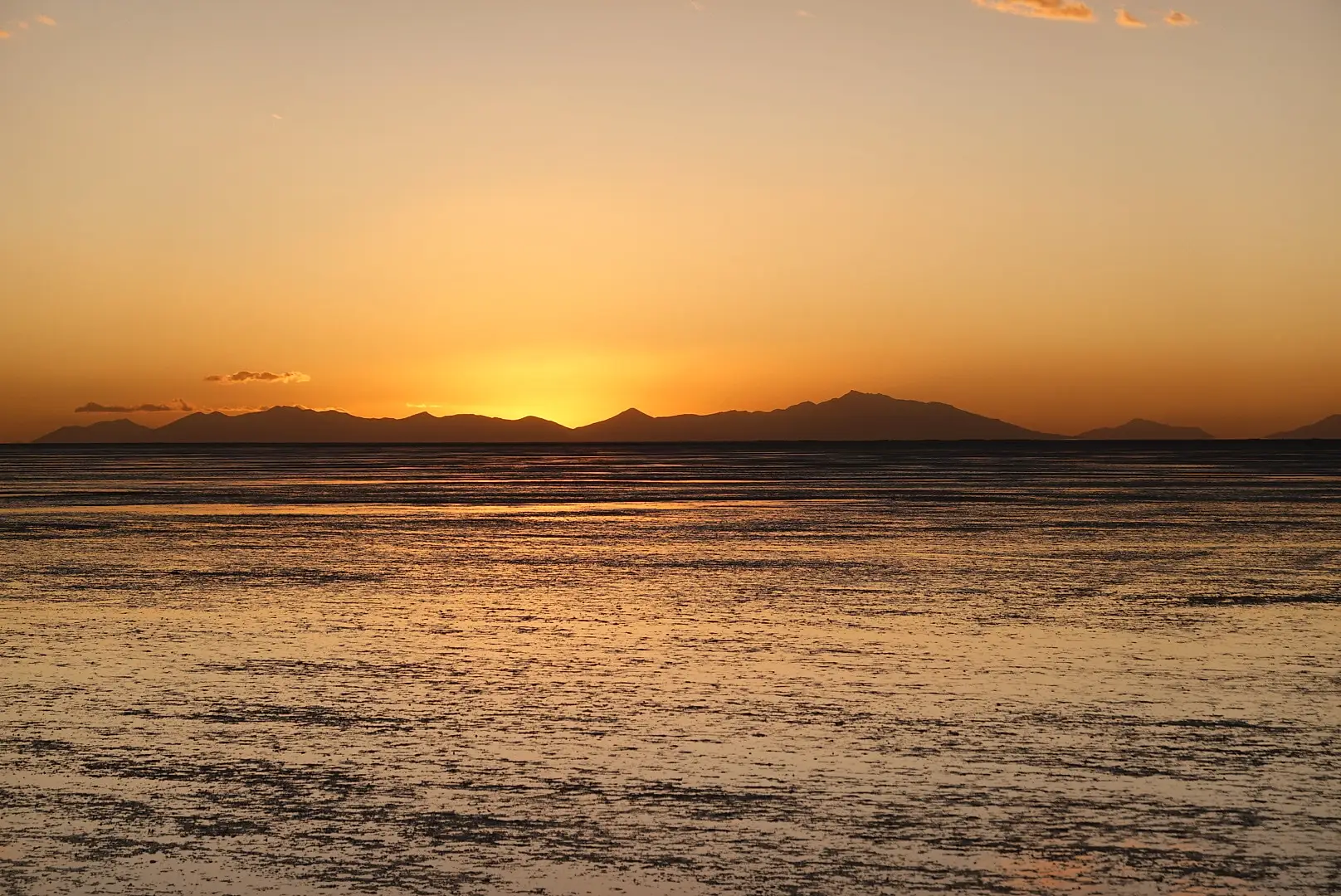
Sunset over the salt crust, with a little water left on the surface. Photo by Latin Lands.
Dry is a normal, not a promise. In August 2026, a month whose normal at Uyuni airport is 1.7 mm, the station collected 44.2 mm, and on one day it measured 36.4 mm, against a previous August record of 16.0 mm for a single day, as SENAMHI’s August 2026 summary records. That kind of month is rare, and it is still a reason to keep a spare day in a dry-season route.
What you get in the dry months:
- The crossing to Isla Incahuasi and the far side of the salar.
- The lagoon route south, with Laguna Colorada and the geysers, and the border crossing into Chile. The crossing has its own guide: Uyuni to San Pedro de Atacama.
- The clearest skies of the year for stars.
- The coldest nights of the year, which need planning of their own.
Stars over the salar
The months with almost no rain are also the months with the clearest skies, so for stars the dry season wins. The Moon matters more than the month: a full moon washes out the Milky Way, so if night photography is the point, check the lunar calendar before fixing your dates and aim for the week around the new moon.
The wet season has its own night photograph, the stars reflected in the flooded salt, but it needs a clear night and still water at the same time, and summer nights here bring cloud. Treat it as a bonus, not a plan.
How cold it gets
The salar sits at about 3,656 m and the nights in the dry season are severe. SENAMHI recorded −20.7 °C at Uyuni in June 2022 and −21.2 °C in July 2024. The days in those same months are sunny, and the gap between noon and midnight catches people out more than the cold itself.
The lagoon route is higher. The Ramsar information sheet for Laguna Colorada, written in 1998, puts the lagoon at 4,232 m and gives a daily range from −25 °C to +25 °C, with the rain concentrated from December to February. The lodges on that stretch are basic, and in June, July and August we pack as if for a winter night in the mountains, because that is what it is.
Flamingo season at the lagoons
Three species of flamingo feed in the lagoons south of the salar, and Laguna Colorada is the most important nesting site of the James’s flamingo. Its Ramsar sheet counts about 20,000 flamingos at the lagoon in summer, and the first international census, in January 1997, found 13,400 James’s flamingos there alone.
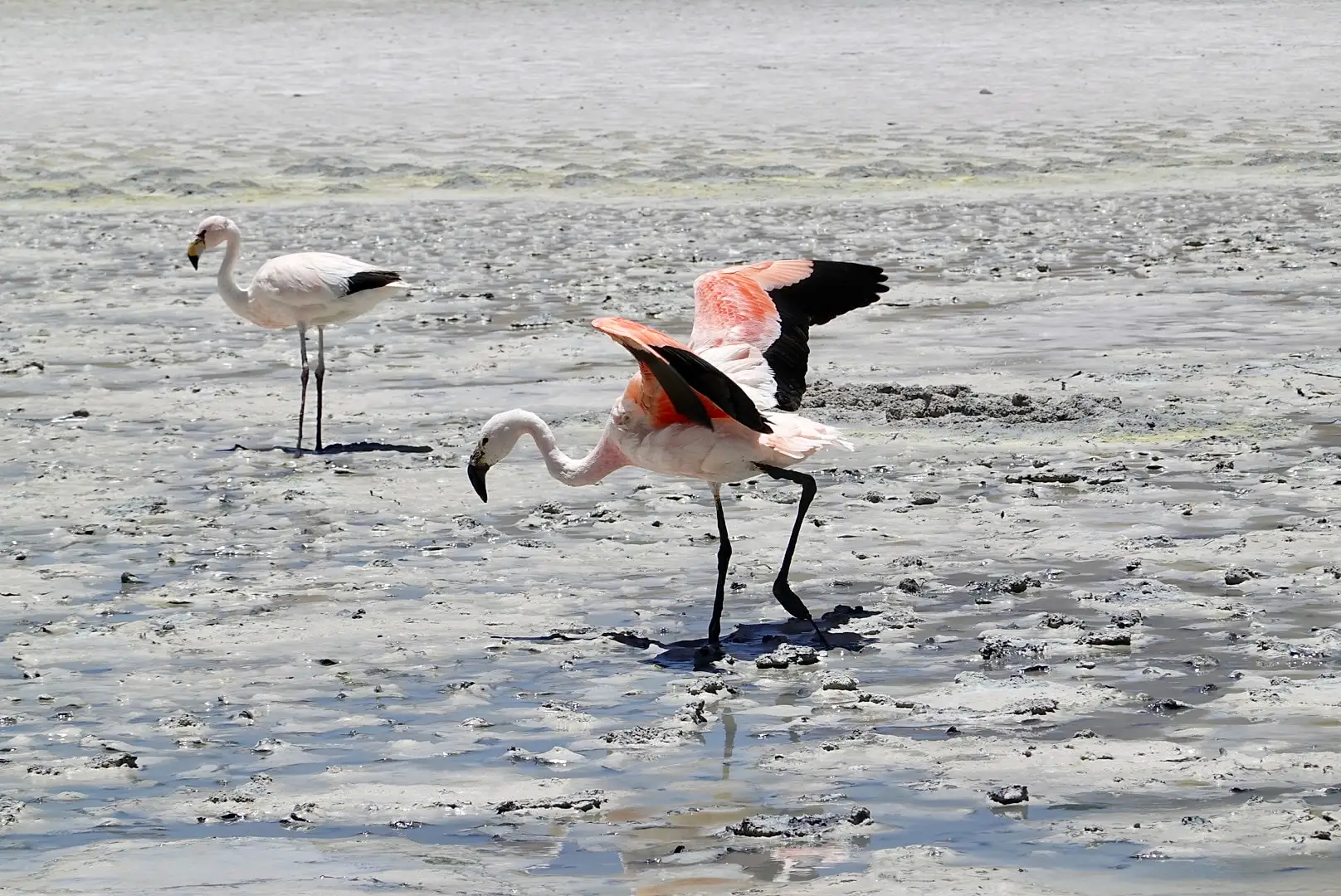
Flamingos feeding on a lagoon of the southern altiplano. Photo by Latin Lands.
In winter the picture changes. Parts of the lagoons freeze and many birds leave to feed elsewhere, as the biologist Omar Rocha explained to the EFE agency. You will still see flamingos in the dry season, but if birds matter as much as the salt, December to March puts the most of them on the water.
Uyuni month by month
January
Wet. Good odds of the mirror, and the highest risk of closures, as in January 2022.
February
The surest month for the mirror on the satellite record. Flamingos in numbers.
March
Still wet in most years, with the mirror fading towards the end of the month.
April
The transition. Some water in a wet year, little in a dry one, as in 2026.
May
Dry and clear, with the crust hardening and the nights getting colder.
June
Dry, very cold at night. The −20.7 °C reading of 2022 was a June night.
July
Dry, the coldest nights, and one of the busiest months. Uyuni’s founding anniversary falls on 11 July: the town was founded in 1889, and its centenary is recorded in Supreme Decree 22241.
August
Normally dry, though August 2026 showed it can still rain. The cold and the crowds are much as in July.
September
Dry, with the lowest normal rainfall in SENAMHI’s figures (0.7 mm) and nights a little less harsh. Our own favourite for the crossing and the lagoons.
October
Dry and warmer. A good month for the whole route with fewer people than July.
November
The first rain arrives. The crust is still open in most years; the water is not reliable yet.
December
The wet season begins, and with it the first water on the salt.
Where this fits in a longer trip
Uyuni is rarely a trip on its own. The months that suit the salar also shape the rest of Bolivia, and our best time to visit Bolivia sets out La Paz, Lake Titicaca and the lowlands month by month. What the salt flat is, how big it is and how to see it properly, whatever the season, is in our guide to the Bolivia salt flats.
If you already have dates, tell us what they are and we will tell you plainly which salt flat those weeks are likely to give you.
Rainfall figures are SENAMHI’s 1991 to 2020 normals for the Uyuni airport station, as stated in its 2026 monthly climate summaries. Checked on 26 October 2026.
The questions we get on this
- When is the mirror effect at the Uyuni salt flats?
- In the wet season, roughly December to March, with February the most reliable month. Satellite radar analysed for the European Space Agency found that nearly half of the salt flat turns mirror-smooth in February, and that the effect usually fades by April. It needs standing water and little wind, so even in February some days give you a mirror and some do not.
- Is April too late for the Uyuni mirror?
- Often, but not always. April is when the mirror fades, because the rain has mostly stopped and the water evaporates. In a wet year there are still flooded patches; in a dry one there may be none: at Uyuni airport, February to April 2026 brought 18.2 mm of rain against a normal of 75.6 mm. Go in April for open routes and some luck, not for a guaranteed reflection.
- Can you visit the Uyuni salt flats in January?
- Yes, and you have a good chance of the mirror, but the route is less certain than in the dry season. In January 2022, after flooding, the Potosí regional government banned crossing the salt flat and driving to Isla Incahuasi. Book January with a flexible route and ask your operator what happens if the authorities close a section.
- When is the dry season at the Uyuni salt flats?
- May to October, and most of November. Bolivia's weather service puts the normal rainfall at Uyuni airport at 1.2 mm in May, 1.7 mm in August and 0.7 mm in September. That is when the crust dries into its white hexagons, the whole salar can be crossed and the lagoon route south is open.
- How cold does it get at night on a Uyuni tour?
- Well below freezing from May to August. Bolivia's weather service recorded −20.7 °C at Uyuni in June 2022 and −21.2 °C in July 2024. The lagoon route is higher and harsher: the Ramsar file for Laguna Colorada, at 4,232 m, gives a daily range from −25 °C to +25 °C.
- When can you see flamingos at Laguna Colorada?
- The largest numbers are in the southern summer, roughly December to March. Laguna Colorada is the main nesting site of the James's flamingo, and its Ramsar file counts around 20,000 flamingos there in summer. In winter parts of the lagoons freeze and many birds move to other wetlands.